
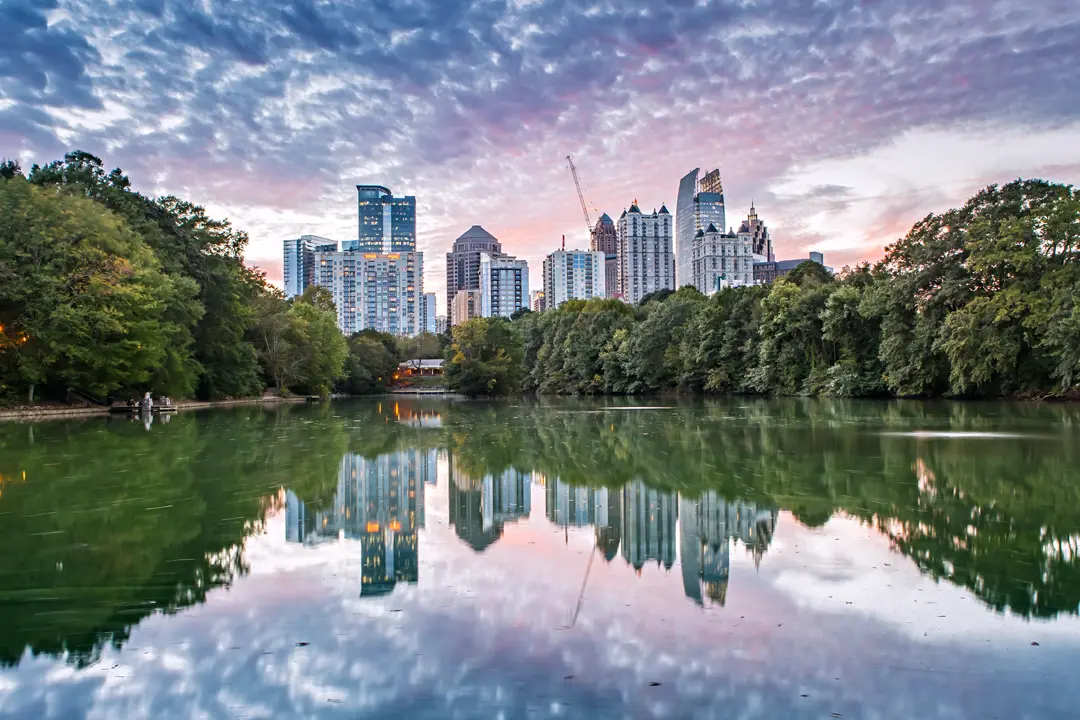
Georgia 101: Atlanta Rising, Peaches, and the Heart of the New South
Michael Reynolds • 14 Jan 2026 • 113 views • 3 min read.You think Georgia is backwards Southern state peach farms, Gone with the Wind nostalgia—irrelevant except Atlanta airport connections. Reality? Georgia is economic powerhouse where Atlanta metro 6.1 million (tenth-largest U.S.—growing faster than Boston, San Francisco combined, 80,000+ annual arrivals—Black mecca "Wakanda" moniker, corporate relocations Mercedes-Benz stadium $1.6 billion, NCR Corporation moved North Carolina), film production capital ("Hollywood of the South"—$4.4 billion tax credits annually, Marvel films Avengers/Black Panther, Walking Dead, Stranger Things, 50,000+ entertainment jobs created), and political battleground where Biden won 2020 +0.2% (11,779 votes—first Democrat since 1992, Stacey Abrams voter registration 800,000+ new voters, Senate runoffs Warnock/Ossoff flipped control, national attention). You dismiss "Peach State" until discovering Hartsfield-Jackson Atlanta Airport busiest globally (110 million passengers annually—connections everywhere, Delta hub dominance), Coca-Cola invented Atlanta 1886 (World of Coca-Cola museum, headquarters, global icon $100+ billion brand), and Martin Luther King Jr. birthplace (Sweet Auburn district, Ebenezer Baptist Church, National Historic Park—Civil Rights central). But brutal truth: Georgia demands accepting crushing rural poverty (South Georgia 25%+ rates—cotton belt legacy unchanged), terrible education outside suburbs (42nd nationally—$11,000 per pupil, Atlanta suburbs excellent but rural failing), political division (Atlanta progressive island versus Trump +25% rural counties—culture war perpetual), extreme heat/humidity (summer 95°F feels 110°F May-September), and recognition Atlanta boom masks statewide inequality where majority residents struggle forgotten. The truth: Georgia offers Atlanta opportunity, film industry growth, political importance—but demands accepting poverty, education crisis, urban/rural divide, and understanding New South prosperity concentrated metro while rural Georgia unchanged Old South poverty.
Geography and Climate: Mountains, Piedmont, Coastal Plain
Understanding Georgia:
Size and landscape:
- 24th largest state:
- 59,000 square miles
- Population: 10.9 million (8th—growing rapidly)
- Density: 186 people/square mile (Atlanta metro 60%, rural sparse)
- Three geographic regions:
- Appalachian Mountains: North Georgia (Blue Ridge, Dahlonega—scenic, tourism, Appalachian Trail southern terminus Springer Mountain)
- Piedmont: Central (Atlanta, rolling hills—urban corridor I-85)
- Coastal Plain: South Georgia (flat, agricultural, Savannah coast—cotton/peanut legacy, poorest region)
- Highest point: Brasstown Bald 4,784 feet (modest—but beautiful overlooks North Georgia mountains)
- Savannah River: South Carolina border (historic Savannah port)
- Chattahoochee River: Alabama border, through Atlanta (water supply, recreation)
Atlanta dominance (overwhelming):
- Metro: 6.1 million (56% state population—tenth-largest U.S., growing 80,000+ annually)
- Economy: Transportation (Hartsfield-Jackson Airport 110 million passengers—busiest globally, Delta headquarters), logistics (UPS, Home Depot, Coca-Cola headquarters), film production ($4.4 billion tax credits—Marvel, Walking Dead, 50,000 jobs), technology (NCR, Salesforce, Google offices—growing startup scene), finance (SunTrust/Truist, 12 Fortune 500 headquarters)
- Culture: Black mecca (52% Black metro—largest Black middle class U.S., "Wakanda" pride, HBCUs Morehouse/Spelman/Clark Atlanta powerful, hip-hop capital OutKast/Ludacris/Migos/Future), international (world's most diverse suburb Clarkston—refugees resettled 60+ countries)
- Sprawl: 8,376 square miles metro (larger than Massachusetts—car-dependent, traffic nightmare I-285 "Perimeter," MARTA rail limited)
- Cost: Median home $370,000 (up from $160,000 2010—+131%, but affordable versus coastal cities)
Regional divide (extreme):
Metro Atlanta: Blue island (Fulton/DeKalb/Gwinnett counties Biden +25-50%—progressive, diverse, growing)
Suburbs: Mixed (Cobb/Gwinnett flipped blue 2020—college-educated whites shifting, Forsyth/Cherokee deep red wealthy exurbs)
Rural Georgia: Trump stronghold (+40-60% counties—white, conservative, declining population, economically struggling)
Climate (hot, humid, subtropical):
Atlanta:
- Summer: 85-95°F (humidity 70-80%—feels 105°F+, oppressive May-September)
- Winter: 35-55°F (mild—occasional ice storms paralyze, snow rare but devastating when occurs)
- Spring/Fall: Pollen capital (yellow dust coats everything—allergies severe, March-May worst)
South Georgia:
- Summer: 90-95°F (more oppressive—humidity higher, less elevation)
- Winter: 45-65°F (milder—snowbirds destination coastal)
Severe weather:
- Tornados: 30+ yearly (spring March-May—EF3/EF4 possible)
- Hurricanes: Coastal (Savannah vulnerable—inland Atlanta gets rain/wind remnants)
- Ice storms: Paralyze Atlanta (2014 "Snowpocalypse" 2 inches shut city—cars abandoned I-285, national mockery but infrastructure simply unprepared)
- Drought: Periodic (water wars Alabama/Florida—Lake Lanier levels critical)
Atlanta: Black Mecca, Film Capital, Traffic Nightmare
Understanding Atlanta's transformation:
Black middle class (largest nationally):
History:
- Post-Civil War: Freedmen moved cities (Atlanta rebuilt after Sherman burning—"Phoenix City")
- Great Migration reverse: 1970s-present (Black professionals returned South—opportunity, affordability, culture)
- Maynard Jackson: First Black mayor 1974 (transformed politics—affirmative action airport contracts, coalition building)
Current reality:
- 52% Black metro: Highest proportion major metro (Chicago 30%, Houston 23%—Atlanta dominance)
- Wealth gap: Narrower than elsewhere (Black homeownership 44% versus 30% nationally—middle-class achievable)
- HBCUs: Morehouse (MLK alma mater), Spelman (women's college—Kamala Harris, Stacey Abrams), Clark Atlanta, Morris Brown (cultural/political power—networking unmatched)
- Culture: "Wakanda" nickname (Black Panther pride—prosperous Black city representation resonates)
Challenges:
- Gentrification: Displacing (Westside, Old Fourth Ward—Tyler Perry studios brought investment, longtime residents priced out)
- Inequality: Still exists (wealthy Buckhead versus poor Southwest Atlanta—stark contrast)
Film industry ("Hollywood of the South"):
Tax credits: 30% (most generous nationally—$4.4 billion annually claimed, unlimited transferable)
Productions: Marvel Cinematic Universe (Avengers, Black Panther, Guardians filmed Pinewood Studios), Walking Dead (Senoia), Stranger Things (Jackson), Ozark (Lake Lanier)
Infrastructure: Pinewood Studios (700 acres—second-largest U.S.), Tyler Perry Studios (330 acres—largest Black-owned, former Fort McPherson)
Employment: 50,000+ jobs created (crew, actors, support services—economic impact $9.5 billion annually)
Criticism: Tax credits expensive (foregone revenue $1+ billion—debate ROI, but jobs/tourism offset)
Transportation hub:
Hartsfield-Jackson: Busiest airport globally (110 million passengers 2023—connections everywhere, Delta dominance 70% market share)
Logistics: UPS Southeast hub (package sorting), trucking (I-85/I-75/I-20 convergence—distribution center)
MARTA: Rail transit limited (four lines—insufficient sprawl, car-dependent culture, suburban counties refused expansion racism alleged)
Traffic (legendary bad):
- I-285 "Perimeter": Parking lot rush hour (2-3 hour commutes common—Gwinnett to Buckhead 25 miles 90 minutes)
- I-85 collapse: 2017 fire (homeless encampment ignited, bridge collapsed—rebuilt 43 days but exposed infrastructure decay)
- Sprawl: 8,376 square miles (no geographic constraints—endless expansion, transit inadequate)
Political Battleground: Stacey Abrams Revolution
Understanding Georgia's shift:
2020 presidential (Biden +0.2%):
- Margin: 11,779 votes (razor-thin—first Democrat since 1992 Bill Clinton)
- Atlanta suburbs: Flipped (Gwinnett, Cobb—college-educated whites shifted, demographic change Asian/Hispanic)
- Stacey Abrams: Voter registration (Fair Fight organization registered 800,000+ new voters 2018-2020—young, Black, diverse)
- Trump response: "Find 11,780 votes" call (January 2021—pressured Secretary of State Brad Raffensperger, indicted RICO case)
2020 Senate runoffs (January 2021):
- Warnock/Ossified: Both won (flipped Senate control—national implications, first Black senator Warnock Georgia since Reconstruction, Jewish Ossoff unexpected)
- Turnout: 4.5 million (extraordinary runoff—organizing triumph)
Current landscape:
Statewide: Competitive (Trump +0.2% 2020 extremely close—purple state now)
Governor: Brian Kemp Republican (defeated Stacey Abrams 2018 controversially, 2022 decisively—moderate reputation, stood up Trump 2020)
Legislature: Republican control (gerrymandered—Democrats win popular vote, lose seats)
Voter suppression allegations:
2018: Kemp Secretary of State overseeing own election (53,000 registrations held—disproportionately Black, "exact match" law, Abrams alleged stolen but never conceded formally)
2021: SB 202 voting restrictions (ID requirements, limited ballot drop boxes, criminalized giving water voters in line—national controversy, MLB All-Star Game moved protest)
Urban/rural divide (stark):
Atlanta metro: Biden +25% (Fulton County Biden +46%, DeKalb +66%—progressive, diverse)
Suburbs: Shifting (Gwinnett flipped 2020, Cobb 2016—demographic change, college-educated whites)
Rural: Trump +40-60% (white, conservative, economically struggling—resentment Atlanta dominance)
Rural Georgia Poverty: Unchanged Since Civil War
Understanding geographic inequality:
South Georgia (cotton belt legacy):
Counties: Quitman, Randolph, Clay (southwest corner—poorest state)
Poverty: 25-35% (Quitman 35%—higher than Mississippi Delta, systemic generational)
Demographics: 60-80% Black (sharecropping legacy—descendants never escaped)
Economy: Agriculture mechanized (peanuts, cotton, pecans—few jobs, migrant labor), Dollar General only store (food deserts—fresh produce unavailable)
Population: Declining (young people flee—Atlanta, elsewhere, aging dying towns)
Black Belt (central Georgia):
Similar: Cotton legacy (Macon, Albany areas—rural poverty concentrated Black)
Poverty: 20-30% (systemic—limited opportunity)
Education crisis (42nd nationally):
Funding: $11,000 per pupil (versus $13,000 national—inadequate)
Property taxes: Low (poor rural districts can't raise—Atlanta suburbs Gwinnett County $14,000 per pupil, Quitman County $8,000)
Teacher shortage: Severe (pay $58,000 average—32nd nationally, rural impossible recruit, emergency licenses common)
Outcomes: Test scores bottom tier (rural schools failing—cycle perpetuates poverty)
Healthcare:
Rural hospitals: Closing (8 closed 2010-2022—obstetric deserts, drive hours emergency)
Medicaid: Not expanded (500,000+ uncovered—working poor uninsured, ideological refusal)
Maternal mortality: Crisis (Black women especially—systemic racism/poverty/access)
Peaches and Agriculture: Symbolic More Than Economic
Understanding Georgia agriculture:
Peach State (ironic):
- Production: Ranked 4th nationally (California #1 produces 10x Georgia—76% U.S. peaches)
- Symbolic: Marketing genius (Georgia peaches famous—premium reputation, $40+ million industry but tiny GDP %)
- Season: May-August (roadside stands—fresh peaches cultural tradition, cobbler)
Actual agriculture:
Peanuts: #1 crop ($600+ million—Jimmy Carter peanut farmer, 50% U.S. peanuts Georgia)
Pecans: #1 nationally ($350 million—Albany area dominance)
Poultry: Chicken capital (Gainesville—50%+ U.S. chickens processed, Tyson/Pilgrim's Pride, harsh working conditions)
Cotton: Legacy crop (declining—mechanized, few jobs, Delta area)
Blueberries: Growing ($200 million—Southeast leader)
Economic reality:
- Agriculture: 3% state GDP (symbolic importance exceeds economic—rural identity)
- Jobs: 50,000 direct (mechanization, consolidation—family farms disappearing)
Cost of Living: Atlanta Affordable, But Rising Fast
Georgia expenses:
Housing (Atlanta affordable major metro):
Atlanta:
- Median home: $370,000 (up from $160,000 2010—+131%, but cheaper than Denver $625,000, Seattle $800,000)
- Neighborhoods: Buckhead $600,000-2 million+ (wealthy, excellent schools, secession movement failed), Midtown $400,000-700,000 (urban, LGBTQ+ friendly, walkable), East Atlanta Village $350,000-500,000 (hipster, gentrifying), Southwest Atlanta $220,000-320,000 (affordable, working-class Black)
- Suburbs: Gwinnett $340,000-450,000 (diverse, good schools), Cobb $380,000-550,000 (white-collar), Forsyth $420,000-650,000 (wealthy exurbs, excellent schools)
- Rent: $1,400-2,200 1-bedroom (Midtown/Buckhead $2,000+)
Savannah:
- Median: $280,000 (historic charm, tourism—affordable)
Rural Georgia:
- Median: $150,000-220,000 (cheap—but limited opportunities)
Taxes (moderate):
- Income tax: 5.75% flat (low—simple, recent cut from 6%)
- Sales tax: 4% state + local (average 7.5%)
- Property tax: 0.91% average ($370,000 home = $3,367/year or $281/month—moderate)
Daily costs:
- Groceries: 5% below national average (Publix, Kroger—competitive)
- Gas: $2.90-3.30/gallon
- Dining: $13-18 lunch, $25-40 dinner (soul food, BBQ—fried chicken, peach cobbler $12-16)
- Utilities: $180-320 summer (AC essential—humidity)
Overall verdict:
- Atlanta: 8-10% below national average (affordable major metro—but rising fast transplants)
- Quality: Good (infrastructure decent, jobs plentiful, culture rich—value high)
Living in Georgia: Who Fits?
Who thrives:
Black professionals:
- Atlanta mecca: Largest Black middle class (homeownership achievable, HBCUs network, culture celebrates—"Wakanda" pride)
- Career opportunities: Corporate (Coca-Cola, Home Depot, Delta—diversity hiring), entrepreneurship (Black-owned businesses ecosystem)
Film industry workers:
- Entertainment: 50,000 jobs ($4.4 billion tax credits—crew, actors, support services, Hollywood relocating)
Corporate relocations:
- Tax: Lower than Northeast (5.75% income versus NYC 10%+—but not zero like Florida/Texas)
- Quality of life: Atlanta affordable, diverse, culture (better than Nashville bachelorette chaos, cheaper than Miami)
College students:
- HBCUs: Morehouse, Spelman, Clark Atlanta (Black excellence tradition—powerful alumni networks)
- Georgia Tech: Engineering (#4 nationally—$35,000 in-state tuition bargain, $75,000-100,000 starting salaries)
- UGA: Athens college town (50,000 students—football Saturdays religion, "dawgs" identity)
Who struggles:
Rural residents:
- Poverty: 25-35% South Georgia (systemic, generational—escape nearly impossible)
- Healthcare: Hospital closures (drive hours emergency—maternal mortality crisis)
- Education: Underfunded (rural schools failing—$8,000 per pupil versus $14,000 Atlanta suburbs)
Traffic-haters:
- Commutes: 2-3 hours daily (I-285 parking lot—sprawl endless, transit inadequate)
- Stress: Quality of life impact (time wasted, mental health—moves to suburbs then complains traffic)
Progressives rural:
- Politics: Trump +40-60% (overwhelmed, voice irrelevant—Atlanta only refuge)
Heat-sensitive:
- Summer: Six months 85-95°F (May-September oppressive—humidity unbearable)
Pollen-sensitive:
- Allergies: Severe (yellow dust March-May—worst nationally, cars coated, sinuses destroyed)
Car-dependent haters:
- Transit: MARTA limited (four rail lines inadequate—suburban sprawl necessitates car, walkable only Midtown/Buckhead/Decatur pockets)
Georgia offers Atlanta opportunity for specific populations—Black professionals (52% Black metro largest middle class, HBCUs Morehouse/Spelman, "Wakanda" cultural pride, corporate diversity), film workers (50,000 jobs, $4.4 billion tax credits, Marvel/Walking Dead, "Hollywood South"), corporate relocations (Mercedes-Benz, NCR, lower taxes 5.75% versus Northeast 10%+), and political junkies (2020 Biden +0.2% battleground, Stacey Abrams 800,000 voters registered, Senate runoffs national attention). Hartsfield-Jackson busiest airport globally (110 million passengers, Delta hub), affordable major metro ($370,000 median home versus coastal $600,000+), Martin Luther King Jr. birthplace appeal to those accepting crushing rural poverty (South Georgia 25-35%, cotton belt legacy unchanged), terrible education (42nd nationally, $11,000 per pupil, rural schools failing), political division (Atlanta progressive versus Trump +40-60% rural—perpetual culture war), extreme heat/humidity (summer 95°F feels 110°F, pollen capital allergies severe), and traffic nightmare (I-285 2-3 hour commutes, sprawl 8,376 square miles, MARTA inadequate). Medicaid not expanded (500,000+ uninsured), rural hospital closures (obstetric deserts). For the right person, Atlanta's growth, diversity, opportunity justify heat and sprawl. For most, urban/rural inequality and traffic outweigh New South promise.
Georgia works for those prioritizing Atlanta opportunity and accepting statewide disparities.