
The Battery Health Report: How to Check the "SOH" of an Electric Vehicle Yourself
Caleb Sterling • 25 Feb 2026 • 116 views • 4 min read.Let me tell you why checking battery state of health before buying a used EV is the single most important inspection step you can take — and then show you exactly how to do it, because the process is more accessible than most people realize. State of health — SOH — is the percentage of original battery capacity that a battery pack currently retains. A battery at 100% SOH delivers the full rated range. A battery at 80% SOH delivers 80% of the rated range. The difference between a used EV with 95% SOH and one with 75% SOH is the difference between a car that mostly works as intended and a car whose daily usability is significantly compromised — and yet both cars might look identical from the outside, have the same odometer reading, and be listed at similar prices. The SOH check is not complicated. It requires either a smartphone app, a thirty-dollar OBD2 adapter, or access to the right menu in the vehicle's own interface. None of these require mechanical expertise. What they require is knowing which tool to use for which vehicle — and that is what this guide provides.
The Battery Health Report: How to Check the "SOH" of an Electric Vehicle Yourself
Why Manufacturers Do Not Make SOH Easy to Find
Before the how-to, it is worth understanding why this critical number is not displayed prominently on every EV's dashboard, because the reason reveals something important about how to interpret the data you find.
Battery capacity measurement is not simple. Unlike a fuel gauge that measures liquid level, battery state of health is a calculated estimate based on multiple measurements — charge capacity at full charge, internal resistance, temperature compensation, and the specific chemistry's degradation model. Different manufacturers use different algorithms, measure at different points in the charge cycle, and calibrate their estimates against different baselines. This means that an 85% SOH reading from a Tesla, a Nissan Leaf, and a Hyundai Ioniq are not directly comparable numbers — they are manufacturer-specific estimates using different methodologies.
The practical implication: when comparing SOH across different brands, use the absolute range estimate at 100% charge as your comparison point rather than relying on percentage figures alone. A car rated at 226 miles that charges to 185 miles at 100% has 82% SOH regardless of what the manufacturer's SOH display says.
There is also a commercial reason SOH is not prominently displayed: visible battery degradation data makes used EV resale more difficult. Manufacturers have an interest in not making it trivially easy for buyers to see that a battery has degraded, because this would suppress used EV prices across their fleet.
Method One: Built-In Vehicle Displays and Apps
The easiest starting point is the vehicle's own interface, because several major manufacturers have added battery health information directly to the vehicle or companion app in response to consumer demand.
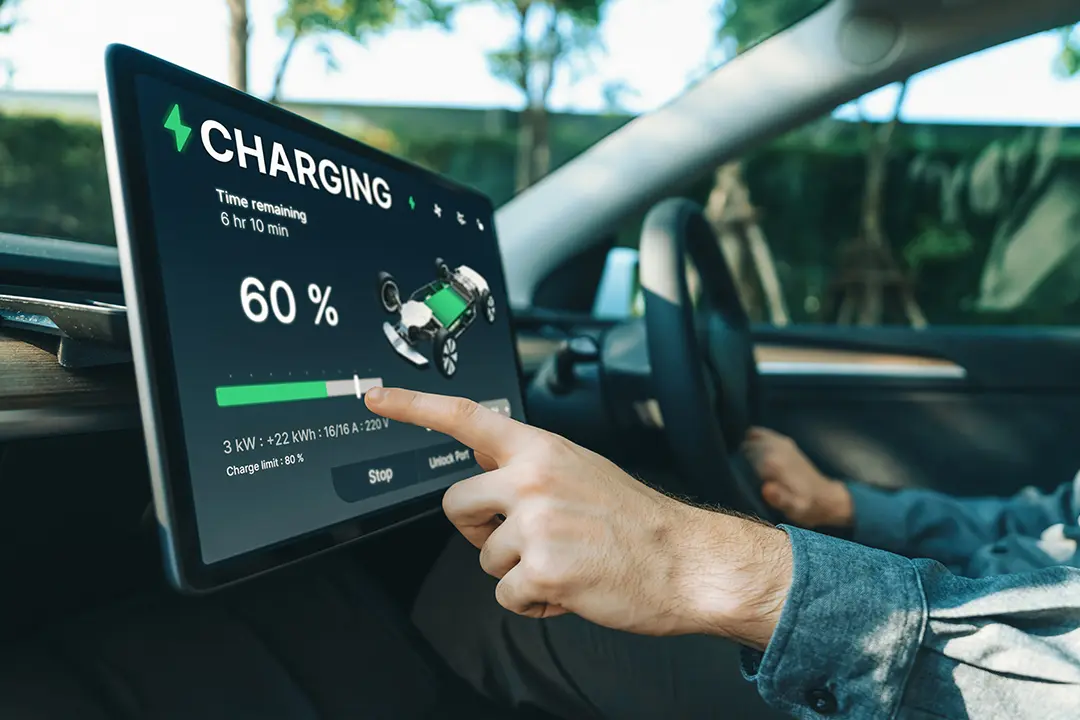
Tesla is the most transparent manufacturer for on-vehicle SOH data. In any Tesla, navigate to the energy app and observe the estimated range at 100% charge. Compare this number to the EPA-rated range for that specific model and year. A Model 3 Long Range rated at 358 miles that shows 310 miles at 100% charge has approximately 87% SOH. This calculation is not an estimate — it is the actual measured capacity the battery management system is currently using to calculate range. The Tesla app shows the same data remotely if you have account access, which allows evaluation before visiting the vehicle.
Tesla also displays battery health indirectly through the charge limit settings. When you set the charge to 100% and observe the rated miles, you are seeing the battery management system's current assessment of usable capacity.
Hyundai and Kia provide SOH data through the BlueLink and UVO connected car apps respectively for vehicles enrolled in those programs. The app shows battery state of health as a percentage directly, though the methodology differs from what OBD2 diagnostic tools report and the numbers are not always consistent.
Nissan's NissanConnect app shows battery health for Leaf models, and the Leaf's own instrument cluster displays the battery health bar — a visual indicator with up to twelve bars representing battery capacity in twelve increments. A Leaf showing twelve of twelve bars has retained more than 85% of its original capacity. A Leaf showing eight bars has retained approximately 65-70% — significant degradation that substantially reduces usability. The bar display is approximate rather than precise, but it provides an immediately visible health indicator.
GM's myChevrolet app shows battery health information for Bolt EV models, including state of health percentage and the estimated range the battery can deliver at full charge.
Method Two: OBD2 Adapter and Smartphone App
For vehicles without built-in SOH displays, or for verification of manufacturer-reported numbers, an OBD2 Bluetooth adapter connected to a smartphone app is the standard diagnostic approach. This method provides access to battery management system data that the manufacturer reads but does not display to the user.
The hardware: a Bluetooth or WiFi OBD2 adapter plugs into the OBD2 port located under the dashboard on the driver's side of virtually all vehicles sold after 1996. EV-compatible adapters cost fifteen to forty dollars. The critical detail is that not all OBD2 adapters communicate effectively with all EVs — the communication protocol for EVs often differs from gasoline vehicles, and some budget adapters do not support the extended protocols required. Recommended adapters with strong EV compatibility include the OBDLink MX+ (approximately forty dollars, the most reliable for complex EV data) and the Veepeak OBDCheck BLE+ for Apple devices.
The software for specific vehicles: different EV models require different apps because the battery management system data is encoded differently by each manufacturer. Leaf Spy Pro (iOS and Android, approximately fifteen dollars) is the standard tool for Nissan Leaf battery diagnostics and provides detailed cell-level battery data including SOH, state of charge, battery temperature, and individual cell voltage readings. For Chevrolet Bolt, the Car Scanner app with the appropriate EV plugin provides battery SOH data. For BMW i3 and iX models, the Bimmercode app or the dedicated EVNotify service reads battery health. For Volkswagen ID.4 and the MEB platform vehicles, OBD11 or Car Scanner with the appropriate profile provides battery data.
The process: plug the OBD2 adapter into the port, pair with your smartphone via Bluetooth, open the vehicle-specific app, and navigate to the battery health section. The SOH reading appears within thirty seconds of connection on most vehicles. The data is more detailed than manufacturer displays — you can see individual cell voltages, which reveal whether degradation is uniform across the pack or concentrated in specific cells, and battery temperature readings that provide context for the SOH measurement.
Method Three: Third-Party Vehicle History Reports
For vehicles you cannot physically inspect before purchase — remote purchases, auction buying, or initial screening before making the trip to see a car — third-party SOH history services provide battery health data derived from historical telematics data.
Recurrent is the most established service in this category for the US market. Recurrent has collected battery charge and range data from hundreds of thousands of EVs over several years through driver opt-in data sharing, which allows them to provide battery health estimates for specific VINs based on historical charging patterns. A Recurrent report for a specific VIN shows the vehicle's historical range at various states of charge compared to other vehicles of the same model and year, providing a relative health indication even without a physical OBD2 connection.
The limitation of Recurrent data: it is most accurate for vehicles with long participation history in the Recurrent network and least accurate for vehicles with sparse data. The report should be treated as a preliminary screening tool rather than a substitute for direct OBD2 measurement.
SOH Checking Methods Compared
| Method | Cost | Accuracy | Vehicles Supported | Technical Skill | Best For |
|---|---|---|---|---|---|
| Tesla app/vehicle display | Free | High — direct BMS reading | Tesla only | None | Tesla buyers |
| Nissan Leaf bar display | Free | Low — approximate (12 bars) | Leaf only | None | Quick Leaf screening |
| Hyundai/Kia app | Free | Medium — manufacturer estimate | Select Hyundai/Kia with app enrollment | None | Hyundai/Kia buyers |
| OBD2 adapter + Leaf Spy | $15-40 adapter + $15 app | Very High — direct cell data | Leaf (Leaf Spy), others with appropriate app | Low | Detailed Leaf inspection |
| OBD2 adapter + Car Scanner | $15-40 adapter + free/paid app | High | Bolt, VW, BMW, others | Low-Medium | Multi-brand coverage |
| Recurrent vehicle report | Free-$30 | Medium — historical data estimate | Most US EV models | None | Remote pre-screening |
| Dealer/manufacturer diagnostic | $100-200 | Very High — factory tool | All models | None | High-value purchases |
Frequently Asked Questions
What SOH percentage should I walk away from when buying a used EV?
The walk-away threshold depends on your intended use case and the price being asked. The federal battery warranty requires manufacturers to cover degradation below 70% SOH for eight years or one hundred thousand miles — which means any used EV still under warranty with below 70% SOH should be covered for a battery replacement. For vehicles outside warranty, the practical threshold for most buyers is 80% SOH, which provides adequate real-world range for daily use in most cases. Below 80%, the range reduction becomes meaningful for users who need the full rated range for commuting or travel. The price should reflect the SOH — a vehicle at 75% SOH should be priced to account for the reduced range and the possibility that battery replacement may be needed within a few years, and you should be negotiating the price down rather than accepting the degradation as part of the deal.
Why does my OBD2 app show a different SOH than the manufacturer's display?
The discrepancy exists because SOH is a calculated estimate, not a directly measured physical quantity, and different algorithms produce different estimates from the same underlying battery data. Manufacturer SOH calculations are calibrated to be conservative in ways that protect their warranty exposure and provide stable readings rather than readings that fluctuate with temperature and recent charging patterns. Third-party OBD2 app readings use different algorithms that may weight recent capacity measurements differently. The most reliable comparison is the observed range at 100% charge against the EPA-rated range for that specific model and year — this bypasses the SOH percentage discrepancy and gives you the actual usable capacity in the units that matter for your driving needs.
Can a battery's SOH improve after a bad reading, or is degradation always permanent?
Battery SOH can appear to improve with specific interventions even though the underlying electrochemical degradation is generally irreversible. Nissan Leaf batteries in particular are known to show temporarily suppressed SOH readings when the battery has been depleted to very low states of charge, operated at extreme temperatures, or not been calibrated through a full charge-discharge cycle recently. A Leaf showing apparently low SOH may show a higher reading after a complete charge to 100% followed by a drive to near-empty — this recalibration allows the battery management system to measure actual usable capacity across the full range. Before concluding that a Leaf has significant degradation, ensure the battery has been recently calibrated. For other vehicle makes, apparent SOH recovery is less common but can occur if the previous reading was taken in cold temperatures, which temporarily reduces measurable capacity without reflecting permanent degradation.
Is it worth paying for a manufacturer dealer diagnostic instead of using the OBD2 app method?
For high-value purchases — a vehicle priced above twenty-five thousand dollars, or any purchase where the battery health determination is the primary financial risk — a manufacturer dealer diagnostic is worth the cost. Factory diagnostic tools have access to more complete battery management system data than any third-party OBD2 tool, can identify specific cell failures or module-level issues that consumer tools may not detect, and provide documentation that supports warranty claims if problems emerge post-purchase. For lower-value purchases or as a screening tool before deciding whether to pursue a dealer diagnostic, the OBD2 app method is accurate enough for most decision-making purposes. The practical workflow: use OBD2 tools for initial screening and walk away if the reading is clearly bad; use dealer diagnostics for final verification on vehicles you are seriously considering at significant price points.
Checking battery SOH before buying a used EV is the most important inspection step you can take and one of the most accessible — it requires either a free app check for manufacturers who expose the data, or a fifteen to forty dollar OBD2 adapter and a vehicle-specific diagnostic app for those that do not.
For Tesla: calculate SOH from the observed range at 100% charge against the EPA rating — no additional tools required.
For Nissan Leaf: buy a Leaf Spy Pro license and a compatible OBD2 adapter — the fifteen-dollar investment pays for itself immediately in the information it provides on a multi-thousand-dollar purchase.
For most other EVs: the Car Scanner app with appropriate vehicle profiles, combined with an OBDLink MX+ adapter, provides battery health data that manufacturers do not surface through their standard interfaces.
Any seller who declines to allow a battery health check before purchase is displaying a red flag more significant than any reading the check might produce.
Check before you buy.
The number takes thirty seconds to read.
The financial consequence of not reading it can take years to recover from.