
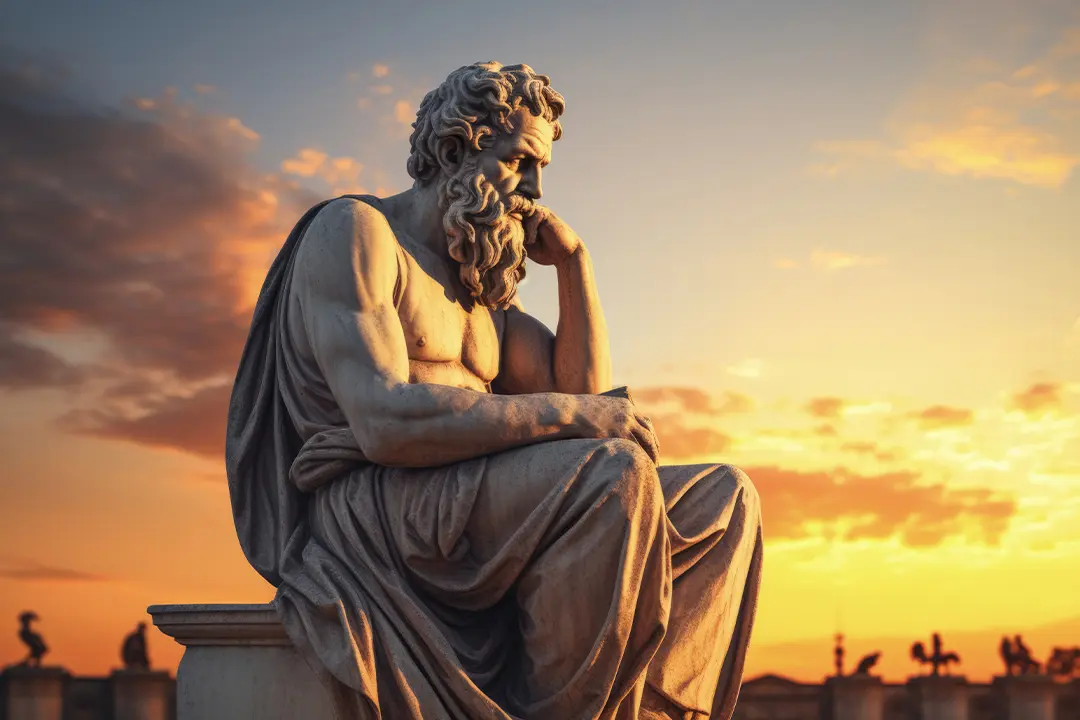
The Stoics’ Guide to Modern Stress: Lessons from Marcus Aurelius for the 21st Century
Lauren Mitchell • 18 Feb 2026 • 215 views • 3 min read.Let me tell you about a man who ran the most powerful empire in the known world, fought wars on multiple fronts simultaneously, watched several of his children die, managed a court full of political intrigue and personal betrayal, dealt with a plague that killed millions of his subjects, and still found time most mornings to sit quietly and write notes to himself about how to be a better person. Marcus Aurelius was Roman Emperor from 161 to 180 AD. The notes he wrote to himself were never intended for publication — they were a private practice, a daily exercise in self-examination and philosophical discipline. We call them Meditations. They have been in continuous publication since they were first shared after his death and remain one of the most widely read philosophical works in human history. What makes this remarkable is not the content in isolation. Stoic philosophy had been around for four hundred years before Marcus practiced it. What makes the Meditations extraordinary is the context: here is a man with more power and more problems than almost anyone who has ever lived, genuinely trying — in private, with no audience — to apply ancient wisdom to his actual life. That sincerity is what makes it still worth reading in 2026.
The Stoics' Guide to Modern Stress: Lessons from Marcus Aurelius for the 21st Century
What Stoicism Actually Is
Stoicism is a philosophical school founded in Athens around 300 BC by Zeno of Citium. The name comes from the stoa — the painted porch where Zeno taught. Its core ideas were developed further by Epictetus, a former slave who became one of the most respected philosophers of the ancient world, and by Seneca, a Roman statesman and playwright who wrote extensively on how to live well.
Marcus Aurelius synthesized all of this and applied it daily. He is the most practical of the major Stoic writers — less interested in theoretical completeness than in what actually helps when you are dealing with a difficult person, a terrible situation, or your own worst impulses.
Stoicism is not about suppressing emotion or pretending nothing bothers you. That is a popular misconception that the actual philosophy directly contradicts. Stoicism is about distinguishing between what is in your control and what is not — and directing your energy and attention accordingly.
The dichotomy of control is Stoicism's foundational concept. Epictetus states it simply at the beginning of his Enchiridion: some things are up to us, some things are not. Up to us: our judgments, our impulses, our desires, our values, our responses. Not up to us: our bodies, our reputation, our property, the actions of other people, external events.
This distinction sounds simple. Living by it is one of the more demanding practices available.
The Dichotomy of Control Applied to 2026
Think about the sources of stress most commonly reported by people today. Financial uncertainty. Political instability. Social media comparison and judgment. Work performance anxiety. Relationship conflict. Health concerns. The gap between where you are and where you think you should be.
Every item on that list contains a mixture of what is in your control and what is not. The Stoic practice is to separate them clearly.
You cannot control whether the economy produces inflation or recession. You can control your spending decisions, your skill development, your financial preparation. You cannot control what other people post on social media or what judgments they make. You can control whether you look, how often, and what meaning you assign to what you see. You cannot control whether your company downsizes. You can control the quality of your work, the relationships you build, the skills you maintain.
Marcus wrote in Meditations that the impediment to action advances action — that the obstacle is the way. He was not being poetic. He was describing a practical psychological reorientation: instead of treating obstacles as things that prevent you from getting what you want, treat them as the material you work with. The difficult colleague is not preventing you from doing good work — the difficulty is the work. The frustrating situation is not blocking your growth — the frustration is the growth opportunity.
This reframe does not make hard things easy. It changes your relationship to hard things in a way that makes them less psychologically depleting.
Negative Visualization: The Counterintuitive Practice
Modern positive psychology emphasizes visualization of desired outcomes — imagining the thing you want as a motivational tool. The Stoics practiced something that sounds opposite and functions as a complement: negative visualization, or what Seneca called premeditatio malorum — the premeditation of evils.
The practice involves deliberately imagining losing the things you value. Your health. Your relationships. Your work. Your comfort. Not as a pessimistic exercise but as a specific antidote to hedonic adaptation — the human tendency to stop appreciating what we have once we have had it long enough.
Marcus wrote about imagining that everything he had was borrowed, not owned — that his health, his family, his power could be withdrawn at any time. Not to generate anxiety about this possibility but to maintain active appreciation for what was present.
Applied practically: spend a few minutes periodically imagining what your life would look like without the things you currently take for granted. The functional relationships. The stable housing. The health that lets you move through the world without thinking about it. The people who care about you. This is not morbid. It is the psychological mechanism that produces genuine gratitude rather than obligatory gratitude — the felt kind, not the performed kind.
The View from Above
Marcus frequently returned to a perspective exercise he called the view from above — zooming out spatially and temporally to see current problems at their actual scale rather than the magnified scale that proximity creates.
He would remind himself that the Roman Empire occupied a small portion of the Earth's surface. That his reign would occupy a brief period of history. That the things people argued and stressed over in his court had been argued and stressed over before and would be again, and that future generations would not remember the specifics. He was not using this to dismiss his responsibilities — he took them seriously — but to calibrate the emotional weight he gave to individual setbacks, insults, and difficulties.
The modern application is available in seconds. The thing generating your anxiety right now — the email you have not answered, the comment someone made, the decision you are avoiding, the presentation you are worried about — how significant will it appear in five years? In ten? To someone on the other side of the country who does not know you?
This is not dismissal. Your problems are real. The view from above does not make them less real. It makes them accurately sized rather than catastrophically sized, which is what most of our anxiety machinery gets wrong.
Core Stoic Practices Compared
| Practice | What It Involves | Modern Problem It Addresses | Time Required | Difficulty |
|---|---|---|---|---|
| Dichotomy of Control | Identifying what is and is not in your control before reacting | Anxiety about external events, rumination | 2-5 minutes daily | Medium — requires honesty |
| Negative Visualization | Imagining loss of valued things to generate appreciation | Hedonic adaptation, taking things for granted | 5-10 minutes weekly | Low-Medium |
| View from Above | Spatially and temporally zooming out on current problems | Catastrophizing, proportion distortion | 1-2 minutes in the moment | Low |
| The Daily Review | Morning intention-setting and evening reflection on the day | Reactive living, lack of self-awareness | 10-20 minutes daily | Low |
| Voluntary Discomfort | Periodic intentional exposure to mild hardship | Over-reliance on comfort, fear of difficulty | Variable | Medium-High |
| Memento Mori | Reflecting on mortality to clarify priorities | Procrastination, misaligned priorities | 5 minutes occasionally | Medium |
Frequently Asked Questions
Is Stoicism compatible with having and expressing emotions?
Yes, and this is the most important misconception to correct. The Stoics distinguished between initial emotional responses — which are involuntary and not subject to control — and the judgments and sustained emotions that follow from them. You cannot prevent the initial flash of fear, anger, or grief. You can work on what you do with it, how long you sustain it, and whether you allow it to drive your actions. Marcus was not an emotionless administrator. He grieved his children. He expressed anger. He was practicing moderation and direction of emotion, not elimination.
Where should I start reading Stoic philosophy?
The Meditations by Marcus Aurelius is the most accessible entry point because it is personal and practical rather than systematic. Read the Gregory Hays translation — it is the most readable modern English version. Epictetus's Enchiridion is the most concentrated statement of Stoic principles — short, blunt, and directly applicable. Seneca's Letters from a Stoic contains some of the most beautiful and practically useful writing in the Stoic tradition. Ryan Holiday's The Obstacle Is the Way is a modern introduction that applies Stoic principles to contemporary examples.
How is Stoicism different from cognitive behavioral therapy?
They share significant overlap — CBT was explicitly influenced by Stoic philosophy, and Albert Ellis, one of CBT's founders, cited Epictetus directly. Both focus on the relationship between judgments and emotional responses, and both emphasize distinguishing between facts and interpretations. Stoicism is broader — it includes ethics, metaphysics, and a complete philosophy of how to live. CBT is a clinical intervention for specific psychological conditions. They are compatible rather than competing.
Is the Stoic acceptance of what cannot be changed the same as giving up?
This is the most common misreading of Stoicism. Acceptance of what cannot be changed is the precondition for effective action on what can be changed — not a substitute for it. Marcus spent his reign fighting wars, reforming laws, managing the empire, and working to improve what was in his power to improve. He accepted what he could not change in order to avoid wasting energy on it and direct that energy toward what he could affect. Stoic acceptance is psychologically practical, not spiritually passive.
Can Stoicism help with grief?
The Stoic perspective on grief is nuanced and worth understanding accurately. The Stoics did not teach that grief was wrong or should be suppressed. They taught that clinging to what cannot be recovered extends suffering without serving the person who is gone. The practical Stoic approach to grief acknowledges the loss fully, feels the pain honestly, and gradually reorients toward continued engagement with life — not because the grief is resolved but because the person who is gone would not be served by your permanent dissolution. This is easier to describe than to practice and the Stoics knew it.
Marcus Aurelius was not a sage who had transcended ordinary human difficulties. He was a man under extraordinary pressure who practiced a philosophy every morning in his private journal, imperfectly and consistently, and found it useful enough to keep practicing until he died.
The Meditations are not a self-help book. They are not a productivity system. They are a record of someone genuinely trying to apply ancient wisdom to immediate reality — the difficult colleague, the political betrayal, the illness, the loss, the temptation to react badly when someone treats you badly.
The Stoic tools are simple. The dichotomy of control: direct your energy toward what you can affect, release your grip on what you cannot. Negative visualization: appreciate what you have by imagining its absence. The view from above: size your problems accurately. The daily review: live deliberately rather than reactively.
None of these require equipment, subscription fees, or specialist knowledge.
They require practice.
Marcus Aurelius practiced them as emperor of Rome.
They remain available to everyone else on ordinary mornings.