
Marketing 101: The 4 Ps Explained (Product, Price, Place, Promotion)
Emily Carter • 01 Jan 2026 • 400 views • 3 min read.You have a product or service to sell but don't know where to start. Should you focus on pricing it competitively? Advertising heavily? Choosing the right sales channels? You're overwhelmed by marketing advice—social media gurus say "just post content," business books preach complex strategies, and everyone has conflicting opinions. You need a framework, a foundation, a starting point that makes sense. Enter the 4 Ps of Marketing: Product, Price, Place, and Promotion. This foundational framework, created in 1960 and still relevant today, provides a systematic approach to marketing strategy. Understanding what you're selling (Product), how much to charge (Price), where to sell it (Place), and how to communicate value (Promotion) transforms scattered efforts into coherent strategy. Whether you're launching a startup, marketing a small business, or studying for your first marketing exam, mastering the 4 Ps gives you the vocabulary and thinking framework every marketer needs. This guide breaks down each P with practical examples and actionable strategies.
What Are the 4 Ps of Marketing?
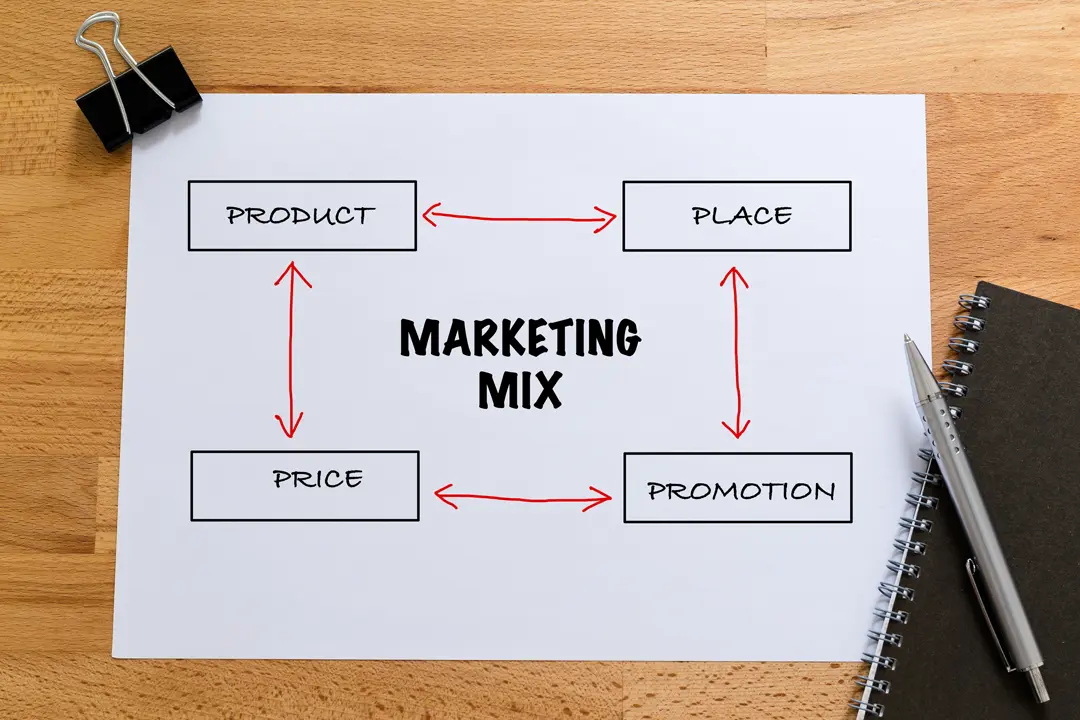
The Marketing Mix framework:
Definition:
The 4 Ps (also called the Marketing Mix) are the controllable variables a company can adjust to influence customer buying decisions:
- Product: What you're selling
- Price: How much you charge
- Place: Where/how customers buy it
- Promotion: How you communicate its value
Why it matters:
✅ Holistic thinking: Forces you to consider all aspects, not just advertising ✅ Strategic alignment: All four must work together coherently ✅ Decision framework: Guides product launches, repositioning, market entry ✅ Timeless principles: Applicable to products, services, B2B, B2C, nonprofits
Modern additions: Some add 3 more Ps (People, Process, Physical Evidence) for services, but we'll focus on the core four.
P #1: Product (What You're Selling)
More than just the physical item:
What "Product" includes:
Features and benefits:
- Features: What it does (technical specs)
- Benefits: What it does FOR customer (solves problems, satisfies needs)
Example:
- Feature: Smartphone with 256GB storage
- Benefit: Never delete photos, apps, or videos
Quality and design:
- Materials, durability, aesthetics
- User experience
- Packaging
Branding:
- Name, logo, identity
- Brand promise (what you stand for)
- Emotional associations
Services:
- Warranties, guarantees
- Customer support
- Installation, training
Product development questions:
Before launching, ask:
✅ What problem does this solve? (If none, why would anyone buy it?) ✅ What makes it different from competitors? (Unique value proposition) ✅ Who is this for? (Target customer—be specific) ✅ What features are essential vs. nice-to-have? (MVP thinking) ✅ How does it fit into customer's life? (Use cases, context)
Product lifecycle stages:
Introduction:
- Launch phase
- Building awareness
- Often unprofitable (R&D costs)
Growth:
- Sales accelerating
- Competitors entering
- Profits increasing
Maturity:
- Sales peak
- Market saturated
- Competition intense (price wars)
Decline:
- Sales decreasing
- New technology/trends replace
- Decision: Sunset or reinvent?
Strategy changes at each stage
Real-world example: Apple iPhone
Product:
- Premium smartphone (feature)
- Ecosystem integration (benefit: seamless across devices)
- Design excellence (sleek, status symbol)
- Regular updates (longevity)
- AppleCare (service)
Why it works: Not selling phone, selling experience and status
P #2: Price (How Much You Charge)
Most visible and psychologically powerful P:
Pricing isn't just math:
Price communicates:
- Quality perception (higher price = premium assumption)
- Brand positioning (luxury vs. budget)
- Target market (who can afford it)
Example:
- Rolex $10,000+: Luxury, status, exclusivity
- Timex $30: Functional, affordable, practical
- Same basic function (tell time), vastly different pricing and positioning
Pricing strategies:
1. Cost-plus pricing:
Formula: Cost + Desired Profit Margin = Price
Example:
- Product costs $50 to make
- Want 100% markup
- Price: $100
Pros: Simple, ensures profitability Cons: Ignores what customers will pay, competitor pricing
2. Value-based pricing:
Formula: What customer perceives it's worth = Price
Example:
- Adobe Photoshop: $55/month
- Could be $10/month, but professionals would pay $100+
- Priced based on value delivered (professional tool for livelihood)
Pros: Maximizes revenue, aligns with perceived value Cons: Requires understanding customer perception
3. Competition-based pricing:
Formula: Competitor price ± Differential = Your Price
Example:
- Competitors charge $100
- You price at $95 (undercut) or $110 (premium positioning)
Pros: Safe, market-tested Cons: Commoditizes you, ignores your unique value
4. Penetration pricing:
Strategy: Start low to gain market share quickly, raise later
Example:
- Netflix initially $7.99/month
- Now $15.49+ (established habit, raised price)
Pros: Fast customer acquisition Cons: Hard to raise prices later, trains customers to expect low prices
5. Skimming pricing:
Strategy: Start high (early adopters pay premium), lower over time
Example:
- iPhone launches at $999
- Year later, $799 (newer model out)
Pros: Maximizes profit from willing early adopters Cons: Limits initial market size
6. Freemium pricing:
Strategy: Basic free, premium paid
Example:
- Spotify: Free (ads) vs. Premium $10.99/month (ad-free, downloads)
Pros: Low barrier to entry, upsell opportunity Cons: Must convert enough to premium to sustain
Psychological pricing tactics:
Charm pricing: $9.99 instead of $10 (feels significantly cheaper) Prestige pricing: $100 instead of $99.99 (luxury, round numbers) Anchoring: Show $200 option first, $100 feels like deal Bundling: Three products for $50 (feels better than $20 each)
Pricing mistakes to avoid:
❌ Pricing too low (devalues product, attracts wrong customers, unsustainable) ❌ Competing on price alone (race to bottom, no differentiation) ❌ Not testing (survey, A/B test different price points) ❌ Ignoring psychology (price isn't purely rational)
P #3: Place (Where/How Customers Buy)
Distribution and accessibility:
What "Place" includes:
Distribution channels:
- Direct to consumer (your website, store)
- Retailers (Walmart, Target, Amazon)
- Wholesalers (bulk to other businesses)
- Online marketplaces (Etsy, eBay, Amazon)
Geographic reach:
- Local, regional, national, international
Logistics:
- Inventory management
- Warehousing
- Shipping, delivery
Distribution strategies:
Intensive distribution:
- Everywhere possible (Coca-Cola in every store)
- Maximizes availability
- Best for: Low-cost, mass-market products
Selective distribution:
- Specific retailers (Nike at athletic stores + own stores)
- Balance availability and brand control
- Best for: Mid-market products
Exclusive distribution:
- Limited outlets (Tesla only at Tesla stores/online)
- Maximum brand control, prestige
- Best for: Luxury, premium products
Online vs. Offline:
E-commerce (online):
Pros:
- Global reach
- Lower overhead (no physical stores)
- Data collection (customer behavior)
- 24/7 open
Cons:
- Shipping costs/complexity
- Can't touch/try before buying
- Competition intense
Brick-and-mortar (offline):
Pros:
- Tangible experience
- Immediate gratification (take home now)
- Personal service
- Local presence
Cons:
- High overhead (rent, staff)
- Limited hours
- Geographic constraints
Trend: Omnichannel (both, seamlessly integrated)
Place strategy questions:
✅ Where do my customers already shop? (Meet them there) ✅ What shopping experience do they expect? (Convenience, expertise, luxury?) ✅ Can I fulfill logistically? (Shipping, inventory, returns) ✅ What do competitors do? (Gaps, opportunities)
Example: Warby Parker
Place strategy:
- Started online-only (lower costs, disrupted eyewear)
- Added physical stores (try-on experience, convenience)
- Home try-on program (mail 5 frames, keep what you like)
- Omnichannel: Order online, pick up in-store
Why it works: Meets customers wherever they are
P #4: Promotion (How You Communicate Value)
Getting the word out:
What "Promotion" includes:
Advertising:
- Paid media (TV, radio, print, digital ads)
- Reaches broad audience
- One-way communication
Public Relations:
- Media coverage (news, articles, reviews)
- Influencer partnerships
- Earned media (free but must pitch/deserve coverage)
Sales Promotion:
- Discounts, coupons, BOGO
- Limited-time offers
- Loyalty programs
Personal Selling:
- Salespeople, demonstrations
- One-on-one, consultative
- High-touch, high-value sales
Direct Marketing:
- Email campaigns
- Direct mail
- Targeted, measurable
Digital Marketing:
- Social media (organic + paid)
- Content marketing (blogs, videos, podcasts)
- SEO, SEM
- Influencer marketing
The promotion mix:
Depends on:
Budget:
- Small budget: Content marketing, social media organic, PR
- Large budget: TV ads, sponsorships, celebrity endorsements
Target audience:
- Gen Z: TikTok, Instagram
- Professionals: LinkedIn, industry publications
- Seniors: Facebook, TV, print
Product type:
- B2C impulse purchase: Social media ads, influencers
- B2B enterprise software: White papers, trade shows, sales team
Stage of customer journey:
- Awareness: Broad advertising, PR, content marketing
- Consideration: Case studies, demos, testimonials
- Decision: Sales calls, discounts, urgency
Promotion mistakes:
❌ Promoting before product/price/place figured out (cart before horse) ❌ One-channel dependence (diversify or platform change kills you) ❌ Talking features, not benefits ("10GB storage" vs. "Never run out of space") ❌ No clear call-to-action (What should customer do next?) ❌ Inconsistent messaging (confuses brand identity)
Example: Dollar Shave Club
Promotion:
- Viral video ($4,500 production, millions of views)
- Humorous, relatable messaging ("Our blades are f***ing great")
- Subscription model (simple, convenient)
- Content marketing (blog, social media)
Result: $1B acquisition by Unilever
Why it worked: Differentiated through personality and humor in boring industry
How the 4 Ps Work Together
They must align coherently:
Example 1: Premium product, mismatched mix:
❌ Product: Luxury watch (high quality) ❌ Price: $50 (too cheap, signals low quality) ❌ Place: Gas station convenience stores (wrong context) ❌ Promotion: Spam emails (cheap, annoying)
Result: Brand confusion, failure
Example 2: Aligned strategy:
✅ Product: Luxury watch (Swiss craftsmanship) ✅ Price: $5,000 (signals quality, exclusivity) ✅ Place: High-end jewelry stores, own boutiques ✅ Promotion: Magazine ads in luxury publications, influencer partnerships
Result: Coherent premium brand
Applying the 4 Ps: Step-by-Step
For your business/project:
Step 1: Start with Product
- Define what you're selling (features + benefits)
- Identify target customer
- Determine unique value proposition
Step 2: Determine Price
- Research competitors
- Calculate costs
- Choose pricing strategy
- Test with target customers
Step 3: Select Place
- Identify where target customers shop
- Choose distribution channels
- Plan logistics
Step 4: Plan Promotion
- Set budget
- Choose channels based on audience
- Create messaging
- Measure and adjust
Step 5: Review and Iterate
- All 4 Ps aligned?
- Working together coherently?
- Adjust based on market feedback
Beyond the 4 Ps (Modern Additions)
For services and modern context:
People: Employees delivering service (customer service, sales team) Process: Systems ensuring consistent delivery (ordering, fulfillment) Physical Evidence: Tangible cues of service quality (store ambiance, packaging, website design)
Digital Marketing Mix additions:
- Personalization: Tailored experiences
- Partnerships: Collaborations, integrations
- Platform: Technology enabling business model
The 4 Ps—Product, Price, Place, Promotion—provide foundational marketing framework. Product defines what you're selling (features, benefits, branding, quality). Price determines how much to charge using strategies like cost-plus, value-based, penetration, skimming, or freemium, considering psychological factors ($9.99 vs. $10). Place decides where customers buy through distribution channels (direct, retail, online marketplaces) and omnichannel strategies. Promotion communicates value via advertising, PR, sales promotion, personal selling, direct marketing, and digital channels. All four must align coherently—premium product requires premium pricing, exclusive placement, and sophisticated promotion. Apply systematically: Start with Product, determine Price, select Place, plan Promotion, then review for alignment.