
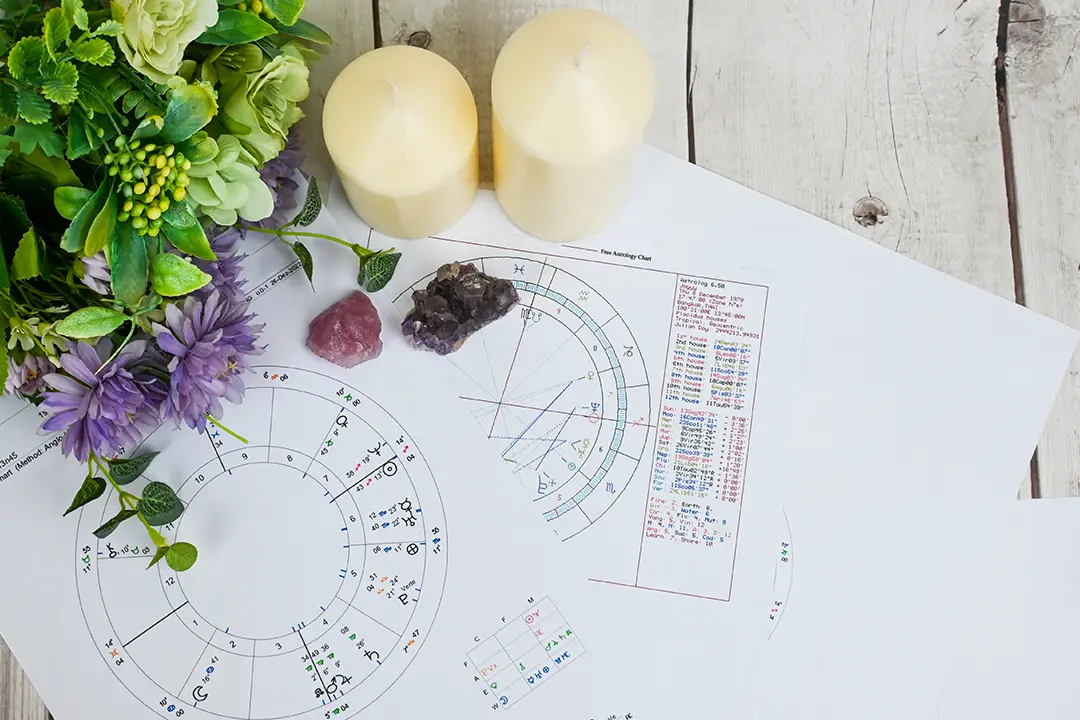
Top 5 Methods to Navigate Your Career Using Your Birth Chart
Savannah Brooks • 07 Mar 2026 • 120 views • 4 min read.Let me give you the same honest framing I apply to every astrology guide before we get into the methods, because it makes the content more useful rather than less. Birth chart career guidance has no empirical validation as a predictive system. There is no peer-reviewed research demonstrating that planetary positions at birth determine professional outcomes, predict career satisfaction, or identify vocational strengths with statistical reliability. If you are looking for an evidence-based career navigation tool, the Holland Codes, the Strong Interest Inventory, and the CliftonStrengths assessment have documented validity that astrology does not. What birth chart career guidance does offer — and this is genuinely useful for many people — is a rich symbolic framework for structured self-reflection on questions that most professional development frameworks address only partially. Your relationship with authority. The type of work environment where you function best. Whether you are energized by collaboration or depleted by it. The difference between work that feels like genuine expression and work that feels like a performance. These are real dimensions of professional satisfaction that birth chart interpretation addresses through a vocabulary many people find more engaging and personally resonant than standardized assessment language. Use the methods in this guide as reflection prompts and self-examination tools. Apply the same critical thinking you would to any framework that lacks empirical validation. Notice where descriptions resonate with actual professional experience rather than accepting them as cosmic confirmation of predetermined outcomes. With that framing in place, here are five specific birth chart methods for career navigation, with concrete implementation for each.
Top 5 Methods to Navigate Your Career Using Your Birth Chart
Method One: Read the Full Career Trinity — MC, Sixth House, and Second House Together
Most birth chart career guidance focuses exclusively on the Midheaven (MC) — the career angle discussed in our Midheaven guide — and stops there. Professional astrologers work with what is often called the career trinity: the Midheaven, the Sixth House, and the Second House together, because each addresses a different and complementary dimension of work.
The Midheaven describes your vocational calling — the type of contribution and public identity that feels most authentic. It addresses the question of what kind of work would feel most like genuine expression of your deepest professional orientation.
The Sixth House addresses your daily work experience — the routine, the environment, the type of tasks and pace that suit your natural functioning. The Sixth House sign and any planets in it describe what the day-to-day of work needs to feel like for sustainable engagement. A Sixth House in Gemini suggests thriving in varied, communication-heavy daily work. A Sixth House in Taurus suggests needing predictable, methodical daily work with tangible outcomes. The Sixth House is about how you work rather than what you work toward.
The Second House addresses your relationship with material security and the values that should underlie your income-generating work. The Second House sign describes what gives you a sense of material security and what you actually value in a compensation structure beyond raw salary. A Second House in Capricorn suggests finding security through structured, incrementally growing compensation with clear advancement tracks. A Second House in Sagittarius suggests finding security through work that provides growth, variety, and meaning alongside material compensation.
Reading all three together produces a more dimensional career picture than any single placement alone. A person with MC in Leo, Sixth House in Virgo, and Second House in Scorpio has a career profile suggesting: public-facing creative leadership as the vocational calling (Leo MC), detailed and analytical daily work as the sustainable functioning environment (Virgo Sixth House), and deep investigation with psychological complexity as the value driver in compensation (Scorpio Second House). A therapist, a film director with a perfectionist editing process, or a forensic accountant who presents findings publicly might all fit this profile — the combination narrows the vocational picture without prescribing a specific job title.
Pro Tip: To find your Sixth and Second House signs, use a free chart calculator at Astro.com or AstroSeek. You will need birth date, birth time, and birth location. The houses are labeled 1 through 12 on the chart wheel — count counterclockwise from the Ascendant (the horizontal line on the left side of the chart) to find each house.
Method Two: Identify Your Tenth House Ruler and Its Position
Every house in the birth chart is ruled by a planet — the planet that rules the zodiac sign on the cusp (beginning edge) of that house. The Tenth House is the house associated with the Midheaven and career, and its ruling planet's sign, house position, and aspects provide additional texture to the career picture that the MC sign alone does not capture.
The logic: the Tenth House ruler is the planet that "runs" your career sector. Its sign describes the energy quality of your career expression, its house position describes the life area where your career finds its context and motivation, and its aspects to other planets describe how the career energy interacts with other dimensions of your chart.
A practical example: if your Midheaven is in Scorpio, the Tenth House ruler is Pluto (modern ruler) or Mars (traditional ruler). If that Pluto is in the Third House in Sagittarius, the career energy is directed through communication (Third House) with a philosophical or expansive quality (Sagittarius) — suggesting that the Scorpionic career themes of transformation and depth research are expressed through writing, teaching, or media rather than through more private investigative work.
Warning: The Tenth House ruler interpretation requires knowing the basics of planetary rulerships — which planet rules which sign — and how to read a planet in a house. If you are new to birth chart interpretation, the Astro.com "Astro Wiki" and the free learning resources at AstroSeek provide clear introductory explanations of rulerships that do not require purchasing anything.
Method Three: Examine Your Saturn Placement for Career Lessons and Timing
Saturn is the planet traditionally associated with career, ambition, structure, discipline, and the relationship with authority and institutions. Its sign, house, and aspects in your birth chart describe both the challenges and the eventual rewards in your professional development — the areas where you are asked to work harder and build more deliberately, and the areas where sustained effort eventually produces recognition and mastery.
The Saturn career method has two components: natal Saturn (your birth position, describing the lifelong themes of your professional development) and Saturn transits (Saturn's current position in the sky relative to your natal chart, describing the current phase of professional development).
Natal Saturn placement by house describes the arena of professional challenge and eventual mastery. Saturn in the First House suggests developing a professional identity that requires sustained self-examination and authority-building rather than immediate recognition. Saturn in the Tenth House directly intensifies the career sector, suggesting a professional life characterized by significant ambition, significant delays or obstacles before recognition arrives, and eventual mastery in a field that requires long-term sustained effort. Saturn in the Third House suggests professional development that is closely tied to communication skills, writing, or education — fields where Saturn's discipline and patience produce depth that more casual practitioners do not develop.
Saturn transits to your natal chart provide timing information that psychological astrology uses for career transition planning. Saturn conjunct the natal Midheaven — occurring approximately every twenty-nine years — is traditionally associated with significant career reckoning periods: either a professional peak and recognition or a restructuring that changes the career direction significantly. Saturn transiting the Tenth House (approximately a seven-year period) is associated with sustained professional effort, possible restriction, and eventual foundation-building.
Pro Tip: Find your natal Saturn sign and house in your birth chart, then Google "Saturn transits 2025-2026" with your natal Saturn position to understand which transit phase you are currently in. The transit information provides a temporal framework for understanding why certain career pressures or opportunities feel particularly active in the current period.
Method Four: Use Your Moon and Venus Placements for Work Environment Fit
The Moon and Venus are the two planets most associated with what you need for emotional comfort and what you find genuinely pleasurable — both of which have underappreciated relevance to career satisfaction and work environment fit.
The Moon in your birth chart describes your emotional needs in any environment, including work. Moon in Cancer needs psychological safety, team cohesion, and work that has personal meaning — corporate environments with high political complexity and low trust produce Moon in Cancer distress regardless of the role's title or compensation. Moon in Aquarius needs intellectual freedom, detachment from emotional complexity in the workplace, and work that serves a larger purpose beyond organizational hierarchy. Moon in Aries needs autonomy, quick decision-making ability, and work that moves fast enough to match its energy — slow bureaucratic processes produce Moon in Aries frustration regardless of other positives.
Venus in your birth chart describes what you find genuinely pleasurable in work beyond ambition and achievement. Venus placements by sign describe the aesthetic and relational dimensions of work that produce intrinsic satisfaction. Venus in Libra finds genuine pleasure in collaborative, aesthetically refined work environments where relationships are harmonious and work products have visual or conceptual beauty. Venus in Capricorn finds genuine pleasure in work that produces tangible, lasting results and where excellence and refinement are recognized and respected.
The practical application: when evaluating a job opportunity, consider whether the role's daily environment matches your Moon's needs and whether the work itself contains elements that your Venus finds genuinely pleasurable. A role that addresses your Midheaven's vocational themes but violates your Moon's emotional needs is unlikely to produce sustained satisfaction regardless of its external markers of success.
Method Five: Track Jupiter Transits for Career Opportunity Windows
Jupiter is the planet traditionally associated with expansion, opportunity, abundance, and growth. Jupiter transits to key career points in your natal chart — the Midheaven, the Tenth House, natal Jupiter, and natal Saturn — are traditionally associated with periods of expanded professional opportunity, recognition, and growth.
Jupiter moves through the zodiac in approximately twelve years, spending approximately one year in each sign and house. When Jupiter transits your Tenth House — approximately once every twelve years for a roughly year-long period — traditional astrology associates this with a period of expanded professional visibility, opportunity, and potential advancement. This does not guarantee career success automatically, but the Jupiter transit framework suggests timing professional initiatives — launching a business, pursuing a promotion, making a significant career change, or increasing professional visibility — to coincide with Jupiter's favorable transits rather than with Saturn's more challenging ones.
Birth Chart Career Navigation Methods Compared
| Method | Chart Points Used | Career Question Addressed | Requires Birth Time? | Difficulty | Best For |
|---|---|---|---|---|---|
| Career trinity (MC + 6th + 2nd) | Three house cusps and planets in each | What/how/why of work — complete vocational picture | Yes | Medium | Foundational career self-reflection |
| Tenth House ruler by sign and house | MC ruler planet position | How career energy is expressed and where it finds context | Yes | Medium-High | Nuancing MC interpretation |
| Saturn placement and transits | Natal Saturn + current transits | Career challenge themes and developmental timing | Yes (house position) | Medium | Career timing and challenge areas |
| Moon and Venus for environment fit | Two natal planets | Emotional needs and pleasures in work | Partial (Moon house needs time) | Low-Medium | Work environment evaluation |
| Jupiter transits for timing | Current Jupiter position vs natal chart | Opportunity windows for career initiatives | Yes (for house transits) | Low-Medium | Career move timing |
Frequently Asked Questions
Do I need all five methods or is there a priority order for someone new to birth chart career work?
The career trinity method — reading the Midheaven, Sixth House, and Second House together — is the appropriate starting point for someone new to birth chart career interpretation because it provides the most complete foundational picture with the clearest interpretive framework. After establishing the career trinity baseline, the Moon and Venus method adds the emotional and environmental dimension that the house-based methods do not address. Saturn placement and transits add developmental timing context after you have established what you are developing toward. The Tenth House ruler method and Jupiter transits add refinement and timing nuance that is most useful once the foundational picture is clear. The priority order: career trinity first, Moon and Venus second, Saturn third, Jupiter transits fourth, Tenth House ruler for ongoing refinement.
What do I do if my birth chart career indicators seem to conflict with each other — for example, a Midheaven suggesting public leadership but a Moon suggesting a need for privacy?
Apparent conflicts between chart indicators are the most interesting and most informative aspects of birth chart interpretation rather than problems to resolve by prioritizing one indicator over another. The MC in Leo suggesting public creative leadership alongside a Moon in Scorpio suggesting a deep need for privacy and emotional protection is not a contradiction — it is a description of someone who may need to build public-facing professional work while maintaining strong personal privacy boundaries, or who does their best leadership work in contexts where they can control the depth of personal exposure. The tension between indicators often describes the specific challenge that the person's professional development asks them to navigate rather than a sign that the chart is inconsistent. When you encounter apparent conflicts, the productive reflection question is not "which indicator is right" but "what does the tension between these two things tell me about the specific challenge of my professional development?"
How do I use birth chart career guidance alongside conventional career counseling and assessment tools rather than instead of them?
The most productive integration of birth chart career work with validated assessment tools treats them as addressing different and complementary questions rather than competing claims about the same territory. Validated tools like the Holland Codes address empirically documented patterns in vocational interest and occupational fit with statistical reliability — they tell you what types of work environments and tasks are most likely to engage your interests based on patterns that hold across large populations. Birth chart interpretation addresses the more personal, narrative, and meaning-oriented dimensions of vocation — the symbolic framework for understanding why certain work feels meaningful and certain work feels empty, what your relationship with authority and institutional structure tends to be, and how the timing of your professional development relates to the larger patterns of your life. Using both: take a validated interest inventory to identify the empirically grounded career field directions with the strongest fit, then use birth chart interpretation to examine the personal, environmental, and meaning dimensions of the specific opportunities within those fields. The evidence-based tool answers "what fields fit my interests" — the birth chart framework helps answer "what kind of expression of that interest would feel most like genuine vocation."
The birth chart offers five specific methods for career navigation — the career trinity, the Tenth House ruler, Saturn's career lessons and timing, Moon and Venus for environment fit, and Jupiter transits for opportunity windows — that together provide a reasonably complete framework for examining the vocational questions that most professional development approaches address only partially.
The consistent caveat throughout: this is a reflective framework rather than an empirical prediction system. Its value is in the quality of career self-examination it enables, not in the accuracy of its forecasts.
Find your birth chart at Astro.com — you need birth date, time, and location.
Identify your Midheaven, Sixth House, and Second House signs as the career trinity starting point.
Read each placement as a question about your actual professional experience rather than a statement about your predetermined path.
Notice where the framework resonates with what you have actually observed about yourself at work.
That resonance — not the planetary mechanics — is where the practical value lives.