
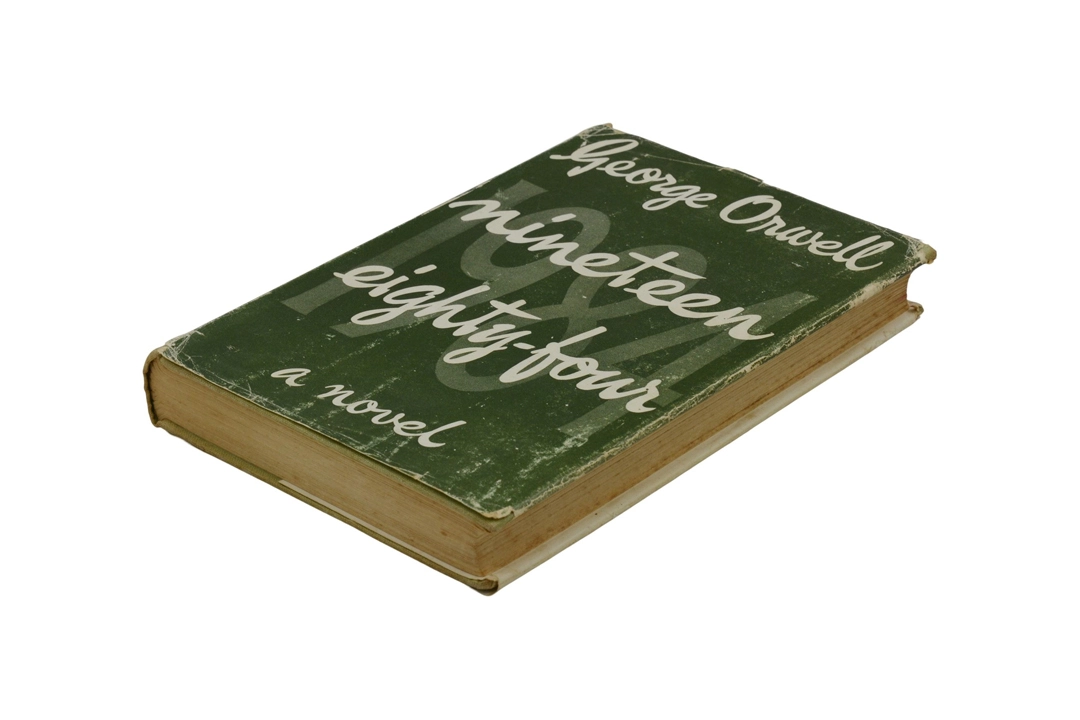
1984 – George Orwell: Book Summary
Beverly Ashford • 12 Feb 2026 • 198 views • 3 min read.Let me tell you something unsettling about this book. George Orwell wrote 1984 in 1948, dying of tuberculosis on a Scottish island. He was writing a warning about the future based on the totalitarian horrors of his present—Stalin's Soviet Union, Hitler's Germany, the propaganda machines he'd witnessed firsthand. He thought he was exaggerating for effect. Seventy-five years later, we have surveillance cameras on every corner, governments that rewrite history, social media mobs that enforce acceptable thought, and corporations that know more about us than Orwell's Thought Police could have dreamed. The book wasn't prophecy. It was a warning. The question is whether we listened.
1984 – George Orwell: Book Summary
Quick Summary:
- A nightmarish vision of totalitarianism taken to its logical extreme
- Winston Smith rebels against the Party through thought and love
- The state controls reality itself through language and surveillance
- Published in 1949, it predicted technologies and tactics we live with now
The World of Oceania
The year is 1984. Or is it? The Party controls all records, so even the date might be a lie.
The world has been divided into three superstates: Oceania, Eurasia, and Eastasia. They're perpetually at war, though alliances shift. Oceania comprises the Americas, Britain (now called Airstrip One), and Australia. It's ruled by the Party, whose figurehead is Big Brother—a mustachioed face on posters everywhere, watching.
London is gray, decaying, and monitored. Telescreens in every room broadcast propaganda and record everything. The Thought Police arrest people for thoughtcrime—wrong thinking, wrong expressions, wrong dreams. Neighbors inform on neighbors. Children inform on parents.
The Party's slogans hang everywhere:
WAR IS PEACE FREEDOM IS SLAVERY IGNORANCE IS STRENGTH
These aren't lies. They're reality in Oceania, because the Party defines reality.
Winston Smith's Rebellion
Winston Smith is a minor Party member working at the Ministry of Truth. His job is rewriting history—altering newspaper articles and records so the past always confirms whatever the Party currently claims. Last week Oceania was at war with Eurasia. This week it's Eastasia. Winston makes the records agree that it was always Eastasia.
He's 39, unhealthy, ordinary. But he has a fatal flaw: he remembers. He remembers when the past was different. He notices contradictions. Worse, he writes them down in a secret diary—an act of thoughtcrime punishable by death.
Winston knows he's already dead. The Thought Police will find him eventually. But he can't stop. He starts believing there must be others who think like him. There must be resistance.
He meets Julia, a young woman who passes him a secret note: "I love you."
Their affair becomes rebellion. In a world where the Party controls even orgasm—redirecting sexual energy toward political fervor—their physical relationship is a political act. They rent a room above a shop in the prole district, believing they've found privacy.
They seek out O'Brien, an Inner Party member Winston believes is secretly part of the Brotherhood—a legendary resistance movement led by Emmanuel Goldstein, the Party's official enemy. O'Brien gives them a book explaining how the Party maintains power.
Then comes the knock at the door.
The Trap and the Breaking
The room was monitored all along. The shop owner was Thought Police. O'Brien was never a rebel—he was the trap. The Brotherhood may not even exist.
Winston and Julia are taken to the Ministry of Love.
What follows is not interrogation in any normal sense. The Party doesn't want confessions. It doesn't want to kill Winston. It wants to cure him. It wants to make him love Big Brother genuinely, without reservation.
O'Brien becomes Winston's torturer, teacher, and confessor. Through pain, starvation, and psychological manipulation, he dismantles Winston's mind. He teaches him doublethink—holding two contradictory beliefs simultaneously. He makes Winston believe that 2+2=5 if the Party says so.
But one rebellion remains. In his heart, Winston still loves Julia. He still hates Big Brother.
Room 101 fixes that.
Room 101 contains your worst fear. For Winston, it's rats. Faced with a cage of starving rats being strapped to his face, Winston breaks completely. "Do it to Julia!" he screams. "Not me! Julia!"
He has betrayed the only thing he had left.
The novel ends with Winston sitting in a café, drinking gin, watching a telescreen announce military victory. He finally loves Big Brother. The rebellion is over. It never really began.
Key Concepts and Terms
| Term | Meaning | Purpose |
|---|---|---|
| Big Brother | The Party's figurehead, possibly fictional | Object of worship, symbol of surveillance |
| Thoughtcrime | Unorthodox thoughts | Makes internal rebellion impossible |
| Doublethink | Holding contradictory beliefs simultaneously | Eliminates logical resistance |
| Newspeak | Simplified language with reduced vocabulary | Makes thoughtcrime literally unthinkable |
| Memory hole | Chute for destroying documents | Erases inconvenient history |
| Room 101 | Contains your worst fear | Final tool for breaking individuals |
| Proles | The working class, 85% of population | Kept ignorant but allowed freedom |
| Unperson | Someone erased from all records | Complete elimination from existence |
| Two Minutes Hate | Daily ritual of directed anger | Channels emotion toward Party's enemies |
The Party's Philosophy
The book contains long passages from "The Theory and Practice of Oligarchical Collectivism," supposedly written by Goldstein. Whether Goldstein exists or the Party wrote it doesn't matter. The analysis is accurate.
Power is not a means; it is an end. The Party doesn't seek power for wealth or comfort. It seeks power for power's sake. The goal is total control, forever. "If you want a picture of the future, imagine a boot stamping on a human face—forever."
Control of the past is control of the present. Whoever controls records controls memory. Whoever controls memory controls identity. The Party can make people believe anything because no external record contradicts them.
War is not meant to be won. Perpetual war justifies perpetual emergency. It consumes surplus production that might raise living standards and create an independent middle class. It channels patriotic emotion. Victory would end its usefulness.
The proles could overthrow the Party instantly. They're 85% of the population. But they're kept distracted with work, cheap entertainment, and lottery dreams. They're free because they're harmless. "Until they become conscious they will never rebel, and until after they have rebelled they cannot become conscious."
Why It Still Matters
Every generation rediscovers 1984 and finds new relevance.
Surveillance has exceeded Orwell's imagination. Your phone tracks your location. Your search history reveals your thoughts. Cameras recognize your face. Orwell's telescreens couldn't follow you outside.
Language manipulation is everywhere. Political euphemisms multiply. "Enhanced interrogation" means torture. "Collateral damage" means dead civilians. Newspeak's goal—limiting thought through limiting language—has professional practitioners.
Memory holes exist digitally. News cycles erase last week's scandals. Websites disappear. Records get altered. Who controls the algorithms controls what's findable.
Doublethink has become normalized. People believe contradictory things simultaneously and don't notice. Tribal loyalty overrides logical consistency.
The book isn't prophecy because Orwell wasn't predicting. He was warning. He saw what totalitarian systems do and traced the logic to its endpoint.
Frequently Asked Questions
Is 1984 about communism or fascism?
Both and neither. Orwell fought against fascism in Spain and criticized Soviet communism relentlessly. The novel targets totalitarianism itself—the impulse toward total control that exists across ideologies. Ingsoc (English Socialism) has elements of both.
Does the Brotherhood actually exist?
Unclear and probably not. O'Brien suggests the Party may have invented Goldstein as a useful enemy. The "resistance" may be entirely a Party operation to identify dissidents. This uncertainty is part of the horror.
Why doesn't Winston escape or fight back?
He tries, in his limited way. But the Party's control is total. There's nowhere to escape to. Physical resistance is impossible. The only rebellion available is internal—and the Party conquers even that.
What does the ending mean?
Winston's defeat is complete. He doesn't just obey—he genuinely loves Big Brother. The Party has achieved what it wanted: not forced compliance, but genuine belief. The human spirit can be broken entirely.
Is there any hope in the novel?
Almost none. The appendix on Newspeak is written in past tense, suggesting the regime eventually fell. But this might be Orwell's editor's addition. The novel itself offers no escape, no resistance, no hope—only warning.
Here's what Orwell understood that remains true.
The ultimate goal of totalitarianism isn't obedience. It's love. The Party doesn't want Winston to say 2+2=5 while secretly knowing it's 4. It wants him to believe it. It wants his soul.
Modern soft authoritarianism works differently. We're not tortured into compliance. We're entertained into distraction. We're algorithmically fed what we already believe. We're encouraged to self-censor.
The boot on the face might come someday. But Orwell also warned us about the comfortable path to unfreedom—the voluntary surrender of privacy, autonomy, and truth.
Read the book. Not because it's assigned. Because it's relevant.
Then look around.