
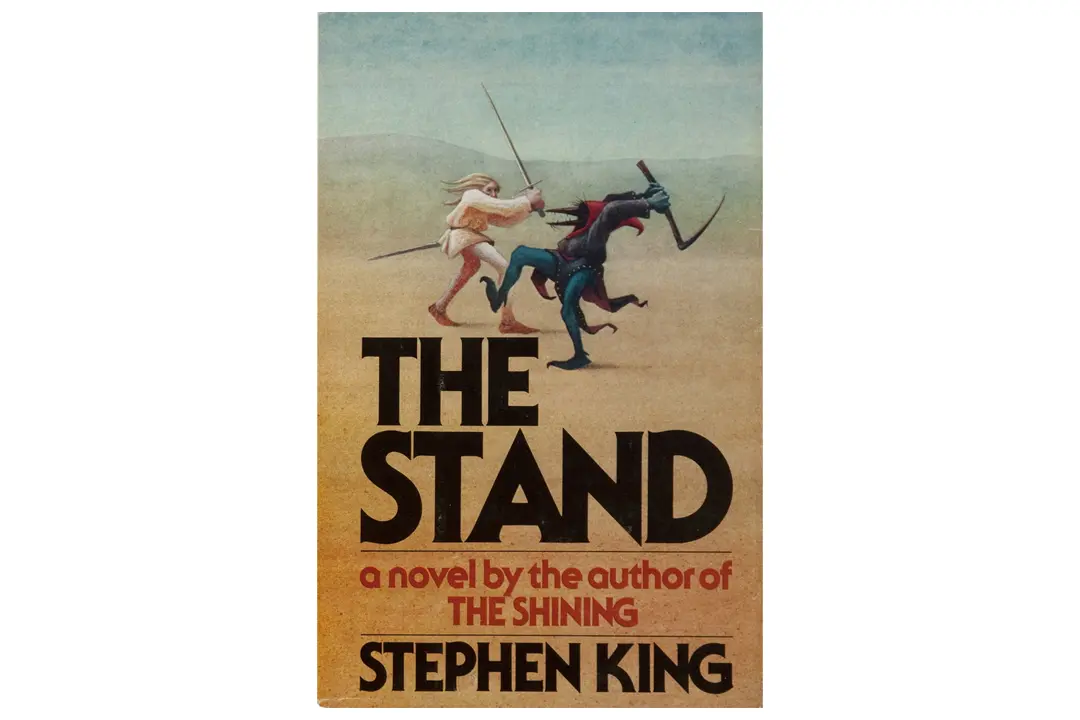
The Stand by Stephen King: Book Summary
Beverly Ashford • 19 Mar 2026 • 115 views • 3 min read.Let me tell you about the novel that Stephen King has called his Lord of the Rings — the one where he emptied everything he had onto the page and produced something that readers either find overwhelming or cannot put down, with very little middle ground. Stephen King wrote The Stand in the late 1970s, asking himself what would happen if he unleashed a plague on America and watched what survived. The original 1978 publication was cut significantly by the publisher — too long, too expensive to produce. The 1990 uncut edition restored the deleted material, updated the setting from the 1980s to the 1990s, and became the version most readers know. The complete and uncut edition is 1,141 pages. King is aware this is a commitment. He writes in the introduction that he wanted to write a long book — not padded, not self-indulgent, but genuinely long in the way that certain stories require length to breathe. Whether he succeeded is a genuine debate. That he attempted something extraordinary is not.
The Stand by Stephen King: Book Summary
Quick Summary:
- A weaponized flu kills ninety-nine percent of humanity and the survivors are drawn into an apocalyptic battle between good and evil across the ruins of America
- Originally published in 1978 and expanded in 1990, the complete edition runs over 1,100 pages and remains King's most ambitious novel
- King's central argument: when civilization falls, human beings immediately rebuild hierarchies, communities, and moral frameworks — because that is what humans do
- A book that is simultaneously a post-apocalyptic survival story, a character study of dozens of people, and a meditation on whether good can survive contact with genuine evil
The Plague
Captain Trips — the street name survivors give to the weaponized superflu that escapes a government facility in California — kills with horrifying efficiency. It spreads through respiratory contact, mutates fast enough to defeat immune responses, and has a mortality rate of approximately ninety-nine point four percent.
King does not rush through the collapse. He spends hundreds of pages on it — individual stories of infection and death, small communities dissolving, the last broadcasts from radio stations going silent one by one, highways clogged with abandoned vehicles, dogs going feral, the specific texture of a world that had seven billion people last month and has perhaps one million now.
This patience is either the book's greatest strength or its most significant demand on the reader, depending on who you are. King is not interested in skipping to the interesting part. He believes the collapse is the interesting part — the human texture of it, the specific ways people respond to watching civilization end around them while they happen to be among the survivors.
The Survivors
The novel follows an ensemble cast large enough to populate a small town — which is eventually what they do.
Stu Redman is a quiet, competent Texan who was one of the first exposed to Captain Trips and one of the first discovered to be immune. His practicality and decency make him a natural leader despite his resistance to the role.
Frannie Goldsmith is a young woman from Maine who is pregnant when the plague hits and must navigate survival, loss, and an unexpected community while carrying a baby into a world that may not be safe for children.
Larry Underwood is a rock musician who had a hit song right before the plague and was in the process of discovering that fame and genuine goodness are not the same thing. His arc is the novel's most complete — he begins as someone who does not like himself very much and earns, slowly, the right to.
Nick Andros is deaf-mute, young, and perhaps the most purely decent person in the novel. His story is the one King is most visibly invested in.
Tom Cullen is intellectually disabled and carries a kind of wisdom that the other characters — most of them too smart for their own good — cannot access. He is written with more care and dignity than the trope usually receives.
Mother Abagail is one hundred and eight years old, Black, and has been called by God to gather the survivors. She is the good side's prophet and spiritual center — and the character readers find either luminous or frustratingly vague depending on their relationship to the religious framework King is using.
Randall Flagg — the Dark Man, the Walkin' Dude — is evil. Not corrupted-by-circumstances evil. Genuinely, cosmically evil, with powers that are never fully explained and a smile that everyone who sees it remembers as the worst thing they have ever seen. He is gathering his own survivors in Las Vegas, building a different kind of community under a different kind of flag.
Two Communities
The novel's second half is essentially a tale of two cities. The Boulder Free Zone forms around Mother Abagail in Colorado — messy, democratic, full of conflict, trying to rebuild something like the civilization that died. Las Vegas forms around Flagg — efficient, ruthless, organized around fear and the intoxication of power.
King is interested in what each community reveals about human nature. Boulder is not idealized. It is full of petty politics, genuine disagreements, people who loved the old world's comforts and want them back immediately, and the specific difficulty of democratic decision-making among traumatized survivors who have all lost everyone they loved.
Las Vegas is not uniformly evil. Many people end up there because they were drawn by the same thing that draws people to strong leaders in real crises — the comfort of someone who seems to know exactly what to do. Flagg provides certainty. Certainty is attractive when everything else is rubble.
The confrontation between the two communities is structured as a spiritual battle — King is explicit about the religious framework, drawing on Revelation and the Book of Job and the specific American evangelical tradition of good versus evil writ large across a landscape. Whether this framework works depends heavily on the reader's relationship to it.
The Four Who Walk
Four members of the Boulder community are sent west toward Las Vegas on a mission that Mother Abagail has dreamed. The mission's purpose is not military. They have no plan, no weapons, no strategy. They walk into the heart of Flagg's power because they have been told to stand — to be witnesses, to be the visible representatives of the choice between the two ways of living.
King is asking what moral courage looks like when it is completely stripped of tactical advantage. The answer the novel gives is uncomfortable and not entirely satisfying, which is probably honest.
Key Characters Compared
| Character | Background | Core Quality | Role in the Story | Fate |
|---|---|---|---|---|
| Stu Redman | East Texas working class | Quiet competence and decency | Boulder Free Zone leader | Survives |
| Frannie Goldsmith | Maine college student | Moral clarity and maternal strength | Carries hope literally and figuratively | Survives |
| Larry Underwood | Rock musician | Potential goodness he has to earn | Transforms from self-absorbed to genuinely good | One of the four who walk west |
| Nick Andros | Deaf-mute drifter | Pure decency without performance | Conscience of the Boulder community | Does not survive |
| Mother Abagail | 108-year-old Black woman | Faith as absolute conviction | Spiritual center and prophet of Boulder | Dies having completed her purpose |
| Randall Flagg | Unknown origin | Pure appetite for chaos and power | Antagonist and Vegas leader | Defeated but not destroyed |
| Tom Cullen | Intellectually disabled | Innocent wisdom | Spy mission to Vegas, crucial messenger | Survives |
| Harold Lauder | Intelligent outcast | Resentment curdling into evil | Betrays Boulder, joins Flagg | Does not survive |
Frequently Asked Questions
Do I need to read the original 1978 version or the 1990 uncut edition?
The 1990 uncut edition is the version King considers definitive and is what most readers encounter. It restores approximately four hundred pages of cut material and updates cultural references. The original is leaner and some readers prefer it. Start with the uncut edition unless length is a serious concern.
Is the religious framework a barrier for non-religious readers?
King uses Christian mythology — specifically the battle between good and evil, God and the Devil — as the novel's structural spine. Readers who find this framework meaningful will engage with it differently than readers who do not. The character work and the apocalyptic narrative function independently of the religious content for many readers. It is a genuine consideration but not a disqualifier.
How does it compare to other post-apocalyptic novels?
The Road by Cormac McCarthy covers similar territory in under three hundred pages with a bleakness and literary compression that The Stand never attempts. Station Eleven by Emily St. John Mandel is more interested in what survives culturally than in the battle between good and evil. The Stand is the most ambitious and most maximalist of the three — it is trying to do everything simultaneously and largely succeeds.
Is Randall Flagg scary?
Flagg is one of King's most enduring creations and appears in multiple other novels. His scariness comes not from what he does but from what he represents — the appeal of someone who is absolutely certain, absolutely powerful, and absolutely willing to use both. He is more disturbing than frightening in the conventional horror sense.
Why did King cut the original version?
Publishers in 1978 were concerned about production costs for a novel this length and marketability for a first-time epic from an author known primarily for horror. The cuts were not creative decisions. King restored the material when he had the commercial leverage to insist on the uncut version in 1990.
What should I read next?
The Road by Cormac McCarthy is the essential counterpoint — apocalyptic fiction that is almost entirely stripped of the mythological and spiritual framework King relies on. Swan Song by Robert McCammon covers nearly identical territory — nuclear apocalypse, good versus evil, survivors rebuilding — and is often cited by readers who loved The Stand and want more. It by King himself is his other maximalist ensemble novel and rewards readers who responded to the character depth here.
The Bottom Line
Here is what Stephen King actually attempted in eleven hundred pages.
Not a horror novel in the conventional sense — there are frightening elements, but the book is more interested in what humans do after the worst has already happened than in the worst itself.
A portrait of human community under impossible conditions. What it takes to build something democratic and decent when everyone is traumatized and the easiest thing available is a strong leader who promises certainty. What moral courage looks like when it has no tactical advantage. Whether good can survive genuine contact with evil without becoming something it did not intend to become.
The answers King provides are not entirely satisfying, which is probably the most honest thing about the book. Good does not triumph cleanly. Evil does not die completely. The survivors return to Boulder carrying the same human flaws that made the pre-plague world what it was.
But they return. They rebuild. They hold elections and argue about policy and make mistakes and try again.
King's argument is quiet but consistent throughout eleven hundred pages: this is what humans do. Not because they are good. Because they cannot help it.
The stand they take is not against Flagg.
It is for the irreducible human need to live in community, to make meaning, to choose — even in rubble, even in grief, even facing something that cannot be defeated by any ordinary means — to try.