
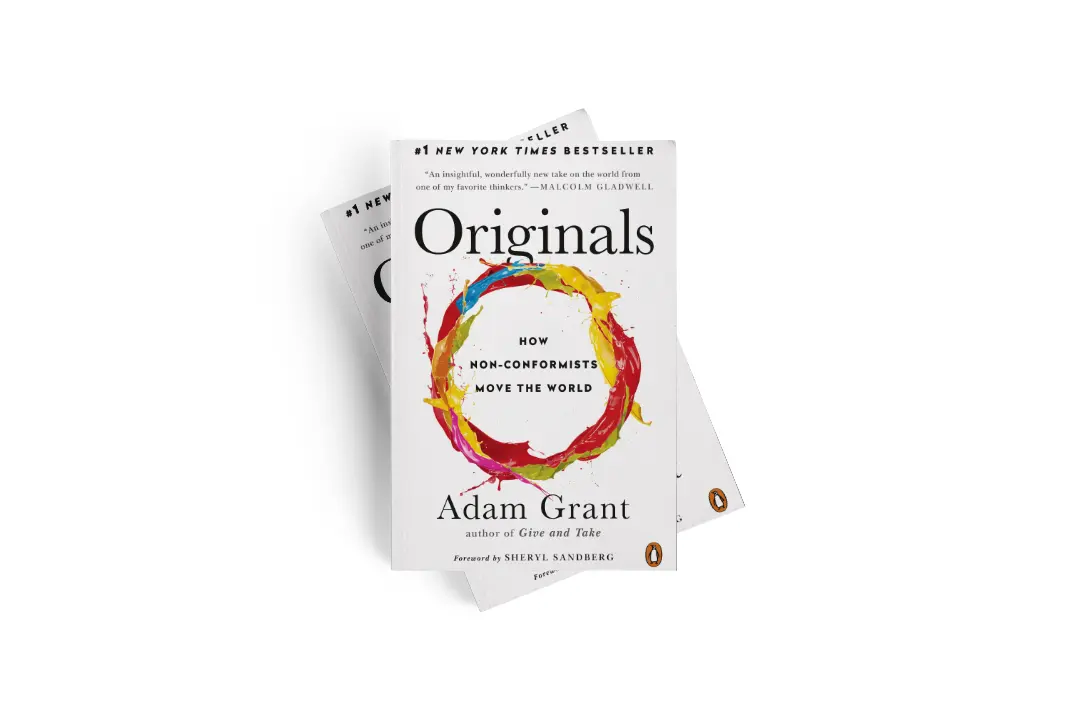
Originals by Adam Grant: Book Summary
Beverly Ashford • 19 Mar 2026 • 89 views • 3 min read.Let me tell you about the book that made me stop feeling guilty about not quitting my job to follow my passion — and start thinking more carefully about what originality actually requires. Adam Grant published Originals: How Non-Conformists Move the World in 2016. He is a organizational psychologist at Wharton who studies how people champion new ideas, navigate risk, and drive change in organizations and in their own lives. He started the book after passing on an early investment opportunity in a company called Warby Parker — the eyewear startup founded by four of his students — and spending years thinking about what he got wrong and why. What he found surprised him. The originals he studied — people who generated creative ideas and actually got them implemented — did not look like the Silicon Valley mythology. They were not fearless. They did not burn their boats. They experienced doubt, they procrastinated, they kept backup plans, and they failed repeatedly before anything worked. The difference between them and everyone else was not courage in the conventional sense. It was something more specific and more learnable.
Originals by Adam Grant: Book Summary
Quick Summary:
- A Wharton organizational psychologist dismantles the myth that original thinkers are fearless visionaries who burn their boats and bet everything
- Published in 2016, it reframes creativity and change-making as skills that can be cultivated rather than traits you either have or do not
- Grant's central finding: the most successful originals doubt themselves constantly, procrastinate strategically, and keep their day jobs longer than you think
- A book that will make cautious people feel better about being cautious — and help them channel that caution into something useful
The Myth of the Fearless Original
Grant opens by demolishing the entrepreneurial hero narrative. The story we tell about successful innovators — they saw the opportunity, they took the leap, they risked everything, they won — is almost always a retrospective construction that strips out the doubt, the hedging, and the extended period of not-quite-committing that preceded the leap.
He presents research showing that entrepreneurs who kept their day jobs while developing their ventures had significantly higher survival rates than those who quit to pursue their ideas full time. The conventional wisdom — that full commitment signals belief and produces better outcomes — turns out to be mostly wrong. Part-time entrepreneurs, who maintained income security while testing ideas, made better decisions and built more durable companies.
The same pattern appears across creative domains. Darwin spent years collecting evidence before publishing On the Origin of Species — not because he lacked conviction but because he understood the magnitude of what he was claiming and wanted the case to be overwhelming. Martin Luther King Jr. did not plan the Montgomery Bus Boycott. He had prepared extensively across years of organizing before the moment arrived. The originals who changed history were not waiting for the right moment while doing nothing. They were preparing while waiting.
The Procrastination Paradox
One of the book's most counterintuitive arguments concerns procrastination. Grant presents research by his doctoral student Jihae Shin showing that moderate procrastination — starting a task and then delaying completion — improved creative output compared to either completing tasks immediately or extreme procrastination.
The mechanism is incubation. When you start a project and let it sit, your mind continues processing it unconsciously. Ideas that seemed complete reveal gaps. Connections to unrelated material emerge. The first solution — which immediate completion would have locked in — gets replaced by something better.
Grant tests this on himself and on his students. The results hold. The problem is that this procrastination has to be intentional rather than anxious. Procrastinating because you are avoiding the task produces different cognitive effects than procrastinating because you are deliberately leaving space for ideas to develop. The former produces anxiety that narrows thinking. The latter produces the kind of open, associative processing that generates novel connections.
Generating Volume to Find Quality
The most practically important finding in the book for creative professionals: original thinkers generate more ideas in total, not better ideas per attempt. Creativity is partly a numbers game.
Grant documents this across domains. The most prolific composers produced the most masterpieces — and also the most forgettable work. Picasso created more than twenty thousand pieces. Einstein published papers that were wrong. The originals who changed their fields had high output rates and accepted that most of what they produced would not be their best work.
The implication is direct. The path to generating one great idea is usually through generating many ideas, most of which will not work. People who wait for the right idea before committing to action produce less original work than people who generate and test ideas continuously, treating most of them as learning material rather than failures.
This reframes the relationship between quantity and quality. They are not in tension. High-quality original output is typically the result of high-quantity generation with rigorous filtering — not a process of carefully producing only high-quality ideas from the start.
Timing and Strategic Patience
Grant devotes significant attention to timing — when to champion an idea, when to wait, and how to read the environment for receptivity. His finding is that originals are often better at strategic patience than they are given credit for.
First-mover advantage — the idea that being first to market confers lasting competitive benefit — is largely a myth, Grant argues. Research shows that pioneers in most industries are frequently displaced by settlers who enter later with better products, clearer understanding of customer needs, and the advantage of learning from the pioneer's mistakes. Striving for novelty too early, before the market is ready or before the idea is fully developed, is a significant failure mode for originals.
The better strategy is to enter when the idea is ready and the environment is receptive — which sometimes means waiting longer than feels comfortable. This is different from avoidance. It is strategic reading of conditions combined with continued preparation during the wait.
Building Coalitions and Managing Audiences
The second half of the book moves from individual creativity to organizational change — how originals actually get ideas accepted by institutions that resist them.
Grant's most important finding here is that the most effective advocates for new ideas are not the most radical voices in the room. Presenting an idea as a revolution — as a complete break from current practice — triggers the threat response in decision-makers and produces rejection. Presenting the same idea as an extension of existing values, a refinement of current practice, or a solution to a problem the organization already acknowledges produces significantly better uptake.
This is not selling out. It is recognizing that the goal is implementation, not the purity of the idea. An original idea that gets rejected changes nothing. The same idea, framed to connect with existing concerns, can change everything.
Myths vs Reality of Originals
| Common Myth | What Grant's Research Shows | Practical Implication |
|---|---|---|
| Originals are fearless | They feel doubt constantly — they act despite it | Fear is not a signal to stop; it is normal |
| First movers win | Settlers who refine often outlast pioneers | Being second with a better product beats being first |
| Quitting the day job signals commitment | Part-time entrepreneurs have higher survival rates | Financial security enables better risk-taking |
| Procrastination is always harmful | Moderate procrastination improves creative output | Build incubation time into creative process |
| Quality over quantity | High volume generates the conditions for quality | Generate more ideas, filter ruthlessly |
| Radical framing wins converts | Connecting to existing values is more persuasive | Frame new ideas as extensions, not revolutions |
| Originals act alone | Coalition building is essential for implementation | Find the right allies before going public |
Frequently Asked Questions
Is this book only for entrepreneurs and creative professionals?
Grant writes for a general audience and the principles apply across professional contexts. Anyone who has ever wanted to champion a new idea — in a workplace, a community organization, or a personal project — will find the frameworks useful. The research covers managers, activists, parents, and students alongside entrepreneurs.
How does this relate to Grant's other books?
Give and Take examines how generosity affects career success. Think Again covers the importance of intellectual flexibility and updating beliefs. Originals sits between them — it is about generating and championing new ideas, which requires both the relational intelligence Grant covers in Give and Take and the cognitive flexibility he covers in Think Again. All three reward reading together.
Is the procrastination finding an excuse to avoid work?
Grant is careful about this. The research applies to creative tasks requiring novel connections — not to execution tasks with clear specifications. Procrastinating on writing a first draft to let ideas incubate is different from procrastinating on sending an email. The finding is not general permission to delay. It is specific evidence that incubation improves certain kinds of creative work.
Does the book address failure?
Extensively. Grant profiles originals who failed repeatedly — sometimes catastrophically — before their ideas found traction. The pattern across cases is that originals treat failure as information rather than verdict, maintain enough psychological safety to keep generating, and use failure to refine rather than to stop. This is easier said than done and Grant is honest about that.
How does Grant handle confirmation bias in his examples?
This is a fair criticism of the book. Grant selects cases that support his argument and presents them compellingly. He is a journalist-adjacent academic who prioritizes narrative accessibility over methodological caution. The research he cites is real but the case studies are curated. Read the findings as frameworks for thinking rather than as iron laws.
What should I read next?
Think Again by Grant himself is the natural follow-up — it covers the intellectual flexibility that originality requires. Creativity Inc. by Ed Catmull shows originals operating inside an organization specifically designed to support them. Range by David Epstein complements the volume-generation argument with evidence for why breadth of experience produces original thinking.
The Bottom Line
Here is what Adam Grant actually found after studying originals across domains and decades.
They are not who the mythology says they are. They are not fearless. They are not certain. They do not burn their boats and bet everything on a single vision.
They generate more ideas than everyone else and accept that most will not work. They procrastinate strategically and let problems incubate. They keep their options open longer than feels heroic. They build coalitions before going public. They frame new ideas in the language of existing values. They act despite doubt rather than waiting for doubt to resolve.
And they fail. Repeatedly, publicly, and without letting it stop them from generating the next idea.
The myth of the fearless original is a retrospective story — the version told after something worked. The reality is messier, more patient, and considerably more accessible to people who have always assumed that originality required a kind of boldness they do not possess.
You do not need to be fearless.
You need to be curious, persistent, and willing to generate enough ideas that one of them turns out to matter.
That is what originals actually do.