
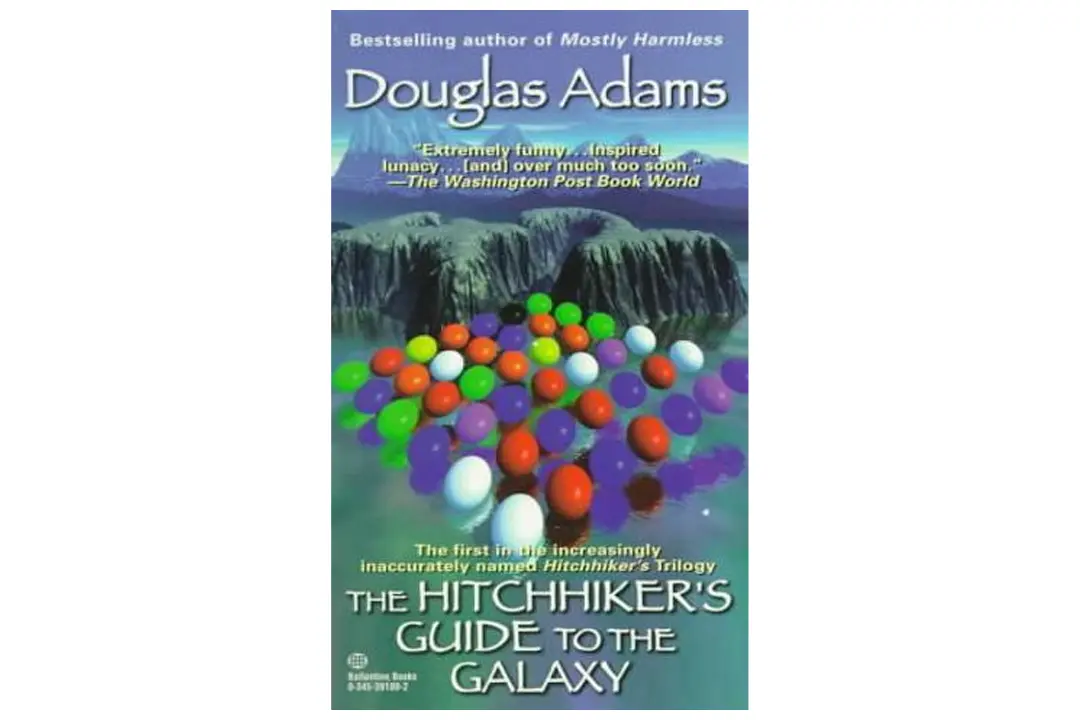
The Hitchhiker's Guide to the Galaxy by Douglas Adams: Book Summary
Beverly Ashford • 26 Feb 2026 • 116 views • 3 min read.Let me tell you about the book that was written because Douglas Adams missed a train, lay down in a field in Innsbruck with a copy of the Hitchhiker's Guide to Europe, looked up at the stars, and thought someone should write a hitchhiker's guide to the galaxy. Douglas Adams published The Hitchhiker's Guide to the Galaxy as a novel in 1979, adapted from the BBC radio series he had written the previous year. He was twenty-seven years old, constitutionally unable to meet deadlines, and possessed of a comic sensibility so distinctive that no one has successfully imitated it in the forty-plus years since. The book has sold over fifteen million copies. It has been adapted into a radio series, a television series, a stage musical, a film, and a video game. It spawned four sequels that Adams wrote and one that he did not live to write himself. The phrase mostly harmless — Earth's full entry in the Hitchhiker's Guide — entered the language as a description of something accurately summed up by its inadequacy. Adams died of a heart attack in 2001 at forty-nine. He left behind five novels in the series and the specific sense, shared by millions of readers, that the universe got noticeably less interesting the day he stopped describing it.
The Hitchhiker's Guide to the Galaxy by Douglas Adams: Book Summary
Quick Summary:
- An ordinary Englishman is rescued from Earth's demolition by his alien friend and discovers that the universe is vast, indifferent, and considerably more absurd than anyone had warned him
- Originally a BBC radio comedy in 1978, adapted into a novel in 1979, it became one of the most beloved comic science fiction works ever written
- Adams's central argument: the universe does not have a meaning, the search for meaning is still worth doing, and a good cup of tea is underrated
- A book that is simultaneously a comedy about existential meaninglessness and a genuinely comforting read — which is a difficult trick that Adams pulls off completely
The Setup
Arthur Dent is having a bad Thursday. The local council wants to demolish his house to build a bypass. He is lying in front of the bulldozers in his dressing gown when his friend Ford Prefect arrives and tells him they need to go to the pub.
Over beer, Ford explains several things. He is not from Guildford. He is from a small planet near Betelgeuse. He has been stranded on Earth for fifteen years while researching an entry for the Hitchhiker's Guide to the Galaxy — a wholly remarkable book that contains the best efforts of researchers on many different planets to say what the universe is all about and how to live in it. Earth's full entry, after all that research, is: Mostly harmless.
And the Earth is about to be demolished. A Vogon constructor fleet has arrived to build a hyperspace bypass. The demolition will happen in approximately twelve minutes. Ford has hitched them a ride on a Vogon ship.
This is how Arthur Dent's Thursday goes from bad to significantly worse. He is rescued from Earth's destruction with approximately thirty seconds to spare, wearing his dressing gown, clutching a towel because Ford told him to bring one, and deeply confused about everything.
The Universe Adams Built
The comedy in Hitchhiker's operates through a specific mechanism: Adams takes the logic of bureaucracy, corporate culture, and human self-importance and applies it to cosmic scale. The result is a universe that is not cruel so much as indifferent in the specific way that large organizations are indifferent — not malevolent, just comprehensively incapable of caring about individuals.
The Vogons are the bureaucracy made manifest. They are not evil. They are simply deeply committed to proper procedure. The demolition of Earth was properly announced — the planning notice has been available in the local planning office on Alpha Centauri for fifty years. If Arthur had not bothered to check, that is his problem. The Vogon captain finds Arthur's distress mildly irritating, reads him some terrible poetry as punishment, and drops him into space.
The Heart of Gold is a spacecraft powered by an Infinite Improbability Drive — a technology that exploits the fact that if something is sufficiently improbable, it will eventually happen. The ship generates a field of improbability that allows it to cross interstellar distances by passing through every possible state simultaneously. It also turns the missiles fired at it into a sperm whale and a bowl of petunias, the whale spending its brief conscious existence wondering what it is and the petunias having a very bad feeling it recognizes but cannot place.
This is Adams's mode: cosmic events described in the register of mild inconvenience, with asides about the specific absurdity of consciousness finding itself suddenly and inexplicably existing.
Zaphod, Trillian, and Marvin
Zaphod Beeblebrox is the President of the Galaxy — a role he won by being sufficiently distracting that no one noticed he was doing it for personal reasons. He has two heads, three arms, the attention span of a hummingbird, and the specific confidence of someone who has never experienced consequences. He stole the Heart of Gold on its maiden voyage because he needed it to find the legendary planet of Magrathea.
Trillian is a human astrophysicist who left Earth with Zaphod at a party in Islington six months before the demolition. Arthur met her at that party and failed to follow through on the conversation, which he now regrets with the specific intensity of someone who has lost his entire planet and the woman he might have known better.
Marvin is a robot. He is afflicted with what the Sirius Cybernetics Corporation cheerfully describes as a Genuine People Personality — in Marvin's case, a personality of crushing, comprehensive, technically accurate depression. He has a brain the size of a planet. He is asked to park the car. He has been waiting for 37 million years in one instance of the novel. His descriptions of his own suffering are the funniest passages in the book because Adams calibrates them to exactly the point where misery becomes comedy without ever quite resolving into either.
The Answer
The novel's central set piece is Magrathea — a legendary planet whose inhabitants built custom planets for the very wealthy before the economy made it unviable. Deep Thought, a computer the size of a city, was built to calculate the Answer to the Ultimate Question of Life, the Universe, and Everything.
It ran for seven and a half million years.
The Answer is 42.
The problem, Deep Thought explains, is that no one knew what the Question actually was. A new computer — Earth, as it turns out, populated with organic life as part of the computational process — was built to calculate the Question. It was demolished five minutes before the program completed.
Adams claimed the number 42 was chosen because it was ordinary. He wanted the answer to the ultimate question to be something completely undramatic. The joke is not the number. The joke is that the answer is useless without the question, that seven and a half million years of computation produces something that requires another ten million years of context to be meaningful, and that the universe does not particularly care how long you have been working on something.
Key Characters Compared
| Character | Species | Core Quality | Relationship to the Universe's Absurdity |
|---|---|---|---|
| Arthur Dent | Human | Ordinary decency struggling with extraordinary circumstances | Victim of it — repeatedly and specifically |
| Ford Prefect | Betelgeusian | Practical adaptability and mild irresponsibility | Researcher of it — his job is to document the absurdity |
| Zaphod Beeblebrox | Betelgeusian | Spectacular confidence without corresponding wisdom | Cause of much of it — deliberately and cheerfully |
| Trillian | Human | Competence and composure | Accommodation of it — the only character who mostly copes |
| Marvin | Robot | Comprehensive accurate depression | Proof of it — given a planet-sized brain and asked to park the car |
| Deep Thought | Computer | Perfect computational accuracy | Emblem of it — seven million years to produce 42 |
| Slartibartfast | Magrathean | Craftsmanship and melancholy pride | Builder of it — designed the fjords, won an award |
Frequently Asked Questions
Do I need to read the sequels?
The Restaurant at the End of the Universe picks up immediately and is equally good. Life, the Universe and Everything and So Long and Thanks for All the Fish are uneven but contain passages that rank with Adams's best. Mostly Harmless — the fifth book — is significantly darker and divides readers sharply. Eoin Colfer wrote And Another Thing as a sixth installment after Adams's death, received with affection but understood to be something different from the original. The first two books are the essential reading.
Is this actually science fiction?
It uses science fiction furniture — spaceships, aliens, galactic civilizations — to tell jokes about philosophy, bureaucracy, and the human condition. Adams was not particularly interested in scientific accuracy or world-building consistency. He was interested in comic timing and the specific absurdity of consciousness. Whether that qualifies as science fiction depends on how you define the term.
Why is knowing where your towel is important?
The Guide's entry on towels explains that a towel is the most massively useful thing an interstellar hitchhiker can have — useful practically and useful as a signal that you are someone who has it together. The phrase knows where his towel is became shorthand among fans for basic competence and preparedness. Towel Day on May 25 is observed annually by fans carrying towels in Adams's memory.
How does the radio series compare to the novel?
They differ in significant ways — the radio series came first and the novel adapts and extends rather than directly transcribes it. Both are excellent and both contain material the other does not. The radio series has the advantage of Peter Jones's narration as the Book, which is one of the great voice performances in British radio. Neither is definitive.
Is the 2005 film worth watching?
The film with Martin Freeman as Arthur and Sam Rockwell as Zaphod is affectionate toward the source material and finds its own register. It adds a love story and some softening that Adams himself had a hand in before his death. It is enjoyable if you accept it as a different version rather than an adaptation. It does not capture Adams's prose voice, which is the irreplaceable element.
What should I read next?
The Restaurant at the End of the Universe continues immediately and is essential. Dirk Gently's Holistic Detective Agency is Adams's other novel series — different in form, equally funny, and deeply interested in the same questions about coincidence and interconnection that run through Hitchhiker's. Terry Pratchett's Discworld series — particularly Guards Guards or Mort as entry points — shares Adams's method of using genre furniture to ask serious questions with maximum comic precision.
The Bottom Line
Here is what Douglas Adams actually built from a drunken thought in an Austrian field.
Not a science fiction novel exactly. A comedy about consciousness — about what it feels like to find yourself suddenly and inexplicably existing in a universe that is too large, too indifferent, and too strange to be navigated by the conventional tools of meaning-making that humans have spent their entire history developing.
Arthur Dent loses everything — his house, his planet, the entire accumulated context of human civilization — and continues on anyway, in his dressing gown, mildly bewildered, occasionally making tea, sometimes connecting with other beings who are equally lost in a universe that produced them for no particular reason and will not explain itself.
Adams's argument is not that this is terrible. It is that it is funny, and that funny is not the opposite of meaningful but might be the most honest response to meaninglessness available.
The Answer is 42.
The question is whatever you are currently asking.
Don't panic.
Bring a towel.