
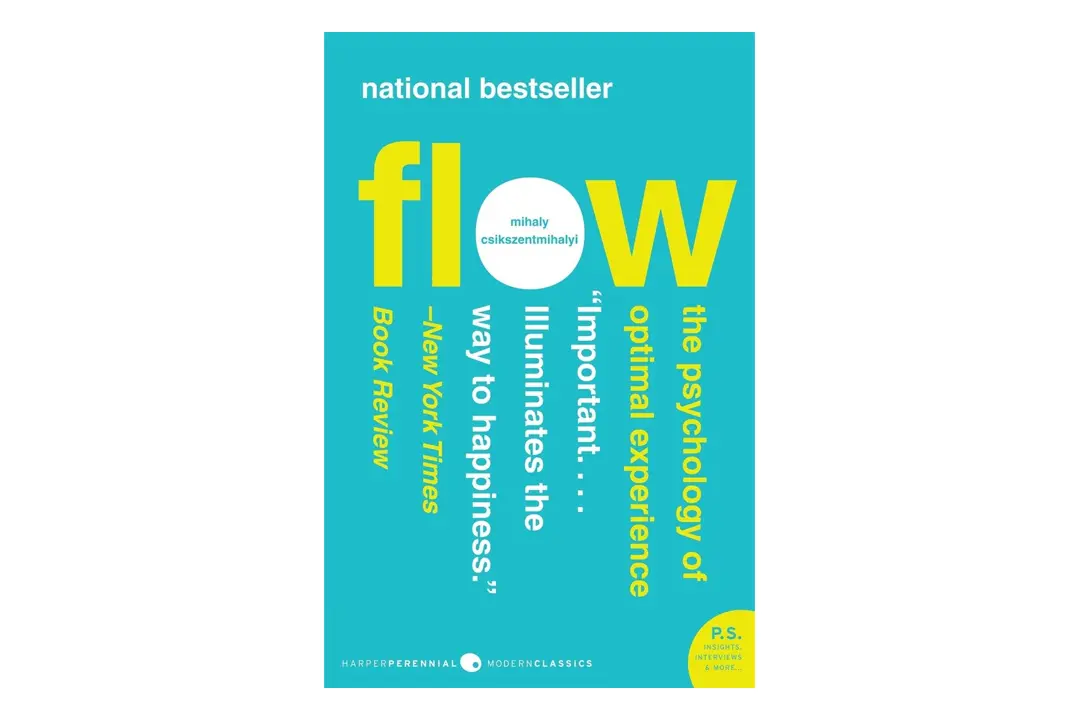
Flow by Mihaly Csikszentmihalyi: Book Summary
Beverly Ashford • 19 Mar 2026 • 81 views • 3 min read.Let me tell you about the book that will make you reconsider whether you actually want what you think you want — and give you a more useful target to aim at instead. Mihaly Csikszentmihalyi — pronounced cheeks-sent-me-high, which he acknowledged was a burden — published Flow: The Psychology of Optimal Experience in 1990. He was a psychology professor at the University of Chicago who had spent thirty years studying a deceptively simple question: when do people feel most alive? He did not find the answer where most people look. Not in leisure, not in relaxation, not in the absence of demands. He found it in complete absorption in a challenging task — in the state he called flow, where skill meets challenge at exactly the right level and the self temporarily dissolves into the activity. The book is not a self-help manual with five steps to happiness. It is a sustained philosophical and empirical argument about what optimal human experience actually consists of and why the way most people are pursuing it is systematically pointed in the wrong direction.
Flow by Mihaly Csikszentmihalyi: Book Summary
Quick Summary:
- A Hungarian-American psychologist spent decades studying optimal human experience and found that happiness is not what most people think it is
- Published in 1990, it introduced the concept of flow — the state of complete absorption in a challenging activity — to mainstream psychology and culture
- Csikszentmihalyi's central claim: pleasure fades, but the deep satisfaction of mastery and engagement endures
- A book that reframes what a good life actually looks like — and why most people are pursuing the wrong thing
The Research Behind Flow
Csikszentmihalyi developed an unusual research method called the Experience Sampling Method. He gave participants electronic pagers — this was the 1970s and 1980s — that beeped at random intervals throughout the day. When the pager went off, participants recorded what they were doing, who they were with, and how they felt. Over thousands of data points across thousands of participants, patterns emerged.
The finding that drove the entire book was counterintuitive. People consistently reported feeling better — more engaged, more creative, more satisfied — when they were working on challenging tasks than when they were relaxing. Watching television, one of the most common leisure activities, produced some of the lowest reported mood and engagement scores. Difficult work that stretched capabilities produced some of the highest.
This contradicted the widespread assumption that happiness means the absence of demands. People said they wanted to relax. But when they were relaxing, they often felt worse than when they were working on something hard.
What Flow Actually Is
Flow is the state of complete immersion in a challenging activity that perfectly matches your current skill level. Csikszentmihalyi identifies eight characteristics that describe it.
Complete concentration on the task. Clarity of goals and immediate feedback. The activity feels intrinsically rewarding — you do it for its own sake, not for external reward. Effortlessness despite high effort — actions feel automatic and fluid. The sense of personal control over the situation. Time distortion — hours pass like minutes or seconds stretch. The loss of self-consciousness — the ego temporarily disappears into the activity. The merging of action and awareness — you are not watching yourself do the thing, you are doing it.
Chess players, surgeons, rock climbers, musicians, athletes, factory workers, and assembly line employees all describe flow in remarkably similar terms across cultures. The content of the activity is irrelevant. The structure is what matters.
The Challenge-Skill Balance
The most practically useful concept in the book is the relationship between challenge and skill. Flow occurs in a specific zone — when the challenge of an activity is matched to your current level of skill. Too easy, and you get boredom. Too hard, and you get anxiety. The sweet spot between boredom and anxiety is where flow lives.
This has immediate practical implications. Activities stop being engaging not because they become boring in some fixed sense, but because your skills have grown past the challenge level they offer. The beginner chess player finds every game absorbing. The grandmaster finds casual games with beginners tedious. The grandmaster needs harder opponents to find the same engagement.
Csikszentmihalyi argues that this is why passive consumption — television, social media, easy entertainment — rarely produces flow. The challenge level is too low relative to the viewer's actual cognitive capacity. The result is not rest but a kind of psychic entropy — a diffuse, low-grade dissatisfaction that feels like nothing in particular but accumulates into a life that feels somehow insufficient.
Pleasure vs Enjoyment
One of the book's most important distinctions is between pleasure and enjoyment. Most people use these words interchangeably. Csikszentmihalyi argues they describe fundamentally different experiences.
Pleasure is the satisfaction of biological or culturally programmed needs — food, sex, comfort, entertainment. It is passive, requires no effort, and fades quickly. Pleasure is necessary and fine. It is not sufficient.
Enjoyment is what happens during flow — the sense of novelty, accomplishment, and forward movement that comes from doing something difficult well. Enjoyment requires effort. It requires skill engaged with challenge. It is active rather than passive. And unlike pleasure, it leaves a lasting residue — you are slightly different, slightly more capable, slightly more complex after an experience of genuine enjoyment.
A good life, Csikszentmihalyi argues, is built primarily from enjoyment rather than pleasure. This requires structuring your time to maximize flow experiences — which means pursuing activities with escalating challenge levels, developing skills deeply, and spending less time in passive consumption that feels like rest but produces psychic entropy.
Flow Beyond Work
The book's later chapters argue that flow is available in almost any domain — not just obvious candidates like sport and art. Csikszentmihalyi profiles people who find flow in conversation, in cooking, in solitary walking, in relationships built around shared challenge and growth.
The common thread is the structure: clear goals, immediate feedback, challenge matched to skill, intrinsic motivation. These elements can be introduced into activities that might not seem like flow candidates. A factory worker who treats assembly as a game — setting personal speed records, finding more efficient movements, tracking improvement — can find flow in work that seems objectively monotonous. The activity does not determine the possibility of flow. The orientation does.
This is the book's most demanding argument. It places significant responsibility on the individual to construct their experience rather than waiting for the right circumstances to produce it. Flow is not something that happens to you. It is something you create, through the deliberate structuring of attention and challenge.
States of Experience Compared
| State | Challenge Level | Skill Level | Subjective Experience | Common Triggers |
|---|---|---|---|---|
| Flow | High | High — matched to challenge | Energized, focused, time distorted, selfless | Deep work, sport, music, creative tasks |
| Arousal | High | Medium | Engaged but slightly stressed, learning fast | Slightly above current comfort zone |
| Anxiety | High | Low | Overwhelmed, self-conscious, avoidant | Task far exceeds current skill |
| Control | Low | High | Comfortable, relaxed, not challenged | Familiar tasks below current ability |
| Boredom | Low | High — exceeds challenge | Restless, disengaged, looking for exit | Repetitive tasks with no escalation |
| Relaxation | Low | Low | Pleasant but unproductive, passive | Rest, easy entertainment |
| Apathy | Low | Low | Flat, unmotivated, dissatisfied | Passive consumption, aimless time |
Frequently Asked Questions
Is flow the same as being in the zone?
Yes — the athletic phrase describes the same phenomenon Csikszentmihalyi studied systematically. Athletes, musicians, and performers have recognized the state intuitively for centuries. Csikszentmihalyi gave it a name, studied its structure, and showed it operates across all domains of human activity.
Can flow be forced or scheduled?
Not directly — you cannot decide to enter flow the way you decide to check email. But you can create the conditions that make flow more likely: remove distractions, set clear goals, choose tasks at the right challenge level, and allow enough uninterrupted time for immersion to develop. Flow becomes more frequent with practice partly because skilled practitioners are better at creating these conditions.
How does this relate to mindfulness?
They overlap but are distinct. Mindfulness involves non-judgmental present-moment awareness, often cultivated through stillness and meditation. Flow is active absorption in a challenging task — present-moment awareness achieved through engagement rather than stillness. Both reduce self-referential thinking and produce subjective wellbeing. They get there differently.
Is the book dated given it was published in 1990?
The core research and conceptual framework have held up remarkably well. The specific examples and cultural references feel their age. The challenge-skill model, the experience sampling research, and the distinction between pleasure and enjoyment remain among the most useful frameworks in positive psychology. More recent research has refined rather than overturned Csikszentmihalyi's core findings.
Does flow apply to social activities or only solitary ones?
Both. Csikszentmihalyi profiles flow in conversation, team sport, ensemble music, and collaborative work. The structural requirements are the same — clear goals, immediate feedback, challenge matched to skill — but they can be satisfied through interaction as well as through solitary activity. Some people find social flow easier to access than solitary flow.
What should I read next?
Peak by Anders Ericsson covers deliberate practice — the specific training method most likely to develop the skills that make flow accessible at higher challenge levels. Deep Work by Cal Newport applies related ideas to knowledge work specifically. The Rise of Superman by Steven Kotler examines flow states in extreme athletes and argues for specific triggers that accelerate access to flow.
The Bottom Line
Here is what Mihaly Csikszentmihalyi actually found after thirty years of studying when human beings feel most alive.
Not during vacation. Not during relaxation. Not when demands are absent and comfort is complete.
During the moments when skill meets challenge at exactly the right level and the self dissolves into the activity. During the hours when you forget to check your phone because the problem in front of you has consumed your entire attention. During the work that leaves you tired and satisfied rather than exhausted and empty.
Pleasure is easy and fades. Enjoyment is hard and accumulates. The good life is not built from maximizing the first. It is built from structuring enough of the second.
This requires choosing difficulty over comfort more often than feels natural. It requires developing skills past the point of competence into genuine mastery. It requires spending less time consuming and more time creating, practicing, and engaging with challenges that actually stretch you.
Most people know, intuitively, that their most alive moments were not their easiest ones.
Csikszentmihalyi spent thirty years explaining why.
The answer is flow.
And flow is available to anyone willing to earn it.