
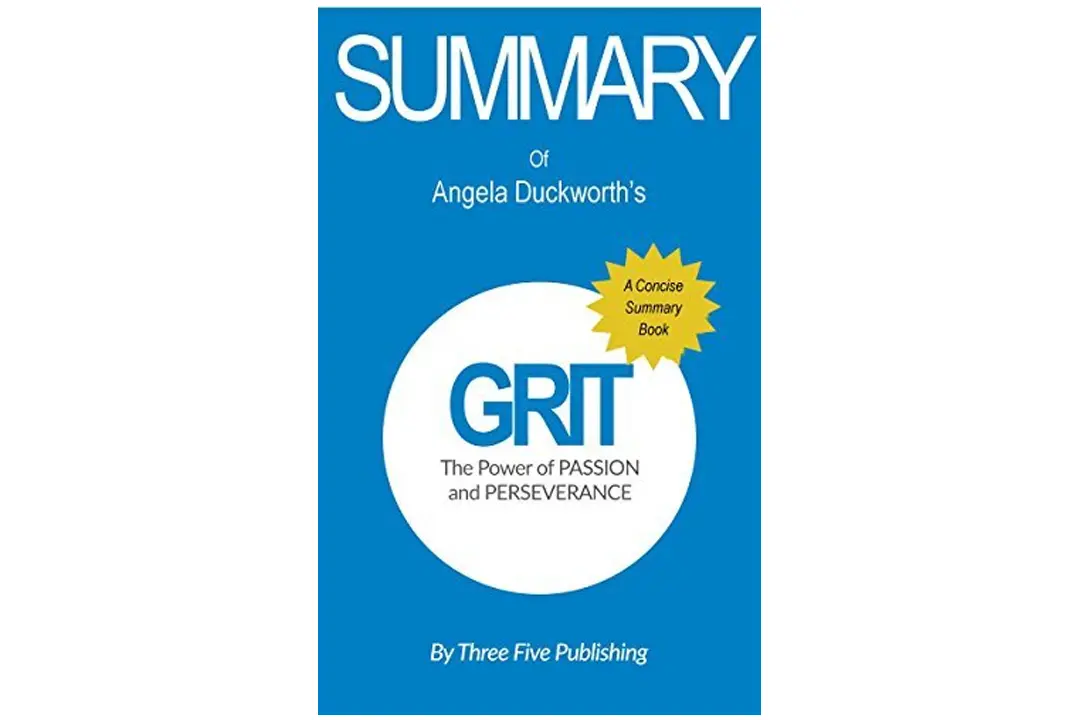
Grit by Angela Duckworth: Book Summary
Beverly Ashford • 06 Mar 2026 • 167 views • 3 min read.Let me tell you about the book that made talent feel overrated and consistency feel underrated — which is either deeply motivating or deeply annoying depending on how you feel about hard work. Angela Duckworth published Grit in 2016. She is a psychologist at the University of Pennsylvania who left a demanding consulting career to teach math to seventh graders in New York City public schools. What she noticed in the classroom became the seed of a decade of research: the students who succeeded were not always the smartest ones. They were the ones who kept going. Duckworth eventually won a MacArthur Genius Grant for her research on grit. She is aware of the irony of winning a genius award for work arguing that genius is overrated. She mentions it in the book.
Grit by Angela Duckworth: Book Summary
Quick Summary:
- A psychologist argues that passion combined with perseverance predicts success better than talent alone
- Published in 2016, it became the counterargument to the talent-obsessed culture of elite institutions
- Duckworth spent years studying West Point cadets, National Spelling Bee finalists, and salespeople to build her case
- The uncomfortable finding: talent without effort counts for less than most people assume — and effort counts twice
The Core Argument
Duckworth opens with a question she heard constantly at McKinsey and later in academia: what makes someone a natural? The assumption embedded in the question is that talent is the primary driver of achievement. Her research says otherwise.
She proposes two simple equations that reframe everything:
Talent multiplied by effort equals skill. Skill multiplied by effort equals achievement.
Effort appears twice. Talent appears once. This means that for any given level of talent, effort matters twice as much in determining what you ultimately achieve. A moderately talented person who works consistently will outperform a highly talented person who does not — and the gap widens over time.
Grit, as Duckworth defines it, is the combination of passion and perseverance toward long-term goals. Not the passion of momentary excitement. Not the perseverance of white-knuckling through something you hate. The specific combination of caring deeply about where you are going and being willing to sustain effort toward it over years.
What Grit Actually Looks Like
Duckworth is careful to distinguish grit from stubbornness. Gritty people are not people who refuse to quit anything regardless of circumstances. They are people who maintain commitment to their top-level goal while remaining flexible about strategies and lower-level goals. A gritty musician might switch teachers, try different practice methods, and experiment with genres — while never wavering on the commitment to mastering their instrument.
She introduces the concept of the passion hierarchy. At the bottom are moment-to-moment interests — things that capture attention briefly. In the middle are medium-term goals — projects and skills pursued over months or years. At the top is what Duckworth calls the ultimate concern — the organizing purpose that gives the lower levels meaning and direction.
Most people have the bottom two layers. Gritty people have all three, and they know which layer is which.
The West Point Data
The most compelling evidence in the book comes from West Point Military Academy. Every summer, a class of roughly 1,300 new cadets arrives for Beast Barracks — seven weeks of intensive physical, academic, and military training designed to be as demanding as possible. Between five and twelve percent of each class drops out during this period alone.
Psychologists had tried for years to predict who would make it through Beast Barracks. They used SAT scores, class rank, physical fitness ratings, and leadership assessments — a composite score West Point calls the Whole Candidate Score. It did not predict completion.
Duckworth administered a Grit Scale — a twelve-item questionnaire measuring consistency of interest and perseverance of effort — to incoming cadets. Grit predicted completion better than the Whole Candidate Score. Not because physical fitness and academic achievement did not matter. They did. But grit captured something those measures missed: the willingness to keep going when everything is telling you to stop.
She found similar patterns in National Spelling Bee finalists, sales teams, and teachers working in low-income schools. In every domain, grit predicted outcomes that talent measures alone could not.
Can Grit Be Developed?
This is the question the second half of the book addresses. Duckworth's answer is yes — carefully and with specific conditions.
Interest comes first. You cannot sustain effort toward something you do not genuinely find interesting. Passion is not discovered fully formed. It develops through exposure, experience, and repeated engagement. Most people give up on interests too early — before the initial excitement has had time to deepen into genuine passion. Duckworth argues you have to give interests more time than feels natural.
Practice is the second component. Deliberate practice specifically — the kind that targets weaknesses, operates at the edge of current ability, and incorporates feedback. Gritty people practice more than others. They also practice differently — with more intention and more willingness to focus on what is hard rather than what feels comfortable.
Purpose deepens grit. Connecting your work to something beyond personal achievement — contribution, meaning, impact on others — sustains effort through periods where interest alone is insufficient. Research on job crafting shows that people in almost any role can find connections between their daily work and something larger. The connections are not always obvious. Finding them requires effort. But they are almost always there.
Hope holds everything together. Not optimism as a personality trait. Duckworth means a specific cognitive habit — the belief that your actions matter, that effort produces change, that failure is information rather than verdict. This is learnable. Carol Dweck's growth mindset research, which Duckworth discusses extensively, shows that teaching children that ability is expandable rather than fixed changes their relationship to failure and persistence.
Grit Components Compared
| Component | What It Means | How It Develops | What Undermines It |
|---|---|---|---|
| Interest | Genuine curiosity about your field | Exposure, time, repeated engagement | Switching focus too quickly |
| Deliberate Practice | Targeted effort at the edge of ability | Structured feedback, working on weaknesses | Practicing what is already comfortable |
| Purpose | Connection to something beyond yourself | Reflection, job crafting, mentorship | Purely self-focused goals |
| Hope | Belief that effort produces change | Growth mindset, reframing failure | Fixed mindset, helplessness |
| Passion | Sustained direction over years | Deepening of initial interest over time | Confusing excitement with commitment |
| Perseverance | Continuing through setbacks | Building evidence that effort works | Early quitting before evidence accumulates |
Frequently Asked Questions
Does grit mean never quitting?
No, and Duckworth is explicit about this. Quitting lower-level goals — a specific strategy, a particular role, a current approach — is often the right move. Grit operates at the level of your ultimate concern. The question is not whether to quit this job but whether quitting moves you toward or away from your top-level purpose.
How does this relate to Gladwell's 10,000-hour rule?
They are compatible but distinct. Gladwell focuses on the opportunity to accumulate practice hours and the circumstances that enable it. Duckworth focuses on the psychological qualities that sustain practice over time. Both matter. Opportunity without grit produces unused potential. Grit without opportunity produces effort without traction.
Has the grit research held up?
The core findings on grit predicting outcomes have replicated reasonably well. Some critics argue the Grit Scale measures conscientiousness — a well-established personality trait — and does not add much beyond what existing measures already capture. Duckworth acknowledges ongoing debate. The framework remains useful even if the measurement is contested.
Is this just telling people to try harder?
That is the most common criticism and Duckworth addresses it directly. She is not arguing that effort solves everything or that disadvantaged people just need to work harder. She explicitly discusses the role of environment, parenting, coaching, and culture in developing grit. Individual grit operates within systems that either support or undermine it.
What is the Grit Scale?
A twelve-item self-assessment measuring consistency of interest and perseverance of effort on a five-point scale. Duckworth includes it in the book and it is available free on her website. Most people score lower than they expect on consistency of interest — the passion component is harder to sustain than the perseverance component for most adults.
What should I read next?
Mindset by Carol Dweck is the natural companion — it provides the psychological foundation for why effort-based thinking works. Peak by Anders Ericsson goes deeper on deliberate practice than either Gladwell or Duckworth. Range by David Epstein offers a useful counterpoint about the value of breadth and late specialization.
The Bottom Line
Here is what Angela Duckworth actually found.
Talent is real. It matters. Nobody is arguing otherwise. But talent is the starting point, not the destination — and the gap between where talent starts and where achievement ends is filled almost entirely by effort sustained over time.
The people who win the Spelling Bee are not the most linguistically gifted children in America. They are the ones who practiced more deliberately and kept going longer. The West Point cadets who survive Beast Barracks are not the most physically gifted. They are the ones who decided, when everything hurt and quitting was completely reasonable, to keep going anyway.
Grit does not guarantee success. Nothing does. But grit, applied consistently toward something that genuinely matters to you, produces results that talent alone almost never matches.
Effort counts twice.
That is either the most encouraging or the most demanding sentence you will read today.
Probably both.