
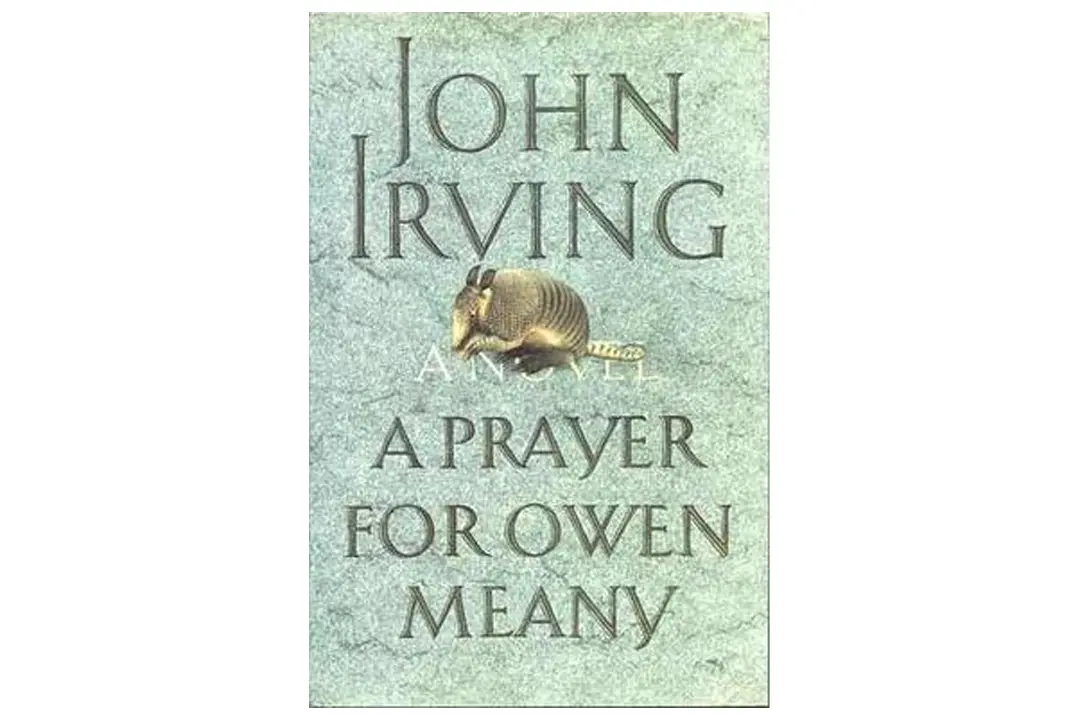
A Prayer for Owen Meany by John Irving: Book Summary
Beverly Ashford • 13 Mar 2026 • 81 views • 2 min read.Let me tell you about the novel that will make you cry on a Tuesday afternoon and then think about it for the rest of the week. John Irving published A Prayer for Owen Meany in 1989. It tells the story of two boys growing up in a small New Hampshire town — John Wheelwright, the narrator, and Owen Meany, the strangest and most unforgettable character in American fiction. Owen is tiny, speaks in a voice so odd that Irving writes all his dialogue in capital letters, and is absolutely certain that he is God's instrument on earth. The novel is funny, then heartbreaking, then funny again, then completely devastating. Irving earns every emotional moment. Nothing is cheap.
A Prayer for Owen Meany by John Irving: Book Summary
Quick Summary:
- A small, unusual boy believes he is God's instrument — and he might be right
- Set across 1950s New Hampshire and the Vietnam era, it's about faith, destiny, and friendship
- Published in 1989, it remains one of the most emotionally devastating novels in American literature
- Not a religious book — it's a book about what it means to believe in something
The Setup
John Wheelwright grows up in Gravesend, New Hampshire, in the 1950s. His mother is beautiful and unmarried — he does not know who his father is. His best friend is Owen Meany, the son of a granite quarry owner, a boy so small he can be lifted by other children, with a voice described as a permanent fingernail on a chalkboard.
Owen believes he is an instrument of God. Not in a quiet, humble way. He is completely certain. He has seen his own name on a gravestone in a dream. He knows when he will die. He knows what his death will mean.
In the summer of 1953, Owen hits a foul ball during a Little League game. The ball strikes John's mother and kills her instantly. Owen never recovers from this. John never recovers from this. The novel is built on that single moment and everything that radiates outward from it.
The Long Middle
Irving structures the novel across decades. John narrates from 1987 Canada, where he is an embittered expatriate who left America in protest of the Vietnam War. He writes about the past to understand the present.
The two boys grow up together through prep school, into the 1960s, into the draft lottery, into the war. Owen enlists. John does not — Owen deliberately injures John's hand to keep him out of the military. He has a reason. Everything Owen does has a reason, even if John cannot see it yet.
The novel's central tension is religious and philosophical. John begins the book without faith. He ends it believing — not because Owen told him to, but because of what he witnessed. Irving is asking the hardest question: what would it actually take to convince you that God is real and operating in the world? His answer is: this. It would take something exactly like this.
The Ending
Here is what you need to know without knowing everything.
Owen's certainty about his death is correct. The manner of it, when it comes, is something Irving has been preparing you for across five hundred pages without you realizing it. A specific action — rehearsed as a joke, as a game, as something silly — turns out to be the thing that matters most.
When it arrives, you will have seen it coming and it will still destroy you. That is the craft. Irving plants everything in plain sight. The emotional impact is not from surprise. It is from recognition.
What the Book Is Really About
Faith is the obvious answer. But the book is really about what friendship can witness and survive. John's faith does not come from theology. It comes from knowing Owen Meany — from watching one person live with absolute conviction and follow it to its conclusion.
The Vietnam War runs through the second half as both backdrop and moral argument. Irving is specific and angry about American foreign policy in a way that still lands. John's exile in Canada is not abstract protest. It is the only response he has left.
The mystery of John's father — who is he, why did his mother never tell — is a long subplot that Irving resolves in a way that is both surprising and oddly satisfying. It connects to faith in a way that feels earned rather than convenient.
Character Comparison Table
| Character | Role | Core Quality | Arc |
|---|---|---|---|
| Owen Meany | John's best friend | Absolute certainty about his destiny | Fulfills it completely |
| John Wheelwright | Narrator | Doubt, loyalty, grief | Finds faith through witnessing Owen |
| Tabitha Wheelwright | John's mother | Warmth, secrecy | Dies early; her absence drives everything |
| Dan Needham | John's stepfather | Decency, patience | Steady presence across decades |
| Rev. Merrill | The local minister | Public faith, private doubt | Forced to confront his own belief |
| Hester | Owen's cousin | Passion, anger | Survives, broken by loss |
| John's Father | The mystery | Complicated faith | Revealed late; connects everything |
Frequently Asked Questions
Is this a Christian novel?
It engages seriously with Christianity — Episcopal and Catholic traditions both appear — but Irving is not writing a devotional text. The book interrogates faith rather than promoting it. Readers without religious belief find it just as powerful as those with it.
Why does Owen speak in capital letters?
Irving wanted his voice to feel physically different on the page — permanent, insistent, impossible to ignore. It works. Owen's dialogue feels like it arrives at a different volume than everything else in the novel.
Is it really that sad?
Yes. The ending is one of the most emotionally forceful in American literary fiction. Irving earns it across five hundred pages of carefully placed setup. You will see it coming and it will still hit hard.
How long is it?
Around 620 pages in most editions. It does not feel long. Irving's prose is readable and the structure moves. Give yourself two weeks and you will be fine.
Is the film adaptation worth watching?
Simon Birch (1998) is loosely based on the novel but strips out most of the Vietnam material and the religious complexity. It is a very different experience. Read the book first — or instead.
What should I read next?
If you want more Irving, The World According to Garp is the natural next step — funnier, stranger, equally emotional. If you want another novel about faith and fate written in long form, try Gilead by Marilynne Robinson, which asks similar questions in a quieter register.
The Bottom Line
Here is what John Irving actually built.
A novel that starts as a coming-of-age story in a New England town and slowly reveals itself to be an argument about whether meaning exists in the universe. Owen Meany believes it does — completely, without hesitation, to the end.
John Wheelwright spends thirty years deciding whether Owen was right.
The evidence Irving presents is meticulous and devastating. By the final pages, you will have your own answer.
It will not be a comfortable one. But it will be real.