
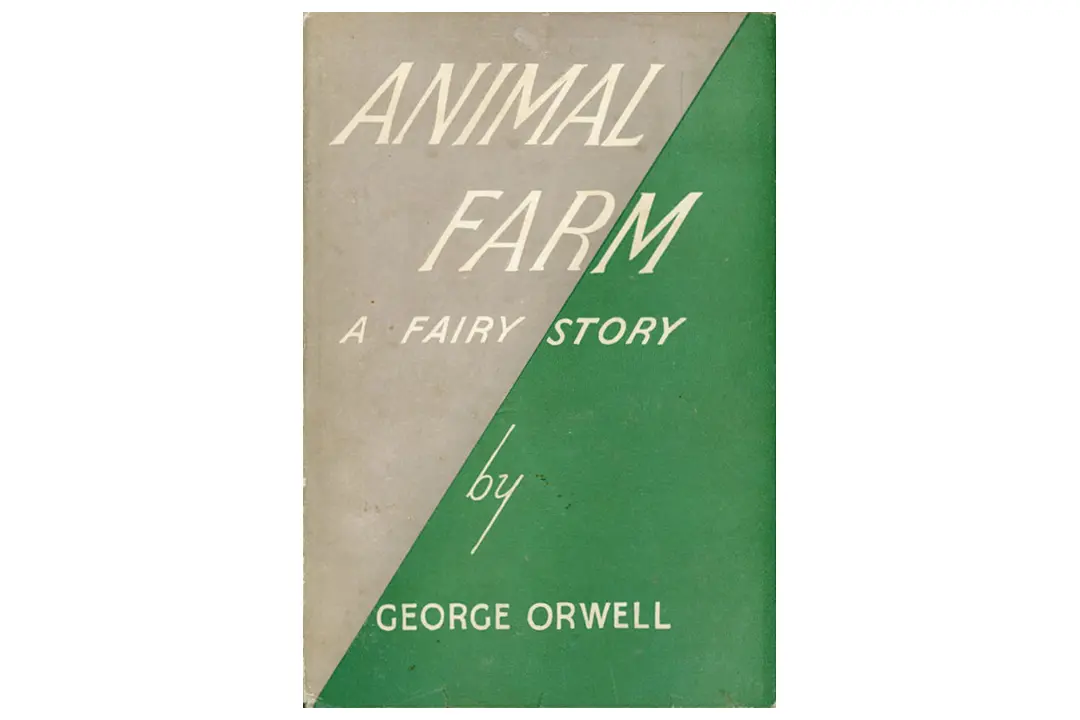
Animal Farm by George Orwell: Book Summary
Beverly Ashford • 19 Mar 2026 • 94 views • 3 min read.Let me tell you about the book that was rejected by T.S. Eliot at Faber and Faber, dismissed by Victor Gollancz as too anti-Soviet, and turned down by Jonathan Cape on advice from the British Ministry of Information — and then became one of the most widely read political allegories in the history of literature. George Orwell wrote Animal Farm in 1943 and 1944 while working at the BBC and watching with growing fury as the British left refused to criticize Stalin's Soviet Union because it was fighting Nazi Germany. The willingness to overlook atrocity for the sake of political alliance — and the capacity of intellectuals to rationalize that willingness — enraged him. He decided to write about it in a form that no publisher could claim was too complicated for the public to understand. He would use farm animals. He would keep it short. He would make the allegory so clear that anyone who defended the book's villains would be defending something they could no longer pretend was defensible. It took him three months to write. It took eighteen months to find a publisher willing to print it. It has been in print continuously since 1945.
Animal Farm by George Orwell: Book Summary
Quick Summary:
- A satirical fable in which farm animals overthrow their human farmer, establish a utopian society, and watch it collapse into tyranny worse than what they started with
- Published in 1945 after being rejected by multiple publishers who feared offending the Soviet Union — a wartime ally
- Orwell's central argument: revolutionary idealism does not fail because the wrong people lead it — it fails because power itself corrupts the people who hold it
- One of the most efficiently devastating political novels ever written, at just over one hundred pages
The Setup
Manor Farm is run by Mr. Jones, a neglectful, frequently drunk farmer who underfeeds his animals and takes everything they produce. Old Major — a prize-winning boar, elderly and respected — calls a meeting one night and delivers a speech about the condition of animals under human domination. Animals labor. Humans consume. Animals are slaughtered when they are no longer useful. The solution, Old Major argues, is rebellion. He teaches the animals a song called Beasts of England — a revolutionary anthem — and dies three days later.
The rebellion happens sooner than anyone planned. Jones forgets to feed the animals for an entire day. They break into the feed store. Jones and his men try to whip them back into submission. The animals turn on the humans and drive them off the farm.
Manor Farm becomes Animal Farm. The pigs, being the most intelligent animals, take charge of organizing the new society. They paint the Seven Commandments of Animalism on the barn wall:
Whatever goes upon two legs is an enemy. Whatever goes upon four legs, or has wings, is a friend. No animal shall wear clothes. No animal shall sleep in a bed. No animal shall drink alcohol. No animal shall kill any other animal. All animals are equal.
These commandments are the heart of the allegory. Watch what happens to each of them.
The Revolution Corrupts
The pigs — led initially by two boars named Snowball and Napoleon — are not villains from the beginning. Snowball is genuinely idealistic, a capable organizer and visionary who designs a windmill that could electrify the farm and reduce everyone's labor. Napoleon is more political, less interested in ideas, and from an early stage more interested in power than in the revolution's stated goals.
Napoleon secretly raises a litter of puppies, training them in isolation. When Snowball presents his windmill plans to the assembled animals, Napoleon signals — nine enormous dogs charge in and chase Snowball off the farm. Napoleon is now in control. There will be no more debates. Decisions will be made by the pigs and announced to the other animals.
From this point, the novel is about the mechanics of how a ruling class consolidates power and rewrites history to justify what it has done.
Squealer — Napoleon's propaganda minister, a pig of extraordinary verbal ability — explains every reversal, every broken promise, every increase in pig privilege as necessary for the revolution's survival. The animals almost always accept these explanations. They cannot remember the past clearly enough to contradict them. Boxer the horse — the novel's most heartbreaking figure — responds to every difficulty with the same two maxims: I will work harder, and Napoleon is always right.
The Commandments Rewrite Themselves
Orwell's most devastating structural device is the gradual revision of the Seven Commandments. Each time the pigs violate one — sleeping in beds, drinking alcohol, killing other animals, trading with humans — Squealer adjusts the relevant commandment in the night so it no longer says what the animals remember it saying.
No animal shall sleep in a bed becomes No animal shall sleep in a bed with sheets. No animal shall drink alcohol becomes No animal shall drink alcohol to excess. No animal shall kill any other animal becomes No animal shall kill any other animal without cause.
The animals look at the barn wall. They see the revised commandment. They wonder if they misremembered. Squealer confirms that they did. They accept the correction and return to work.
This is Orwell's portrait of how authoritarian systems manage memory — not by prohibiting people from remembering the past but by creating enough uncertainty about what the past actually was that people cannot confidently contradict the official version.
The final revision comes at the novel's end, when all seven commandments have been erased and replaced with a single sentence:
All animals are equal, but some animals are more equal than others.
Boxer's Fate
No element of the novel has produced more grief in readers across eighty years than what happens to Boxer.
Boxer is the farm's most dedicated worker — a cart horse of enormous strength and absolute loyalty who has given everything to the revolution without reservation or complaint. When he collapses from overwork, too injured to continue, Napoleon arranges for him to be taken away in a van. The animals watch the van leave. Benjamin the donkey — the novel's cynic, who sees everything clearly and says almost nothing — reads the words on the side of the van aloud.
It is from a horse slaughterer. Napoleon has sold Boxer to be rendered into glue and dog food. Squealer later informs the animals that Boxer died in a hospital, praising Napoleon with his last breath. The hospital, he says, had previously been owned by a horse slaughterer — that is why the van said what it said. The animals accept this explanation. Most of them.
Boxer's fate is the novel's argument about what revolutionary movements do to the people who believe in them most completely and serve them most faithfully.
The Seven Commandments: Before and After
| Original Commandment | Final Revised Version | What the Revision Permitted |
|---|---|---|
| No animal shall sleep in a bed | No animal shall sleep in a bed with sheets | Pigs move into the farmhouse |
| No animal shall drink alcohol | No animal shall drink alcohol to excess | Pigs brew and sell whisky |
| No animal shall kill any other animal | No animal shall kill any other animal without cause | Napoleon's purges of animals accused of disloyalty |
| All animals are equal | All animals are equal, but some animals are more equal than others | Total pig dominance over all other animals |
| Whatever goes upon two legs is an enemy | (Abolished entirely) | Pigs begin walking on two legs and trading with humans |
| Beasts of England (the anthem) | Replaced with a song praising Napoleon specifically | Revolutionary solidarity replaced with personality cult |
Frequently Asked Questions
Is this only about the Soviet Union?
Orwell was specifically targeting Stalinism and the willingness of Western leftists to excuse Soviet atrocities. But the allegory extends to any revolutionary movement that replaces one form of domination with another while using the language of liberation throughout. Readers in countries that have experienced their own versions of this cycle consistently find the novel directly applicable to their own history.
Why are the pigs specifically the ruling class?
Orwell chose pigs for their intelligence and their traditional association in English culture with greed and selfishness. The choice is also satirically precise — the animals who lead the revolution against human exploitation become, step by step, indistinguishable from the humans they replaced. The final scene, in which the other animals look through the farmhouse window and cannot tell the pigs from the men, is the novel's last and most complete image.
What does Benjamin the donkey represent?
Benjamin is the novel's most debated figure. He is the oldest animal on the farm, the most perceptive, and the most consistently silent. He sees what is happening, says almost nothing, and changes nothing. He represents the intellectual who understands a system's corruption clearly but does not act on that understanding — whether from cynicism, self-protection, or the belief that nothing can be done. His one moment of action comes too late to save Boxer, and he knows it.
Why did publishers reject it?
Multiple publishers declined Animal Farm in 1943 and 1944, primarily because the Soviet Union was a British ally in World War II and a fable directly satirizing Stalin was considered politically damaging. Victor Gollancz refused it outright. Jonathan Cape initially accepted and then withdrew after consulting with the British Ministry of Information. T.S. Eliot at Faber rejected it, writing that the pigs should have been more clearly in the right — a response Orwell found particularly revealing about how willing intellectuals were to defend the powerful.
How long does it take to read?
The novel is approximately thirty thousand words — roughly one hundred pages in most editions. Most readers finish it in two to three hours. The brevity is part of the argument: a political allegory that requires a thousand pages to make its point is asking readers to do work that benefits the author more than the reader. Orwell made his case as efficiently as possible.
What should I read next?
1984 by Orwell is the natural companion — longer, darker, and more technically ambitious, covering totalitarianism through surveillance and psychological control rather than revolutionary betrayal. Darkness at Noon by Arthur Koestler examines Stalinist show trials from the inside and was a direct influence on Orwell. The True Believer by Eric Hoffer analyzes the psychology of mass movements and explains how the Boxers of the world get created and used.
The Bottom Line
Here is what George Orwell built in three months and one hundred pages.
Not a children's story about talking animals, though it has often been shelved with them. A precise, devastating account of how revolutionary movements betray their stated principles — not because the wrong people led them, but because the structure of power itself produces the betrayal regardless of who holds it.
The animals wanted freedom from Jones. They got Napoleon. The commandments promised equality. They ended with some animals being more equal than others. Boxer gave everything. He ended in a glue factory.
None of this happened because the pigs were secretly evil from the beginning. It happened incrementally, each step justified by necessity, each justification accepted by animals who could not quite remember what the previous version of the rules had said.
Orwell's warning is not about communism specifically. It is about the human — and apparently animal — capacity to accept each individual step of a descent because each individual step seems small.
The barn wall gets repainted in the night.
By morning, everyone remembers it always said what it says now.
That is how it works.
That is how it has always worked.