
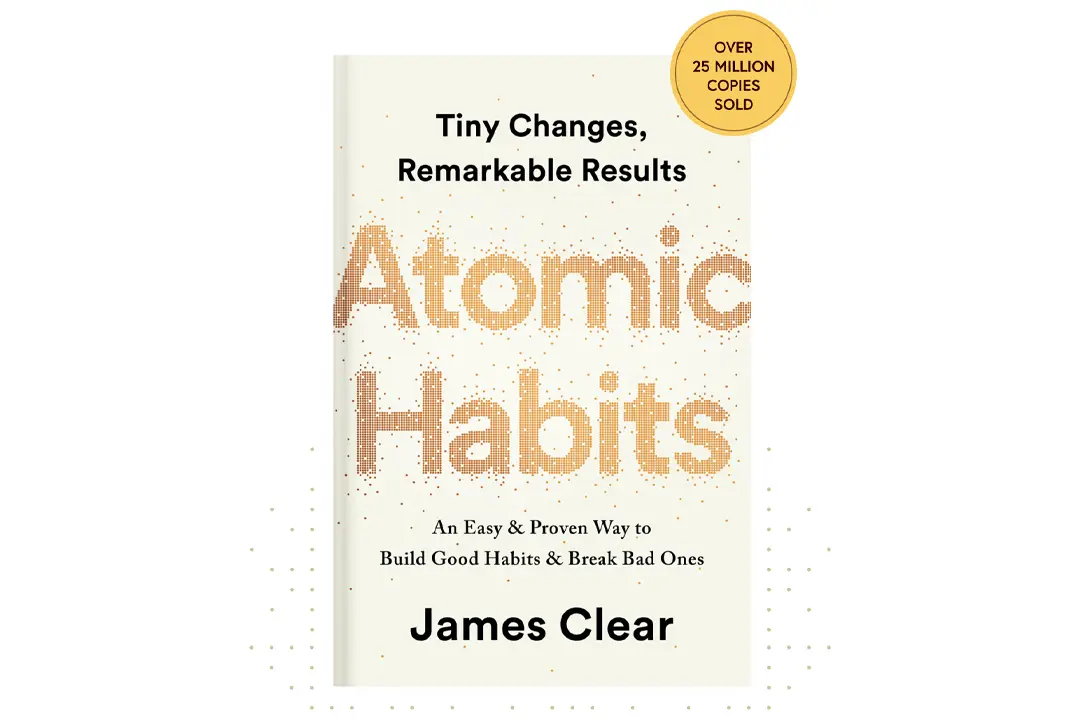
Atomic Habits – James Clear: Book Summary
Beverly Ashford • 11 Mar 2026 • 75 views • 3 min read.Let me tell you why this book succeeded where so many others failed. Self-help books about habits aren't new. We've had The Power of Habit, The 7 Habits of Highly Effective People, dozens more. The shelf is crowded. So why did James Clear's book sell over 15 million copies and become the habit book? Because he made it simple. Not dumbed down—simple. Clear takes behavioral science, strips away the jargon, and gives you a system you can actually use. No willpower worship. No transformation promised in 21 days. Just practical mechanics for how habits actually work. I've read most of the habit books. This is the one I actually use.
Atomic Habits – James Clear: Book Summary
Quick Summary:
- Tiny changes compound into remarkable results over time
- Habits shape identity, not just outcomes
- The Four Laws provide a framework for building any habit
- Published in 2018, it became the definitive guide to behavior change
The Core Idea: 1% Better
Clear opens with a math problem that changes how you think about improvement.
If you get 1% better every day for a year, you end up 37 times better by the end. If you get 1% worse every day, you decline to nearly zero.
The math is dramatic. The point is practical: tiny changes compound.
We overvalue dramatic transformation and undervalue incremental improvement. We want the overnight success story. But real change happens through small adjustments repeated until they become automatic.
That's what habits are—behaviors repeated enough to become automatic. And automatic behaviors, compounded over years, determine who you become.
Clear's central argument: You don't rise to the level of your goals. You fall to the level of your systems.
Everyone has goals. Winners and losers have the same goals. The difference is the systems—the daily habits that either move you forward or keep you stuck.
Identity-Based Habits
Here's where Clear diverges from most habit advice.
Most approaches focus on outcomes: lose 20 pounds, write a book, run a marathon. The problem? Outcome-based habits rely on motivation and willpower, which fluctuate.
Clear proposes identity-based habits instead.
Don't aim to run a marathon. Aim to become a runner. Don't aim to write a book. Aim to become a writer. Don't aim to lose weight. Aim to become someone who values health.
The shift is subtle but powerful. Every action becomes a vote for the type of person you want to be. When you choose the salad over the burger, you're not just eating healthy—you're casting a vote for being a healthy person. Votes accumulate into identity.
The goal isn't to read a book. It's to become a reader. The goal isn't to meditate. It's to become someone who meditates.
Identity drives behavior more reliably than motivation. You act consistently with how you see yourself.
The Four Laws of Behavior Change
Clear provides a framework that applies to any habit you want to build or break.
Every habit follows a loop: Cue → Craving → Response → Reward
The Four Laws map to this loop:
1. Make it Obvious (Cue)
You can't build a habit you don't notice. Design your environment so the cue is unavoidable.
Want to read more? Put a book on your pillow. Want to eat fruit? Put a bowl on the counter. Want to exercise? Sleep in your workout clothes.
The inverse for breaking bad habits: make it invisible. Remove the cues. Delete the apps. Hide the junk food.
2. Make it Attractive (Craving)
The more attractive a behavior, the more likely you'll do it.
Temptation bundling pairs something you need to do with something you want to do. Listen to audiobooks only while exercising. Watch your favorite show only while folding laundry.
Join a culture where your desired behavior is normal. Surround yourself with readers to become a reader. Surround yourself with athletes to become athletic. We imitate the habits of three groups: the close, the many, and the powerful.
3. Make it Easy (Response)
Reduce friction for good habits. Increase friction for bad ones.
The Two-Minute Rule: when starting a new habit, it should take less than two minutes. "Read before bed" becomes "read one page." "Exercise daily" becomes "put on workout shoes." You can always do more, but you must be able to start easily.
Environment design matters enormously. If your running shoes are buried in a closet, you won't run. If your guitar is on a stand in the living room, you'll play it.
4. Make it Satisfying (Reward)
We repeat behaviors that feel good. We avoid behaviors that feel bad.
The problem with many good habits: the reward is delayed. The payoff from exercise comes months later. The payoff from eating a cookie comes immediately.
Immediate reinforcement bridges this gap. Track your habits visibly. Give yourself a small reward after completing a habit. Make progress visible so the behavior feels satisfying now, not just eventually.
The Four Laws Framework
| Law | For Building Good Habits | For Breaking Bad Habits |
|---|---|---|
| 1. Cue | Make it obvious | Make it invisible |
| 2. Craving | Make it attractive | Make it unattractive |
| 3. Response | Make it easy | Make it difficult |
| 4. Reward | Make it satisfying | Make it unsatisfying |
Practical Techniques
Beyond the framework, Clear provides specific tactics:
Habit stacking: Link a new habit to an existing one. "After I pour my morning coffee, I will meditate for one minute." The existing habit becomes the cue for the new one.
Implementation intentions: Plan when and where you'll perform a habit. "I will [BEHAVIOR] at [TIME] in [LOCATION]." Specificity increases follow-through dramatically.
Habit tracking: Mark an X on a calendar each day you complete the habit. "Don't break the chain" becomes motivating once you have a streak.
The Goldilocks Rule: Habits stick when they're not too hard, not too easy. You need challenge, but achievable challenge. Boredom kills habits faster than failure.
Never miss twice: You'll miss days. Everyone does. The rule is to never miss two in a row. One miss is an accident. Two misses is the start of a new habit.
What the Book Gets Right
Environment over willpower. Clear repeatedly emphasizes that willpower is limited and unreliable. Designing your environment is more effective than relying on discipline.
Systems over goals. The focus on process rather than outcome is genuinely useful. Goals create a "when I get there" mentality. Systems create "this is who I am" mentality.
Compounding as the core insight. The 1% improvement framing makes patience feel strategic rather than passive. You're not waiting for change—you're accumulating it.
Practical immediacy. The book is full of tactics you can implement today. It's not theory—it's a manual.
Frequently Asked Questions
How long does it take to form a habit?
Clear addresses the "21 days" myth directly—it's not supported by research. Real habit formation depends on the habit's complexity, your consistency, and individual variation. Some habits take weeks, others months. Focus on repetition rather than timeline.
What if I've failed at habits before?
Clear's approach reduces the failure point. Two-minute versions of habits are almost impossible to fail. You build from there. Previous failure usually indicates the habit was too big or the environment wasn't set up correctly.
Is this just for productivity habits?
No. The framework applies to any behavior—health, creativity, relationships, anything you want to make automatic. The principles are universal.
Should I work on multiple habits at once?
Clear recommends focusing on one habit at a time until it's automatic, then adding another. Trying to change everything at once typically means changing nothing.
How is this different from other habit books?
The Four Laws framework is more practical than most. The identity-based approach is more psychological. The writing is clearer and more direct. It synthesizes research into usable advice.
What if my environment is outside my control?
You have more control than you think, but Clear acknowledges constraints. Focus on the pieces you can control. Even small environmental changes matter.
The Bottom Line
Here's what James Clear achieved.
He wrote the most useful book about habits I've encountered. Not the most original—he synthesizes research from many sources—but the most practical. The Four Laws provide a framework you can apply to any behavior immediately.
The deeper insight is about identity. You don't build habits to achieve goals. You build habits to become someone. Each small action is a vote for who you want to be.
Atomic habits aren't insignificant. They're fundamental—the basic building blocks of everything else. Stack enough atoms together and you get a person. Stack enough tiny habits together and you get a life.
Start with something that takes two minutes. Do it every day.
That's it. That's the whole system.