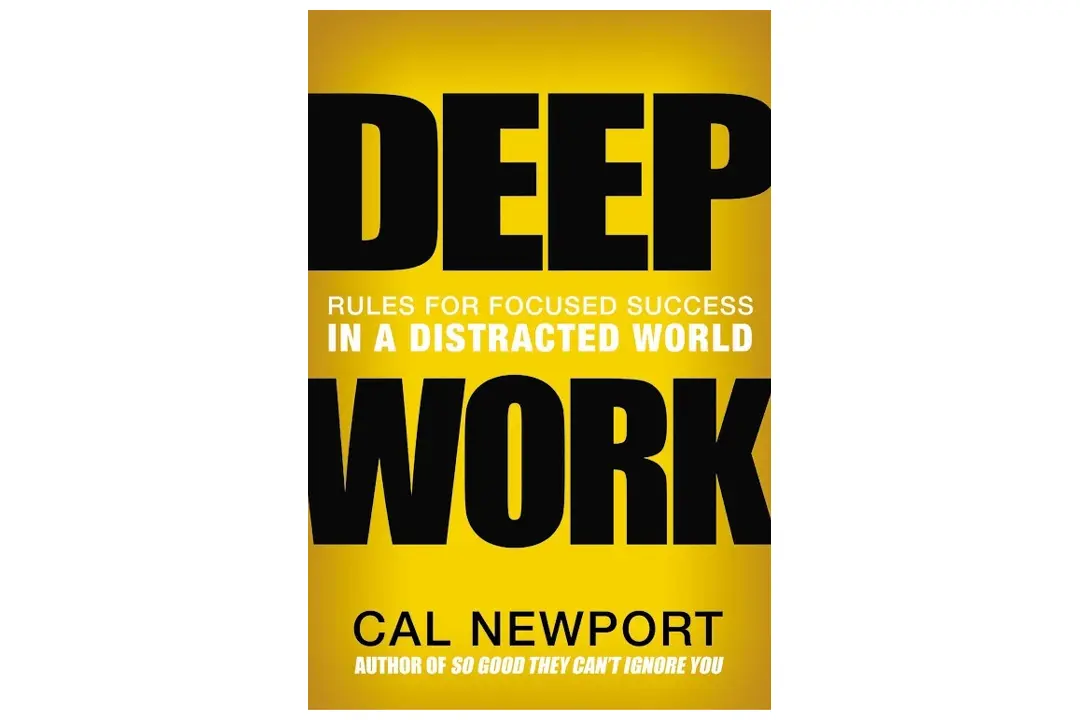
Deep Work by Cal Newport: Book Summary
Beverly Ashford • 13 Mar 2026 • 82 views • 3 min read.Let me tell you about the book that made people quit Slack, block social media, and start treating their calendar like a sacred document — and why most of them were right to do it. Cal Newport published Deep Work in 2016. He is a computer science professor at Georgetown who has never had a social media account and who has, despite this apparent professional handicap, published six books, maintained a popular blog, and built a tenured academic career. He mentions this not to brag but to make a point: the activities most people treat as professional necessities are frequently professional liabilities dressed up as connection. Newport's argument is simple, empirically grounded, and deeply uncomfortable for anyone who has spent the last decade optimizing their inbox response time. The ability to perform deep work — cognitively demanding tasks executed in a state of distraction-free concentration — is becoming rare at precisely the moment it is becoming the primary driver of value in the knowledge economy. The people and organizations that figure this out will have an enormous advantage over the ones that do not.
Deep Work by Cal Newport: Book Summary
Quick Summary:
- A computer science professor argues that the ability to focus without distraction is becoming both increasingly rare and increasingly valuable
- Published in 2016, it diagnosed a problem that most knowledge workers felt but had not named
- Newport's central claim: shallow work is expanding to fill available time while deep work — the kind that actually creates value — is systematically being crowded out
- A book that will make you look at your open-tab, always-on workday and feel genuinely alarmed
The Core Argument
Newport opens with a distinction that frames everything else. Deep work is professional activity performed in a state of distraction-free concentration that pushes cognitive capabilities to the limit, creates new value, improves skill, and is hard to replicate. Shallow work is non-cognitively demanding, logistical-style tasks often performed while distracted — email, meetings, administrative tasks, social media — that create little new value and are easy to replicate.
The problem is not that shallow work is worthless. Some of it is necessary. The problem is that it is expanding to fill available time and actively crowding out the deep work that actually moves the needle. A knowledge worker who spends six hours per day in meetings and on email and two hours on the actual work they were hired to do is not an unusual person. They are a typical person in most modern organizations.
Newport argues this happened for several reasons. Open offices eliminated the physical infrastructure for deep work. Always-on communication culture made unavailability feel unprofessional. Social media trained people to seek constant stimulation and rewired attention spans accordingly. And — most importantly — organizations rewarded visible busyness over measurable output because visible busyness was easier to observe and evaluate.
The Four Philosophies of Deep Work
Newport does not prescribe a single approach. He identifies four models and argues that different people require different structures.
The monastic philosophy involves eliminating or radically minimizing shallow obligations to protect maximum time for deep work. Donald Knuth, the legendary computer scientist, famously does not use email. He communicates by postal mail on a schedule. This approach produces extraordinary deep work output and is available to roughly zero percent of people with normal jobs.
The bimodal philosophy involves dividing time clearly between deep and shallow periods — perhaps deep work from Monday through Thursday and administrative tasks on Friday, or deep work in the mornings and meetings in the afternoons. Carl Jung built a stone tower in Bollingen where he retreated for extended periods of deep work while maintaining his clinical practice in Zurich. The key is that the deep periods are protected completely, not partially.
The rhythmic philosophy involves building a daily ritual — same time, same location, same duration — for deep work. This is the most accessible model for people with normal professional obligations. Small consistent doses of deep work, protected by habit rather than by structural isolation, compound significantly over time.
The journalistic philosophy involves dropping into deep work whenever windows appear — the approach used by journalists trained to write on deadline in chaotic newsrooms. Newport notes this is the hardest to execute because it requires the ability to rapidly achieve concentration on demand, a skill that must be trained deliberately.
Training the Concentration Muscle
The second half of the book addresses the practical question of how to actually do deep work, not just organize time for it.
Newport argues that the ability to concentrate deeply is a skill that atrophies with disuse and strengthens with practice — not a fixed capacity. Most knowledge workers have spent years systematically degrading their concentration through constant context-switching, notification checking, and the habitual relief of distraction at the first sign of cognitive difficulty. Rebuilding it requires deliberate practice.
He recommends several specific approaches. Embrace boredom — resist the urge to reach for your phone in every moment of downtime. The person who cannot tolerate two minutes of waiting without checking their phone has trained their brain to require constant stimulation, which makes sustained concentration increasingly difficult. Schedule every minute of the workday — not to be rigid, but to force deliberate choices about time rather than drifting into whatever demands attention. Execute like a business — identify the small number of activities that produce the majority of results and protect time for them ruthlessly.
The chapter on social media is the sharpest in the book. Newport applies a simple test: identify the core activities that define success in your professional and personal life, then ask whether each social media platform significantly contributes to those activities. If not, quit it. Not reduce it. Quit it. Most people discover that their core activities are not actually served by Twitter or Instagram in any meaningful way. The platforms persist because of network effects and habit, not genuine value to the user's actual goals.
The Deep Work Equation
Newport proposes a simple formula: high-quality work produced equals time spent multiplied by intensity of focus. Most people try to increase output by increasing time. Newport argues that intensity — the depth of focus brought to the time available — is the more powerful variable and the more neglected one.
An hour of genuine deep work — phone off, notifications disabled, single task, full cognitive engagement — produces more valuable output than three hours of fragmented attention interrupted by email checks and Slack messages. The math sounds obvious. The practice is harder than it sounds.
Deep Work vs Shallow Work Compared
| Dimension | Deep Work | Shallow Work |
|---|---|---|
| Cognitive demand | High — pushes current limits | Low — executable while distracted |
| Value created | High — hard to replicate, builds skill | Low — easily replicated, minimal skill development |
| Availability | Increasingly rare in modern workplaces | Expanding to fill available professional time |
| Training required | Yes — concentration is a skill that atrophies | No — distraction is the default state |
| Examples | Writing, coding, analysis, design, strategy | Email, meetings, administrative tasks, social media |
| Compensation premium | Growing — scarce skills command higher value | Shrinking — easily outsourced or automated |
| Environmental requirements | Protected time, single focus, distraction elimination | Can be done anywhere, anytime, alongside anything |
Frequently Asked Questions
Is this book realistic for people with jobs that require constant availability?
Newport addresses this directly. He acknowledges that some roles genuinely require high availability and cannot accommodate extended deep work blocks. His argument is that most people overestimate this constraint — what feels like a requirement for constant availability is often organizational culture rather than genuine operational necessity. Even jobs with real availability requirements usually have windows that could be protected with deliberate scheduling.
How does this relate to the productivity literature more broadly?
Deep Work sits at the intersection of the attention economy critique and practical productivity advice. It is more philosophically grounded than most productivity books and less prescriptive than systems like Getting Things Done by David Allen. Newport is more interested in why concentration matters than in providing a specific system, though the second half of the book does offer concrete practices.
Does Newport address remote work?
The book predates the mass remote work shift of 2020. Remote work creates both opportunities and challenges for deep work — the elimination of commutes and open offices creates potential for deeper concentration, while the collapse of work-life boundaries and the proliferation of video meetings can make things worse. Newport has addressed this extensively in subsequent writing and his podcast. The core framework applies regardless of location.
Is quitting social media really necessary?
Newport is clear that his recommendation is to apply the craftsman approach to tools: use a tool if it substantially contributes to your core professional or personal goals, and not otherwise. For some people, social media genuinely serves their core goals — a journalist covering social media, a marketer whose work requires platform presence. For most knowledge workers, the honest answer to Newport's test is that the platforms are not actually necessary. Whether to act on that answer is a personal choice.
How long does it take to rebuild deep concentration capacity?
Newport does not give a specific timeline because it varies with baseline and consistency of practice. The general research on habit formation suggests meaningful changes in six to twelve weeks of consistent practice. Most people who commit seriously to deep work report noticeable improvement in concentration capacity within a month.
What should I read next?
Digital Minimalism by Newport himself applies similar thinking to technology use in personal life rather than professional context. Indistractable by Nir Eyal covers the psychology of distraction from a slightly different angle with more behavioral science. The One Thing by Gary Keller makes a compatible argument about priority focus in simpler, more accessible form.
The Bottom Line
Here is what Cal Newport actually diagnosed.
The knowledge economy rewards two things above almost everything else: the ability to learn complicated things quickly, and the ability to produce at an elite level in terms of both quality and speed. Both of these abilities depend directly on the capacity for deep work. And deep work is being systematically destroyed by the same technological environment that created the knowledge economy in the first place.
Open offices, always-on messaging, social media, notification culture — these are not neutral tools. They are distraction engines that degrade the primary skill that modern knowledge work requires.
The people who figure this out — who protect their concentration, train their focus, and structure their days around deep work rather than shallow responsiveness — will produce better work, learn faster, and build more valuable careers than the people who do not.
The ones who do not figure it out will be very responsive on Slack.
They will also wonder, at some point, why their output does not reflect the hours they put in.
Newport's answer: it is not about the hours.
It never was.