
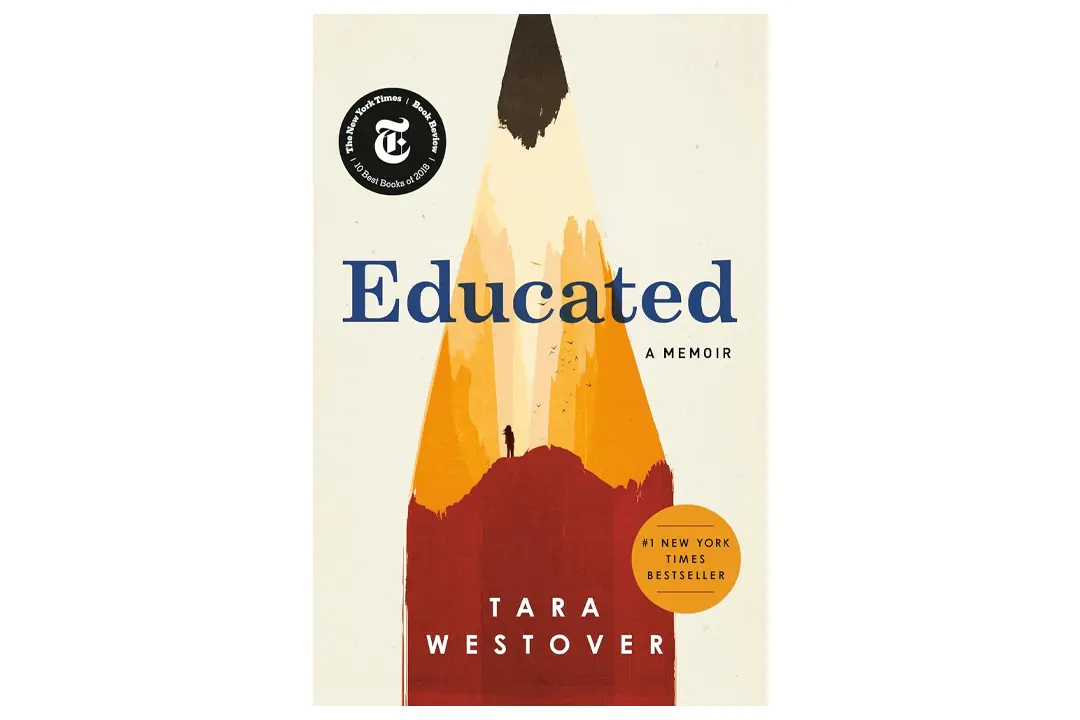
Educated – Tara Westover: Book Summary
Beverly Ashford • 11 Mar 2026 • 81 views • 3 min read.Let me tell you about the most improbable education in modern literature. Tara Westover didn't set foot in a classroom until she was seventeen. She had no birth certificate for years. She never saw a doctor after childhood. She worked in her father's junkyard, survived multiple untreated injuries, and was taught that the government, schools, and hospitals were tools of the Illuminati preparing for the Days of Abomination. Then she got a PhD from Cambridge. Educated isn't a triumph-over-adversity story in the simple sense. It's also a book about how families can love you and destroy you simultaneously. About how education changes not just what you know but who you are. About the price of leaving the world you came from.
Educated – Tara Westover: Book Summary
Quick Summary:
- A memoir of growing up in a survivalist family without school, doctors, or birth certificates
- Against impossible odds, she teaches herself enough to reach Cambridge University
- The story confronts family loyalty versus self-preservation
- Published in 2018, it became one of the decade's most acclaimed memoirs
The Mountain
Tara grows up in Buck's Peak, Idaho, at the base of a mountain her family has worked for generations. Her father, Gene (a pseudonym), runs a junkyard and believes the end times are imminent. He stockpiles fuel, builds bunkers, and prepares his family for the collapse of civilization.
Her mother, Faye, is a midwife and herbalist who treats her family's injuries—including severe burns and head traumas—with tinctures and faith rather than hospitals.
There are seven children. They work from young ages in dangerous conditions. Education is homeschooling in theory; in practice, Tara receives almost none. She learns to read but little else formally. The Bible, the Book of Mormon, and her father's apocalyptic worldview form her curriculum.
This isn't ordinary religious conservatism or rural isolation. Gene shows signs of serious mental illness—likely bipolar disorder or paranoia—that shapes the entire family's reality. His convictions intensify over time. His children are trapped in his vision.
The Violence
Shawn, one of Tara's older brothers, is charming and terrifying. He teaches her to ride horses and also puts her head in a toilet. He breaks her wrists. He drags her by the hair. He calls her a whore for wearing lip gloss.
The violence escalates throughout her childhood and adolescence. Other family members witness it and do nothing. Faye minimizes. Gene doesn't intervene. The family system cannot acknowledge what's happening because acknowledging it would require challenging the father's authority.
Tara learns to survive by dissociating, minimizing, and doubting her own memory. Did Shawn really do that? Maybe she's exaggerating. Maybe she deserved it. These rationalizations become habit.
The violence isn't just Shawn's. Gene pushes the children to work in dangerous conditions. They're crushed, burned, impaled. Tara nearly dies multiple times. Medical care is refused on principle.
The Escape
One brother, Tyler, leaves for college despite their father's opposition. He earns a PhD in engineering. He tells Tara she should educate herself.
At seventeen, Tara decides to try. She teaches herself algebra from a library book. She takes the ACT, scores high enough, and applies to Brigham Young University. She's admitted.
BYU is culture shock. She doesn't know what the Holocaust was—in a class about it, she raises her hand to ask what it is. She doesn't know major historical events, basic science, or how to interact with normal people.
But she learns. Rapidly. She discovers that her entire worldview is constructed—that the facts her father taught her don't hold up. She excels academically, earns a scholarship to Cambridge for graduate study, and eventually completes a PhD in history.
Education doesn't just add knowledge. It replaces a world.
Key People
| Person | Role | Significance |
|---|---|---|
| Tara Westover | Author, protagonist | The one who escapes and tells the story |
| Gene (father) | Survivalist, likely mentally ill | Source of the family's isolation |
| Faye (mother) | Midwife, herbalist | Enables Gene, gaslights children |
| Shawn | Brother, abuser | The violence at the heart of the story |
| Tyler | Brother | The first to leave, Tara's model |
| Audrey | Sister | Initially supports Tara, then recants |
| Richard | Brother | Also eventually leaves the family |
The Break
Tara's education forces confrontation with her family.
As she learns history, psychology, and how other families function, she realizes that what happened to her wasn't normal. Shawn's violence was abuse. Gene's behavior was possibly mental illness. The family's denial was gaslighting.
She tries to address it. She talks to her mother, expecting acknowledgment. Faye denies everything, then fabricates alternative memories. She tells Tara that Tara is the problem—possessed, deceived, betraying the family.
Gene accuses Tara of being controlled by Satan. Shawn threatens to kill her. The sister who initially supported her, Audrey, eventually recants and sides with the family.
The choice becomes binary: accept the family's reality or trust your own mind.
Tara chooses her own mind. The cost is almost everything.
She loses her parents. She loses most siblings. She loses the mountain she grew up on. She gains education, independence, and sanity—but the grief never fully resolves.
What the Book Is Really About
Memory and truth. Tara's family members remember events differently. Some differences are inevitable; others are gaslighting. The book is honest about the limits of memory—Tara notes when her account might be wrong—while insisting that core truths remain real.
Education as transformation. For Tara, education isn't just learning facts. It's developing the ability to question, to consider alternatives, to recognize that received truths can be wrong. This applies to academic subjects but also to her family's stories about themselves.
Family loyalty versus self-preservation. The book's emotional core is the impossible choice between staying connected to people who harm you and leaving them. Neither option is painless. Both cost profoundly.
Survivalism and mental illness. Gene's behavior reads as severe mental illness that the family has normalized. The book doesn't diagnose explicitly but depicts a man whose convictions intensify, whose reality grows more paranoid, and whose family adapts rather than challenges.
The Writing
Westover writes with restraint. The events are dramatic enough; she doesn't need to inflate them. The prose is clear, precise, and occasionally beautiful.
She's careful about uncertainty. When her memory might be unreliable, she says so. When family members remember differently, she notes it. This honesty strengthens rather than weakens the account.
The structure moves chronologically with occasional reflections. Each chapter builds tension. The book is hard to put down despite its weight.
Frequently Asked Questions
Is this all true?
It's memoir, not journalism. Some names are changed. Some events are reconstructed from memory. Her family disputes various details. But the core narrative is documented—her lack of formal education, her degrees from Cambridge, the family estrangement.
Is the family's religion the problem?
Partly, but it's more complicated. Many LDS families don't live like this. Gene's survivalism exceeds mainstream Mormon belief. The issue is extremism and mental illness more than the religion itself.
Did Tara reconcile with her family?
As of the book's publication, largely not. Some siblings who left maintain contact with her. Her parents and most remaining siblings consider her an enemy.
Is this book anti-family?
No. It's a book about what happens when family becomes abusive. Tara clearly loves her family even as she describes their harm. The tragedy is that love wasn't enough.
Should I read this if I find abuse descriptions triggering?
The violence is significant, though not gratuitous. Westover doesn't linger on details but doesn't hide them either. Know yourself before reading.
What has Tara done since?
She became a visiting scholar at Harvard, continued writing and speaking. She hasn't returned to Buck's Peak. The family rift persists.
The Bottom Line
Here's what Tara Westover achieved.
She wrote a memoir that's simultaneously an adventure story, a family tragedy, and a meditation on what education actually means. She survived circumstances that should have destroyed her, then made art from that survival.
The book doesn't offer easy resolution. Tara loses her family. Education frees her but also costs her. The mountain remains, and she can't go back.
What she keeps is her own mind—a mind that learned to question, to verify, to trust itself against an entire family insisting she was wrong.
That's education. Not facts. Not degrees. The ability to think for yourself even when everyone you love tells you not to.