
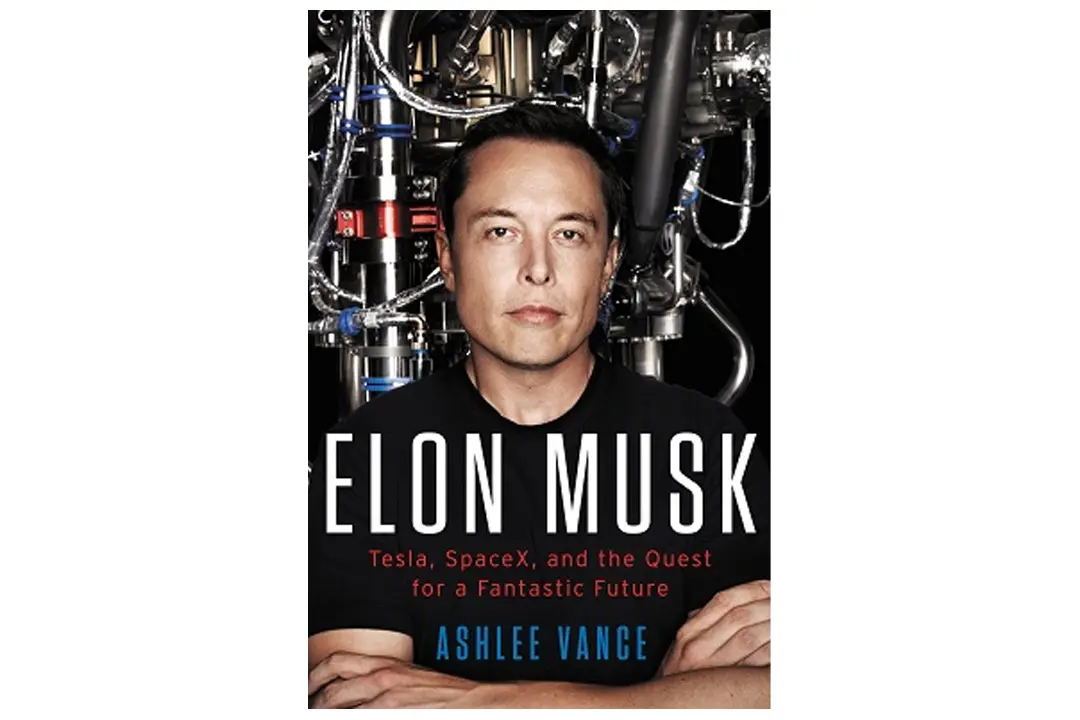
Elon Musk by Ashlee Vance: Book Summary
Beverly Ashford • 13 Mar 2026 • 49 views • 3 min read.Let me tell you about the biography that made people argue about whether its subject was a genius, a sociopath, or proof that those two things are not mutually exclusive. Ashlee Vance published Elon Musk: Tesla, SpaceX, and the Quest for a Fantastic Future in 2015. Musk initially refused to cooperate. Then he agreed — on the condition that he could add his own comments to the manuscript, not to change anything, but to push back where he disagreed. Vance accepted. The resulting book has the unusual texture of a subject who is present in the margins, occasionally arguing with the author about his own story. By 2015, Musk had already built SpaceX and Tesla from nothing. He had nearly bankrupted both simultaneously in 2008, survived, and turned them into dominant companies. He was the most discussed entrepreneur in the world, compared constantly to Steve Jobs and Howard Hughes and occasionally to Bond villains. Vance spent two years trying to figure out which comparison was most accurate. The answer, as usual, is more complicated than any single comparison allows.
Elon Musk by Ashlee Vance: Book Summary
Quick Summary:
- The first major biography of Musk, published in 2015 with his reluctant cooperation
- Covers Zip2, PayPal, SpaceX, Tesla, and SolarCity — five companies, each ambitious enough to define a career
- Vance spent months interviewing Musk and hundreds of people around him, including many who had been fired or burned
- A portrait of someone who might genuinely change civilization — and who treats the people helping him do it as interchangeable parts
The South Africa Years
Musk was born in Pretoria, South Africa in 1971. His childhood was difficult in ways that shaped everything that followed. His father Errol was brilliant, successful, and cruel — a man Musk has described in terms that suggest genuine psychological damage, though he is rarely specific about details.
Musk was bullied severely at school. He was physically small, socially oblivious, and constitutionally unable to navigate the unwritten rules of peer interaction. He was also reading the entire Encyclopedia Britannica by the time he was nine and teaching himself to code shortly after. He sold his first video game at twelve for five hundred dollars.
He left South Africa at seventeen to avoid mandatory military service and to find a larger stage. He went to Canada, then to the University of Pennsylvania, then to Stanford for a PhD in energy physics. He lasted two days before dropping out to start a company.
This pattern — arriving somewhere, rapidly determining it was too small, leaving for something larger — repeated throughout his life.
Zip2 and PayPal: The Foundation
Musk's first company was Zip2, a web software startup that provided maps and business directories to newspapers. He and his brother Kimbal slept in the office, showered at a local YMCA, and shared a single computer between coding and the business. Compaq acquired it in 1999 for three hundred seven million dollars. Musk's share was twenty two million dollars.
He immediately put most of it into X.com, an online banking startup that merged with Peter Thiel's Confinity to become PayPal. The PayPal years were defined by internal warfare — Musk and Thiel had fundamentally different visions for the company, different technical philosophies, and different ideas about who should run it. The board removed Musk as CEO while he was on his honeymoon. He remained the largest shareholder.
eBay acquired PayPal in 2002 for one point five billion dollars. Musk received one hundred eighty million dollars. He was thirty one years old.
He spent essentially all of it on SpaceX and Tesla.
SpaceX: Building Rockets from Nothing
Musk started SpaceX in 2002 because he had looked up NASA's plans for a Mars mission and found that they had none. He believed — genuinely and without apparent irony — that humanity's survival required becoming a multi-planetary species, and that no existing institution was going to make that happen on a timeline that mattered.
Vance's account of SpaceX's early years is the most gripping section of the book. Musk recruited aerospace engineers from Boeing and Lockheed by promising them the chance to actually build something rather than manage programs. He moved operations to a remote island in the Pacific. He drove costs down by manufacturing components that the industry had always purchased from suppliers. He applied software development thinking to hardware problems in ways that the aerospace establishment found either naive or threatening.
The first three Falcon 1 rockets failed. Each failure cost tens of millions of dollars. By the summer of 2008, Musk was nearly out of money, Tesla was simultaneously collapsing, his first marriage had ended, and he was sleeping on friends' couches. The fourth Falcon 1 launch succeeded. NASA awarded SpaceX a one point six billion dollar contract weeks later.
Musk describes the 2008 period as the worst of his life. He also describes it as the year he learned what he was actually made of.
Tesla: The Car Company Nobody Thought Would Work
Tesla was founded by Martin Eberhard and Marc Tarpenning in 2003. Musk joined as chairman and lead investor in 2004, contributing six point five million dollars of his own money. He eventually took over as CEO in 2008 during the crisis, pushing out Eberhard in a process that generated lawsuits and lasting bitterness.
Vance covers the Tesla story with particular attention to the manufacturing challenges — building cars is categorically harder than building software, and Tesla's early production problems nearly destroyed the company multiple times. The Roadster was years late and cost twice what had been projected. The Model S required solving problems that Detroit had spent decades learning to navigate and that Tesla was encountering for the first time.
The Model S launched in 2012 to extraordinary reviews. Tesla became the first American car company to go public since Ford in 1956. By 2015, when the book published, Tesla was worth more than established manufacturers with century-long histories.
Companies and Ambitions Compared
| Company | Founded | Core Ambition | Near-Death Moment | Current Status at Publication |
|---|---|---|---|---|
| Zip2 | 1995 | City guides for newspapers | Investor pressure to replace Musk as CEO | Sold to Compaq for $307M |
| PayPal | 1999 | Redefine banking and payments | Board removed Musk as CEO mid-flight | Sold to eBay for $1.5B |
| SpaceX | 2002 | Make humanity multi-planetary | Three consecutive rocket failures in 2008 | NASA contractor, Falcon 9 operational |
| Tesla | 2003 | Accelerate electric vehicle adoption | Production failures, CEO ousting, 2008 cash crisis | Model S successful, IPO complete |
| SolarCity | 2006 | Transition world to sustainable energy | Dependent on government subsidies and Musk's attention | Largest solar installer in America |
Frequently Asked Questions
How does this compare to Isaacson's 2023 Musk biography?
Vance's book covers Musk through 2015 — SpaceX, Tesla, and the foundational story. Isaacson's biography, published in 2023, covers a much wider period including Twitter's acquisition and Musk's political evolution. Vance is more journalistic and maintains more critical distance. Isaacson had unprecedented access but received criticism for being insufficiently skeptical. Read Vance first for the origin story.
Is Musk portrayed as a villain?
Not exactly. Vance documents behavior that is genuinely troubling — employees fired without warning or severance, credit taken from teams, personal loyalty demanded and rarely reciprocated. But Vance also makes clear that SpaceX and Tesla achieved things that most experts considered impossible, and that Musk's demands, however brutal, were part of what made those achievements happen. The book does not resolve whether the ends justified the means. It presents both clearly enough for you to decide.
How accurate is the book given how much has changed since 2015?
The factual reporting on the pre-2015 period holds up well. The book's broader argument — that Musk is either the most important entrepreneur of his generation or a cautionary tale about unchecked ambition, possibly both — has aged in complicated ways given subsequent events. Read it as the definitive account of the founding era, not as a complete portrait of who Musk is today.
Does the book cover Musk's personal life?
Partially. His first marriage to Justine Wilson, who later wrote candidly about their relationship, is covered in some detail. His relationship with Talulah Riley receives less attention. Vance is more interested in the professional story than the personal one, which is both a limitation and an editorial choice that keeps the book focused.
Is this book relevant if I am not interested in tech or space?
Yes. The core questions the book raises — about ambition, obsession, the relationship between vision and cruelty, what we owe the people who help us build things — apply far beyond technology. Readers interested in leadership, biography, and human psychology find it as useful as readers interested in SpaceX.
What should I read next?
Liftoff by Eric Berger covers SpaceX's early years in significantly more technical and human detail — the best book about the company's founding if the rockets specifically interest you. Ludicrous by Edward Niedermeyer covers Tesla's manufacturing struggles and cultural contradictions from a more critical angle. Power Play by Tim Higgins is the complementary Tesla account with deep reporting on the internal dynamics Vance could not fully access in 2015.
The Bottom Line
Here is what Ashlee Vance actually documented.
A person who looked at the largest problems facing human civilization — fossil fuel dependence, single-planet vulnerability, the gap between what rockets cost and what they should cost — and decided that the absence of solutions was not acceptable and that he was the person to provide them.
And a person who built those solutions on the labor of thousands of people he treated as instruments rather than human beings, who fired loyal employees without warning, who took credit for engineering decisions made by teams, who demanded total commitment and offered conditional loyalty in return.
SpaceX is launching astronauts. Tesla accelerated the electric vehicle transition by a decade by most estimates. Both things are real.
So are the people who gave years of their lives to those companies and left with nothing but stock options and stories about being screamed at in conference rooms.
Vance gives you the full picture and lets you sit with the discomfort of not being able to simply admire or simply condemn.
That discomfort is the most honest response available.