
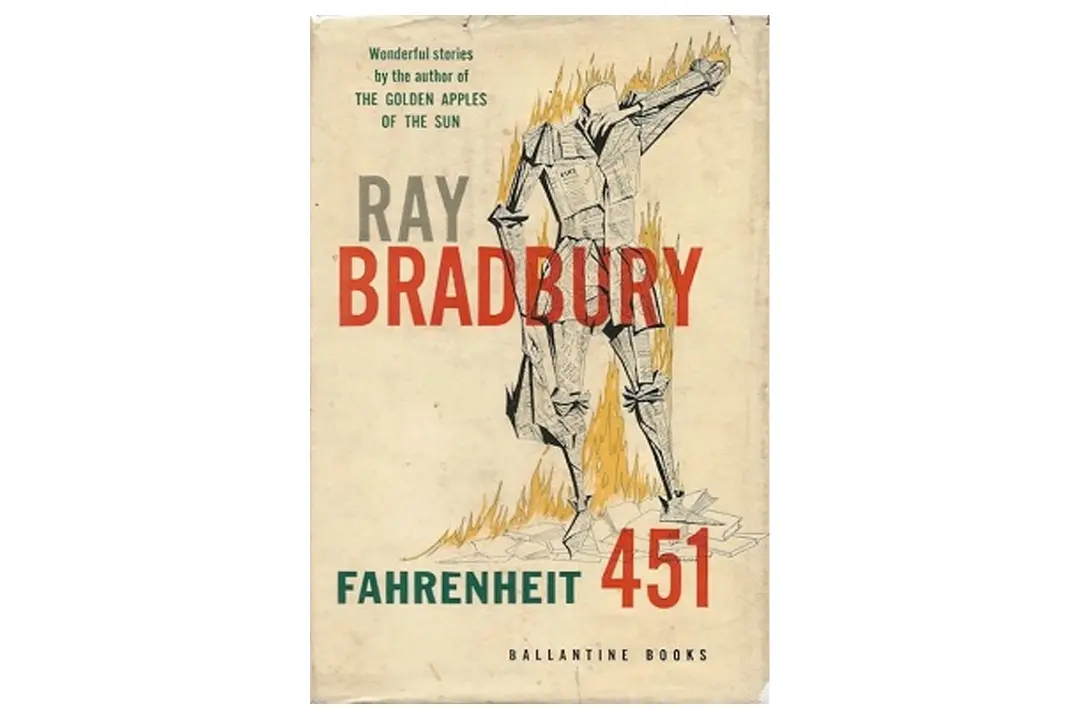
Fahrenheit 451 – Ray Bradbury: Book Summary
Beverly Ashford • 11 Mar 2026 • 79 views • 3 min read.Let me tell you something surprising about this book. Everyone thinks Fahrenheit 451 is about government censorship. Ray Bradbury spent decades correcting this. The book isn't about the government banning books. It's about people voluntarily giving them up. The society in the novel didn't have books taken away by force. People stopped reading because reading was hard, because screens were easier, because thinking made them uncomfortable. The government just formalized what had already happened. That's what makes the book terrifying. It's not about a dystopian government. It's about us.
Fahrenheit 451 – Ray Bradbury: Book Summary
Quick Summary:
- In a future America, firemen burn books instead of putting out fires
- Guy Montag questions his life after meeting a curious teenage girl
- The society is addicted to screens, speed, and shallow entertainment
- Written in 1953, it predicted earbuds, flat-screen TVs, and attention collapse
The World Montag Lives In
America, sometime in the future. The exact year doesn't matter.
Houses have been fireproofed for over a century, so firemen no longer fight fires. Instead, they start them. Their job is to burn books—illegal contraband that makes people unhappy by making them think.
Guy Montag is a fireman. He's been burning books for ten years. He's never questioned it. He has a nice house with wall-sized televisions (Bradbury called them "parlor walls"), a wife who spends all day watching interactive programs with her "family" (the characters on screen), and Seashell earbuds that pump constant noise into his ears.
He thinks he's happy. He's never really thought about what happiness means.
The opening line is famous: "It was a pleasure to burn."
For Montag, it was. Until he met Clarisse.
The Awakening
Clarisse McClellan is seventeen, the girl next door, and profoundly strange by this society's standards.
She walks instead of driving fast. She talks to people about ideas. She asks questions that have no practical purpose. She notices things—the dew on grass, the man in the moon, what billboards used to say before they were stretched to 200 feet because cars drove too fast to read them.
She asks Montag if he's happy.
He lies and says yes. Then he goes home and realizes he's not. He hasn't been happy for years. His wife Mildred is essentially a stranger. His job is hollow. His entire life is hollow.
Shortly after, Clarisse disappears. She's probably dead—hit by a speeding car, her family moved away. The society doesn't really notice or care.
But she's planted a seed in Montag that can't be unplanted.
The Theft and the Awakening
Montag has been stealing books from fires. Not many—one here, one there, hidden in his house. He doesn't know why. He hasn't even read them.
Now he starts reading.
The experience is overwhelming. Books contain multitudes—contradictions, questions, discomfort. They don't provide easy answers. They make him feel things he's not used to feeling.
Mildred is horrified. She wants her walls and her shows and her untroubled non-thoughts. Books threaten all of that.
Montag reaches out to Faber, a retired English professor he met years ago. Faber is afraid but agrees to help. He gives Montag a tiny two-way radio to wear in his ear—ironic technology used to subvert technological numbness.
Montag's awakening accelerates. He reads to Mildred's friends, making them cry with a poem. He argues with his fire chief, Beatty. He can no longer pretend.
The Confrontation
Captain Beatty knows Montag is struggling. He's been watching, waiting, delivering monologues about why books are banned—not by government decree but by popular demand.
People wanted things shorter, faster, simpler. Minority groups complained about books that offended them. Everyone wanted comfort, not challenge. Books became dangerous because they made people think, and thinking made people unequal and unhappy.
"If you don't want a man unhappy politically, don't give him two sides to a question to worry him," Beatty says. "Give him one. Better yet, give him none."
The confrontation comes when Montag's house is reported—by Mildred herself. Beatty forces Montag to burn his own house, his own books.
Then Montag turns the flamethrower on Beatty.
He runs. The Mechanical Hound—a robotic death machine that tracks by scent—pursues him. The city mobilizes. The chase is broadcast live, entertainment for the masses.
The River and the Rebirth
Montag escapes by jumping into a river, washing away his scent, floating downstream while the Hound hunts and the city watches.
The broadcast needs an ending. The authorities find someone else—some random pedestrian—and kill him on television. The city accepts this as Montag's death. The story is concluded. People move on.
Montag finds a camp of wanderers along old railroad tracks. They're led by a man named Granger. They're former professors, writers, intellectuals—each one has memorized a book to preserve it. They've become living libraries.
Montag has memorized parts of the Bible—the Book of Ecclesiastes, which speaks of cycles and time and meaning.
As they watch from the wilderness, the city is destroyed by atomic bombs. War has been imminent throughout the novel, mentioned in passing. Now it arrives.
The wanderers walk toward the smoking ruins. They carry books in their heads. They'll help rebuild. The cycle continues.
Key Characters
| Character | Role | Represents |
|---|---|---|
| Guy Montag | Protagonist, fireman | The awakening individual |
| Clarisse McClellan | Curious neighbor, 17 | Authentic human connection, questioning |
| Mildred Montag | Guy's wife | Society's willful numbness |
| Captain Beatty | Fire chief | Intelligent complicity, the system's voice |
| Faber | Retired professor | Knowledge preserved but hidden |
| Granger | Leader of book people | Hope and preservation |
| The Mechanical Hound | Robotic hunter | Technological enforcement |
What Bradbury Got Right
This is the scary part.
Earbuds everywhere. The "Seashell radios" that Mildred wears constantly, pumping entertainment into her ears, blocking out human connection. Sound familiar?
Wall-sized screens. Mildred wants a fourth wall of television. The characters address her by name. It's interactive but meaningless. We call it social media now.
Shortened attention spans. Books were condensed, then summarized, then abandoned. Everything faster, shorter, easier. "Speed up the film, Montag, quick... Whirl man's mind around about so fast under the pumping hands of publishers, exploiters, broadcasters, that the centrifuge flings off all unnecessary, time-wasting thought!"
Driving too fast to see. Billboards grew to 200 feet because cars drove so fast no one could read them. People hit animals and each other without stopping.
Voluntary withdrawal from difficulty. Nobody forced society to give up books. People chose entertainment over enlightenment. The government just enforced what people already wanted.
Bradbury wrote this in 1953. He didn't have the internet, smartphones, or streaming. He had observation and imagination.
The Book's Real Warning
Most readers focus on censorship, but Bradbury insisted the novel was about television destroying interest in reading.
The deeper point: any society that refuses to engage with difficult ideas will eventually lose the capacity to engage with them at all. Not through government force, but through atrophy.
The firemen aren't the villains. They're symptoms. The real disease is a population that chose not to think.
Frequently Asked Questions
Why is it called Fahrenheit 451?
That's supposedly the temperature at which paper ignites. (The actual number is variable and debated, but 451 works symbolically.)
Is this about government censorship?
Bradbury repeatedly said no. It's about people choosing distraction over depth. The government responds to demand, not creates it.
What's the Mechanical Hound?
A robotic creature that hunts by scent and kills with a needle full of poison. It represents technology as enforcement tool—inhuman, relentless, indifferent.
Why does Beatty seem so well-read?
Beatty knows literature intimately. He quotes it constantly. He's chosen complicity anyway. He's the most tragic figure—someone who knows better and rejects knowledge deliberately.
Is the ending hopeful?
Cautiously. The city is destroyed, but the book people survive. Knowledge persists. But there's no guarantee the cycle won't repeat.
Should I read this today?
More than ever. Every prediction feels more accurate. The book takes three hours to read and might change how you see your own scrolling habits.
The Bottom Line
Here's what Ray Bradbury achieved in this brief, furious novel.
He predicted our distractions with eerie precision. He warned that the death of reading wouldn't come from tyranny but from preference—from choosing the easy over the meaningful.
The book asks uncomfortable questions. Are you Montag, waking up to what you've ignored? Are you Mildred, preferring screens to reality? Are you Beatty, knowing better but choosing conformity anyway?
The books the wanderers memorize aren't destroyed. They're inside people. Ideas survive in minds that engage with them.
That's Bradbury's final point. Books matter because thinking matters. When we stop choosing to think, we get the world Montag lives in.
The screens are already on the walls. The earbuds are already in.
What are you going to do about it?