
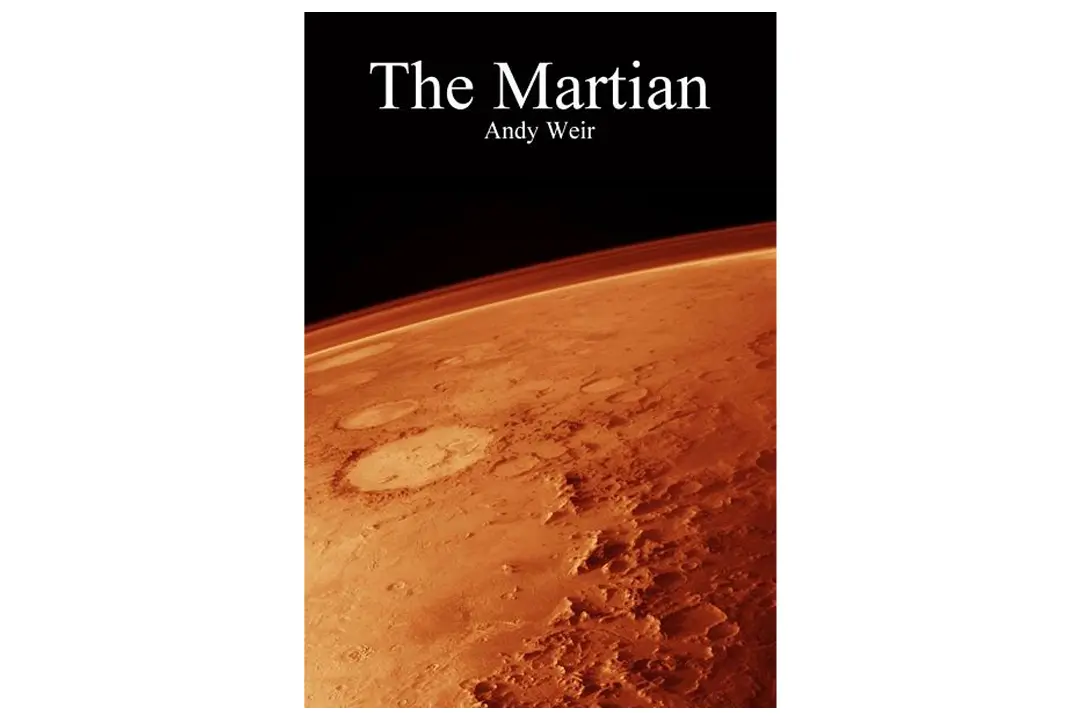
The Martian by Andy Weir: Book Summary
Beverly Ashford • 19 Mar 2026 • 105 views • 3 min read.Let me tell you about the novel that made people genuinely excited about botany, orbital mechanics, and the specific challenges of growing potatoes in Martian soil. Andy Weir published The Martian on his personal website chapter by chapter beginning in 2009. Fans asked for a Kindle version. He put it on Amazon for ninety-nine cents — the minimum price allowed. It sold ninety thousand copies in three months before a traditional publisher noticed and acquired it. The film adaptation starring Matt Damon grossed six hundred million dollars worldwide. Traditional publishers had rejected it. Their consistent feedback was that it was too technical. They were wrong about the market in a way that is now a publishing industry case study. The Martian is not a book about space in the way that most space novels are about space — the awe, the existential scale, the darkness between stars. It is a book about a man who is very good at his job, stuck in an extremely bad situation, who decides the appropriate response is to work the problem. Every single problem. One at a time. With duct tape, mathematics, and a level of sarcasm that probably would not survive peer review.
The Martian by Andy Weir: Book Summary
Quick Summary:
- An astronaut is accidentally left behind on Mars and has to science his way to survival with limited supplies and no communication with Earth
- Self-published in 2011, rejected by traditional publishers, it became one of the most beloved science fiction novels of the decade
- Weir's central achievement: a thriller built entirely from math, botany, orbital mechanics, and one relentlessly funny narrator
- A book about problem-solving as a survival strategy — and about what humans do when one of their own is in trouble
The Setup
Mark Watney is a botanist and mechanical engineer on the third crewed mission to Mars. On Sol 6 — the sixth Martian day of the mission — a massive dust storm forces the crew to abort. During the evacuation, Watney is struck by debris, his suit's bio-monitor is damaged, and his crew — believing him dead — leaves without him.
He is not dead.
He regains consciousness alone on Mars with the following assets: a habitat designed for thirty-one days, enough food for thirty-one days split among six people, equipment for a mission that has already ended, and a degree in botany.
Mars is approximately 140 million miles from Earth depending on orbital position. No rescue mission has ever been attempted. Nobody knows he is alive.
Watney's first log entry, after cataloging his situation with clinical precision, ends with a sentence that establishes the entire tone of the novel: he is going to have to science the hell out of this.
The Science of Survival
What follows is Weir's extraordinary achievement: a survival thriller built from real science that is somehow a page-turner.
The food problem is first. Watney has enough calories for approximately four hundred days. NASA's fastest possible rescue mission, if they attempted one immediately, would take years. He needs to grow food on a planet with no liquid water, toxic soil, and an atmosphere that is ninety-five percent carbon dioxide.
He has a greenhouse. He has Martian soil. He has the frozen waste of six astronauts. And he has a degree in botany.
The solution — growing potatoes using human waste as fertilizer, manufactured water from rocket fuel, and a habitat modified as a greenhouse — is scientifically accurate in its principles. Weir spent years researching it. The specific calculations Watney runs, the crop yield projections, the water production chemistry — these are not hand-waved. They are worked out.
This is the book's defining quality. Every problem produces a solution. Every solution produces a new problem. The reader is doing math alongside Watney — understanding why something will work, watching it almost work, watching it fail in a different way, watching him adapt. The tension is not manufactured. It is the tension of watching someone think very carefully under impossible pressure.
NASA and Earth
About a third of the way through the book, NASA discovers Watney is alive through satellite imaging of the Mars surface showing equipment being moved. The narrative splits three ways — Watney on Mars, NASA on Earth, and eventually Watney's crewmates aboard their return vessel when they learn the truth about what they left behind.
The NASA sections are equally compelling and serve the book's deeper argument about human response to crisis. The institutional machinery of an organization that exists to not lose astronauts grinds into motion — the political considerations, the engineering constraints, the public relations reality of an astronaut abandoned on Mars, and the fundamental question of what resources you commit to saving one person.
The answer NASA arrives at — and the answer Watney's crew arrives at independently when given the choice — is everything. Every available resource. Every risk acceptable to the people taking it. You do not leave someone behind when there is any option remaining.
This is not presented sentimentally. It is presented as the logical conclusion of how humans actually function when the problem is specific, the person is real, and the possibility of action exists.
Watney as Narrator
The novel is structured primarily through Watney's log entries, and the voice Weir created is one of the most distinctive in recent science fiction. Watney is funny in the specific way that very intelligent people under extreme stress sometimes become funny — not performing humor as a coping mechanism, but finding genuine absurdity in his situation and reporting it accurately.
He complains about the music left on the habitat's hard drive — exclusively disco, courtesy of Commander Lewis's personal collection. He calculates exactly how many sols he can survive and then immediately notes that he is the greatest botanist on the planet, which is not a high bar given that he is the only human on the planet. When a critical piece of equipment fails, his log entry begins with an observation that would not pass NASA's language guidelines.
The humor is not decoration. It is the mechanism by which Watney processes catastrophe — by refusing to grant it the gravity it wants, by treating each crisis as a problem with a solution rather than a situation with a verdict.
Key Survival Challenges Compared
| Problem | Stakes | Watney's Solution | What Could Go Wrong |
|---|---|---|---|
| Food supply | Starvation within 400 sols | Potato farm using human waste fertilizer and manufactured water | Habitat breach destroys crops — and does |
| Communication | Complete isolation from Earth | Locates Pathfinder rover, establishes text contact via camera | Limited bandwidth, no audio, one-way initially |
| Power | Equipment failure in darkness | Manages RTG power source, solar panel positioning | Any extended dust storm eliminates solar power |
| Travel to MAV | 3,200 km across Martian surface | Modified rover with extra batteries and solar panels | Unknown terrain, equipment failure, timing constraints |
| Atmospheric breach | Instant death | Patches with varying materials under pressure | Every repair is a temporary solution to a permanent problem |
| Launch to orbit | Rendezvousing with moving spacecraft | Stripped MAV launched to precise coordinates | Weight calculations leave almost no margin for error |
Frequently Asked Questions
How accurate is the science?
Remarkably accurate for the principles involved. Weir consulted extensively and corrected errors readers identified in the serialized version. The one known deliberate inaccuracy is the opening storm — Mars's atmosphere is too thin to generate the kind of force the storm produces, a fact Weir acknowledges and accepted as a necessary narrative device. Everything after that hews closely to real physics, chemistry, and orbital mechanics.
Is this hard science fiction — do I need a science background?
Weir explains every calculation as Watney works through it, in character, in language accessible to non-scientists. The science is present and real but the explanations are built into the narrative rather than presented as technical documentation. Readers with no science background report following and enjoying it without difficulty.
How does the film compare?
The 2015 Ridley Scott film with Matt Damon is faithful to the novel's spirit and compresses the timeline and some technical sequences without sacrificing the core experience. The novel contains significantly more problem-solving detail. Both are worth experiencing — the book first, then the film.
Is the humor consistent throughout or does it get dark?
The tone stays remarkably consistent even as the stakes escalate. Watney's voice does not break. There are moments of genuine weight — particularly when communication with Earth is established and the human cost of his situation becomes more visible — but the fundamental approach of treating catastrophe as a series of solvable problems never wavers.
What makes this different from other survival stories?
Most survival narratives rely on emotional endurance — the will to live against psychological despair. The Martian is almost entirely about cognitive endurance — the application of expertise and problem-solving under compounding difficulty. Watney does not struggle with the will to survive. He struggles with the specific technical challenges of survival. This is an unusual frame and Weir executes it without ever making Watney feel inhuman.
What should I read next?
Project Hail Mary by Andy Weir is his best novel by most readers' assessment — a first contact story with the same scientific rigor and a narrator whose voice is equally distinctive. The Hitchhiker's Guide to the Galaxy by Douglas Adams shares the comedic approach to cosmic catastrophe from a very different angle. Packing for Mars by Mary Roach is non-fiction about the realities of human spaceflight that pairs naturally with the novel.
The Bottom Line
Here is what Andy Weir actually built from a self-published chapter-by-chapter science experiment.
Not a space opera. Not a disaster epic. A novel about what it looks like when someone who is very good at their job faces a problem that exceeds every available resource — and decides that the correct response is to keep working the problem.
Watney does not survive Mars through courage in the conventional sense. He survives through competence, improvisation, and the refusal to treat any problem as the final problem until it actually kills him. Every setback produces a recalculation. Every failure produces a new approach.
The book's argument about human nature is quiet but consistent: given a specific person in specific danger and a realistic possibility of action, humans will commit everything to the rescue. Not because it is rational. Because it is who they are.
NASA commits everything.
The crew commits everything.
Watney commits everything — starting with the first log entry, the first calorie calculation, the first handful of Martian soil turned toward an impossible harvest.
He is going to science the hell out of this.
And he does.