
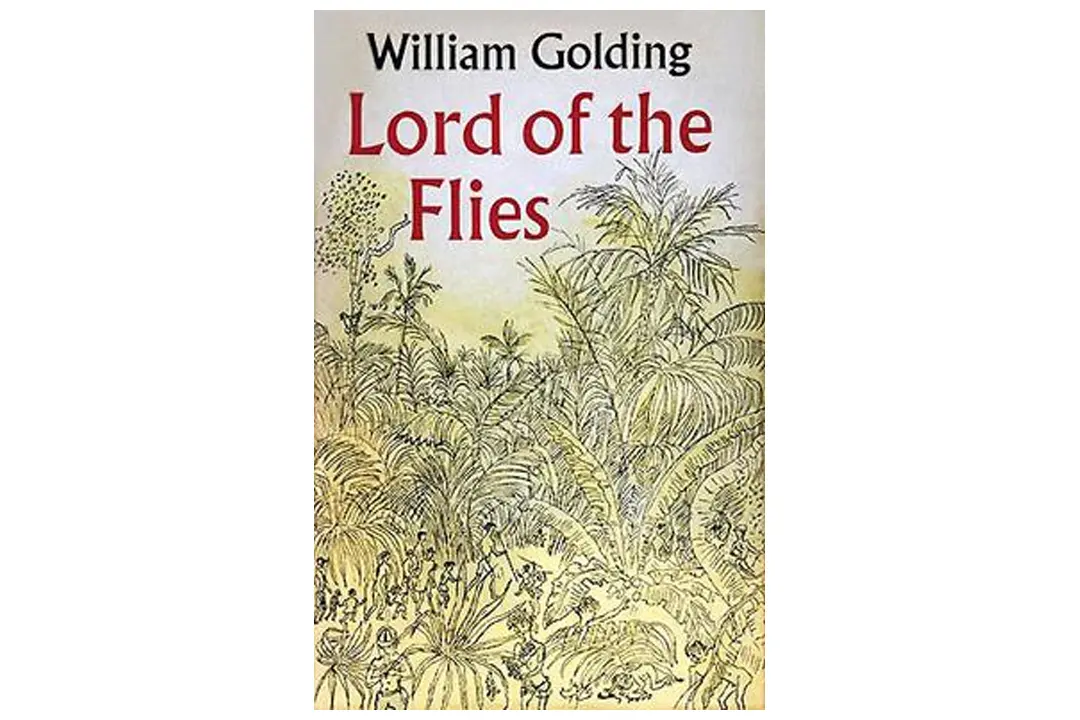
Lord of the Flies by William Golding: Book Summary
Beverly Ashford • 18 Feb 2026 • 93 views • 4 min read.Let me tell you about the novel that was rejected twenty-one times before a junior editor at Faber and Faber pulled it from the reject pile, read it twice, and told his colleagues they would be making a mistake they would regret for decades if they passed on it. William Golding published Lord of the Flies in 1954. He was a schoolteacher who had served in the Royal Navy during World War II, participated in the sinking of the Bismarck, and been present for the D-Day landings. He had watched what human beings did to each other under sufficient pressure and with sufficient permission. He did not come away optimistic. The novel he wrote was a direct response to The Coral Island — an 1857 novel by R.M. Ballantyne in which British boys stranded on a tropical island behave admirably, solve problems efficiently, and demonstrate the inherent superiority of British civilization and Christian values. Golding found this fantasy insulting to his intelligence and his experience. He wrote the counter-argument.
Lord of the Flies by William Golding: Book Summary
Quick Summary:
- A group of British schoolboys stranded on an uninhabited island after a plane crash attempt to govern themselves — and descend into savagery within weeks
- Published in 1954 after being rejected by over twenty publishers, it became one of the most taught novels in the English-speaking world
- Golding's central argument: civilization is not the natural state of human beings — it is a thin layer of conditioning that strips away faster than anyone wants to believe
- A novel that is either a pessimistic argument about human nature or a specific argument about what British colonial violence produces in children, depending on which reading you trust
The Setup
A group of British boys — ranging from roughly six to twelve years old — are being evacuated from a nuclear war in England when their plane is shot down. The pilot is killed. The boys land on an uninhabited tropical island with no adults, no communication with the outside world, and no rescue timeline.
Ralph is the novel's protagonist — fair-haired, athletic, the natural leader the other boys gravitate toward. He finds a conch shell and uses it to call the scattered boys together. The conch becomes the symbol of democratic order: whoever holds it has the right to speak.
Piggy is Ralph's first friend on the island — overweight, asthmatic, intellectually serious, the only boy who consistently understands what is actually required for survival and rescue. He wears glasses. His glasses will become the only means of making fire on the island.
Jack Merridew leads the choir boys who arrive in formation, dressed in black robes, with a commanding sense of his own authority. He wanted to be chief. When Ralph is voted in instead, Jack accepts the decision with a visible effort that does not quite convince anyone.
Simon is quiet, prone to fainting, deeply perceptive in ways the other boys find strange. He understands things about the island and about the boys' situation that he cannot communicate in language they will accept.
Roger is Jack's eventual lieutenant — a boy with a particular affinity for cruelty that the novel tracks from small sadistic impulses to their conclusion.
The Rules and Their Erosion
Ralph's first acts as chief are practical and sound: build shelters, maintain a signal fire on the mountain, establish the conch as the governance mechanism. Jack's choir becomes the hunting party, responsible for finding meat.
The order begins to erode not from a single catastrophic decision but from the accumulation of small failures. The shelters are built by Ralph and Simon because the other boys drift back to playing. The signal fire goes out while Jack's hunters are killing their first pig — and a ship passes during the outage. The rules of the conch are increasingly ignored by Jack and his hunters, who find the structured meetings less interesting than the hunt.
Golding tracks the psychology of this deterioration with precision. The hunters' excitement about killing is not just about food. It is about the intoxication of violence — the ritual, the chant, the release from the self-consciousness that civilization requires. Kill the pig. Cut her throat. Spill her blood. The chant becomes a ceremony that the boys who participate in it find increasingly difficult to stop.
The Beast
A small boy raises the question of the beast first — something in the dark, something from the water. The older boys dismiss it. Ralph and Jack dismiss it. Simon is less certain.
As the weeks pass, fear of the beast organizes itself around the hunters' need for an external enemy. The beast is out there. We are hunters. Our violence is directed outward, against the beast, which is other than us.
A dead parachutist — a casualty from the war happening in the world the boys came from — becomes the physical evidence of the beast. The twins Sam and Eric see it in the dark and report something monstrous. The confirmation feeds the fear.
Simon climbs the mountain alone, finds the parachutist, understands what it is. He comes down to tell the others. He comes down during a ceremonial dance that has become frenzied — the boys acting out the hunt in a circle, chanting, working themselves into something that is no longer play. Simon stumbles out of the forest into the circle. They kill him, believing in the dark and the frenzy that he is the beast. He is not the beast. He was the only one of them who understood there was no beast — that the beast was what they were becoming.
The Collapse
Jack breaks from Ralph's group entirely and establishes a tribe on the other side of the island, built around hunting, feasting, the application of face paint that makes individuals into something less than individual. His tribe raids Ralph's group for Piggy's glasses — the fire-making capacity — in the night.
Ralph and Piggy go to Castle Rock to appeal to the rules of the conch. Jack's tribe has moved beyond the conch. Roger, from above, rolls a boulder onto Piggy. Piggy falls to the rocks below. The conch shatters with him.
Ralph runs. The entire tribe hunts him. Jack orders the forest set on fire to smoke him out. Ralph crashes through the burning forest onto the beach — and finds a naval officer standing there, ship in the harbor behind him, drawn to the island by the smoke.
The officer is cheerful. British boys! Jolly good show. Been having fun? The boys are filthy and diminished and several of them are crying. The officer is embarrassed by their emotion. He looks away to give them time to pull themselves together.
Golding's final image is the naval officer standing on the beach of an island burning behind him, beside a group of children who have just tried to kill each other, waiting for them to compose themselves — a man from the civilization that produced these boys, from the world currently conducting the nuclear war that stranded them, unable to see what he is standing in the middle of.
Characters and Their Symbolic Roles Compared
| Character | What They Represent | What Happens to Them | What It Means |
|---|---|---|---|
| Ralph | Democratic order, civilization's aspirations | Hunted, diminished, weeping on the beach | Civilization survives but barely, and only through external rescue |
| Piggy | Rational intelligence, science, adult wisdom | Killed when the conch shatters | Reason is the first real casualty of mob violence |
| Jack | Tribalism, charisma, the appeal of violence | Victorious until the adults arrive | Power organized around violence works — in the short term |
| Simon | Intuitive truth, spiritual perception | Killed by the group in a ritual frenzy | Truth-tellers are destroyed by the systems that need them most |
| Roger | Pure cruelty without social constraint | Becomes the torturer, kills Piggy | What humans do when all social consequence is removed |
| The conch | Democratic governance, the right to be heard | Shatters when Piggy dies | Order is more fragile than the things it is meant to contain |
| The beast | The boys' projected fear of their own violence | Does not exist externally — it is them | The monster is not outside the group |
Frequently Asked Questions
Is Golding saying all humans are inherently violent?
This is the most contested question about the novel. Golding's own stated view was that the darkness is universal — that any group of children under these conditions would follow this arc. Critics have pushed back: these are specifically British colonial boys trained in a specific hierarchy of violence and masculinity, and the experiment might produce different results with different subjects. Both readings are defensible. The novel does not resolve the debate; it enacts one possible answer.
What does the title mean?
Lord of the Flies is a translation of Beelzebub — one of the names of the devil in Abrahamic religious tradition. The title refers to the pig's head on a stick that Jack's tribe creates as an offering to the beast. Simon, in a hallucinatory conversation with the pig's head, hears it tell him that the beast is inside all of them. The Lord of the Flies is not an external force. It is what the boys have released in themselves.
Why is Simon's death the most significant?
Simon is killed while trying to bring the truth — his discovery that the beast is just a dead man, that there is nothing to fear from the outside. The boys kill him in a state of collective frenzy before he can communicate it. Golding is making a specific argument: the truth that could have saved them is exactly what the mob cannot hear, and the person carrying it is exactly who the mob kills. The structure of the event — mistaking truth-telling for threat — is the novel's darkest statement.
Is the ending hopeful?
Conditionally. Ralph is saved. The boys are rescued. But the officer who rescues them represents the adult world — the world currently conducting nuclear war, the world that produced Jack's entitled authority and Roger's capacity for violence. The rescue is real but its source is not reassuring. Golding ends the novel with the officer looking away from the children's grief, and with the burning island behind them all.
Why was it rejected twenty-one times?
The rejection letters are relatively well documented. Golding submitted it between 1953 and 1954. Most rejections cited the darkness of the subject matter and the implausibility of the premise — British boys would not actually behave this way. The post-war publishing climate was not prepared for a novel arguing that the civilization Britain had just defended was not inherently civilizing. A junior editor named Charles Monteith at Faber rescued it from the rejection pile and championed it internally.
What should I read next?
The Inheritors by Golding is his follow-up — covering the displacement of Neanderthals by Homo sapiens and making a related argument about what humans do to things gentler than themselves. Sa by Kazuo Ishiguro covers similar themes about institutional violence in Never Let Me Go. The Coral Island by R.M. Ballantyne is the specific text Golding was arguing against — reading it alongside Lord of the Flies shows exactly what Golding was dismantling and why.
The Bottom Line
Here is what William Golding actually argued from his naval service and his years teaching schoolboys.
Not that children are evil. Not that human nature is simply violent. Something more precise and more uncomfortable: that civilization is not a permanent achievement but an ongoing effort, and that the effort fails faster than anyone raised within civilization wants to believe, and that the things civilization is supposed to suppress do not disappear — they wait.
The boys on the island did not arrive evil. They had been shaped by everything British schooling and British society had invested in them. That shaping lasted approximately as long as the social consequences that enforced it. When the consequences were gone, something else emerged — not from nowhere, but from somewhere it had always been.
Simon understood what it was. He came out of the forest to say so.
They killed him in the dark, certain he was the beast.
The beast was the certainty.
The beast was the dark.
The beast was them.
It has always been them.
Golding spent a career saying so and nobody wanted to hear it.
The novel has been in print for seventy years.
We keep teaching it because we keep needing the reminder.