
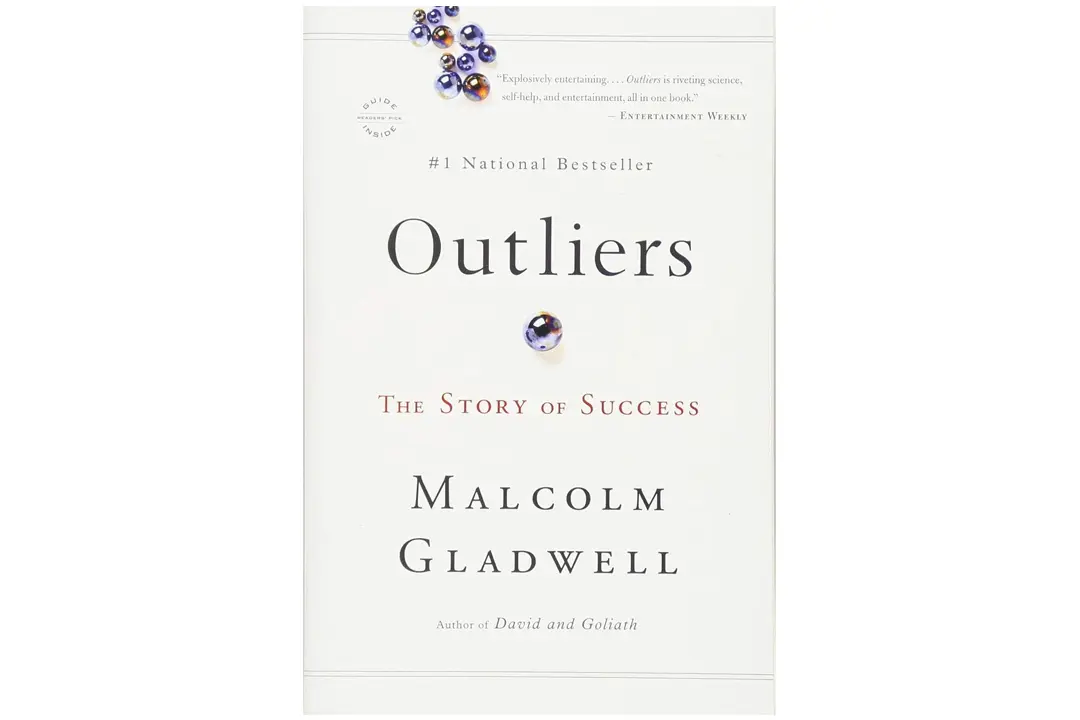
Outliers by Malcolm Gladwell: Book Summary
Beverly Ashford • 13 Mar 2026 • 54 views • 3 min read.Let me tell you about the book that reframed how an entire generation thinks about success — and made a lot of self-made millionaires quietly uncomfortable. Malcolm Gladwell published Outliers in 2008. It asks a question that sounds simple and turns out to be explosive: why do some people succeed far more than others? The answer Gladwell builds across ten chapters is not the one most people want to hear. It is not genius. It is not hustle. It is not vision or grit or any of the qualities celebrated in commencement speeches. It is timing. It is birthplace. It is cultural inheritance. It is being handed the right opportunity at the right moment and having the background to recognize and use it. Gladwell is not saying effort does not matter. He is saying effort alone has never been sufficient — and that pretending otherwise is both factually wrong and socially convenient.
Outliers by Malcolm Gladwell: Book Summary
Quick Summary:
- Success is not about individual genius — it is about hidden advantages, timing, and cultural legacy
- Published in 2008, it introduced the 10,000-hour rule to popular culture
- Gladwell examines Bill Gates, The Beatles, hockey players, and plane crashes to make his case
- Uncomfortable reading for anyone who believes they earned their success entirely on their own
The Argument
Gladwell opens with a puzzle: why are professional hockey players in Canada disproportionately born in January, February, and March?
The answer has nothing to do with winter births or astrological signs. The eligibility cutoff date for youth hockey in Canada is January 1. A child born in January is almost a full year older than a child born in December in the same age cohort. At eight or nine years old, that difference in physical development is enormous. The older children get identified as talented, receive more coaching, make better teams, get more ice time. By the time the age advantage disappears, the gap in skill and opportunity is permanent.
This is Gladwell's entry point into the book's central claim: success is not randomly distributed. It clusters around advantages that have nothing to do with the person's innate ability — and everything to do with circumstances they did not choose.
The 10,000-Hour Rule
The most famous section of Outliers introduces what Gladwell calls the 10,000-hour rule, drawn from research by psychologist Anders Ericsson. The finding: in study after study of elite performers — musicians, chess players, athletes — the people at the top had accumulated roughly 10,000 hours of deliberate practice. Natural talent determined who started. Practice determined who arrived.
Gladwell illustrates this with The Beatles and Bill Gates. The Beatles played Hamburg clubs for eight hours a night, seven nights a week, before they became famous. By the time they had their first hit, they had performed live more than any comparable band in history. Bill Gates had access to a computer terminal at his Seattle prep school in 1968 — an almost unimaginable advantage at a time when most universities did not have terminals. He accumulated thousands of programming hours as a teenager. When the personal computer revolution arrived, he was ready.
The rule is not simply that practice makes perfect. It is that the opportunity to accumulate that practice is itself unevenly distributed — and the people who got the opportunity are often the ones later celebrated for their genius.
The Matthew Effect and Timing
Gladwell borrows the Matthew Effect from sociology: unto everyone who has shall be given, and they shall have abundance. Early advantage compounds. The hockey player who made the better team at nine gets more coaching, more games, more development. By sixteen, the gap between him and the December-born player who did not make the cut is not one year. It is a career.
Timing operates at the macro level too. Gladwell identifies a remarkable cluster of American business titans born between 1831 and 1840 — John Rockefeller, Andrew Carnegie, Jay Gould. They came of age precisely when the American economy was being remade after the Civil War. A generation earlier or later and they miss the moment.
He runs the same analysis on Silicon Valley. Bill Gates was born in 1955. Paul Allen, 1953. Steve Jobs, 1955. Eric Schmidt, 1955. Bill Joy, 1954. The personal computer revolution arrived in 1975. Everyone on that list was between nineteen and twenty-two years old — old enough to understand the technology, young enough to not be locked into an existing career. Born five years earlier and they had already taken jobs at IBM. Born five years later and they missed the window.
Cultural Legacy
The book's second half moves from timing to culture. Gladwell examines why Korean Air had a catastrophic safety record in the late 1990s and finds the answer in Korean cultural attitudes toward hierarchy and authority. Co-pilots who noticed the captain making errors were culturally conditioned not to challenge superiors directly. Planes crashed because cultural inheritance prevented the communication that would have saved them.
He examines why students from Asian cultures outperform Western students in mathematics and connects it to rice farming — an agricultural practice requiring year-round labor, precision, and the belief that sustained effort produces results. The work ethic embedded in rice-farming communities thousands of years ago shows up in math scores today.
This is Gladwell at his most provocative. He is arguing that who you are is shaped profoundly by where your ancestors came from and what they had to do to survive — forces operating decades or centuries before your birth.
Key Concepts Compared
| Concept | What Gladwell Argues | Common Assumption It Challenges | Real-World Example |
|---|---|---|---|
| Relative Age Effect | Birth timing within a cohort determines early advantage | Talent is randomly distributed | Canadian hockey cutoff dates |
| 10,000-Hour Rule | Elite performance requires accumulated deliberate practice | Genius is innate and spontaneous | The Beatles in Hamburg |
| Opportunity Advantage | Access to practice determines who reaches 10,000 hours | Hard work alone creates success | Bill Gates and the school terminal |
| Birth Year Timing | Macro timing determines whether talent meets opportunity | Success is available equally across generations | Silicon Valley founders born 1953-1956 |
| Cultural Legacy | Inherited cultural values shape performance centuries later | Individuals succeed on individual merit | Korean Air cockpit hierarchy |
| Matthew Effect | Early advantage compounds into permanent gaps | Competition is a level playing field | Youth sports selection processes |
Frequently Asked Questions
Is the 10,000-hour rule actually true?
Gladwell popularized Ericsson's research, but the original findings were more nuanced than the rule suggests. Ericsson himself pushed back on Gladwell's interpretation — the research applied specifically to deliberate practice in structured domains, not hours of casual repetition. The underlying point about practice mattering enormously is solid. The specific number is a simplification.
Is Gladwell saying effort does not matter?
He is saying effort is necessary but not sufficient — and that the opportunity to exert effort is itself unequally distributed. A talented kid without access to coaching, equipment, or time cannot accumulate 10,000 hours regardless of how hard they work. Gladwell wants credit given to the systems and circumstances that enabled the effort, not just the effort itself.
How does this hold up against stories of people who succeeded from nothing?
Gladwell addresses this. He is not saying success from disadvantage is impossible. He is saying it is statistically rarer than the cultural narrative suggests, and that we systematically undercount the hidden advantages even apparently self-made people received. Every outlier he examines has a story about a specific opportunity that most people in their position did not get.
Is the book scientifically rigorous?
Gladwell writes journalism, not academic research. He selects examples that support his argument and presents them compellingly. Critics have noted he sometimes oversimplifies findings or ignores contradicting evidence. Read it as a provocation and a framework, not as a research summary.
Which Gladwell book should I read first?
Outliers is the most thesis-driven of his books and the best entry point if you want a sustained argument. The Tipping Point is more eclectic but equally readable. Blink covers snap judgment and intuition. All three reward reading, though none should be treated as final word on their subjects.
What should I read next?
Range by David Epstein is a direct challenge to the 10,000-hour rule — arguing that generalists and late specializers often outperform early specialists. The Talent Code by Daniel Coyle covers the neuroscience of skill development from a different angle. Both extend the conversation Outliers starts.
The Bottom Line
Here is what Malcolm Gladwell actually argued.
The stories we tell about success are incomplete. We celebrate the individual and ignore the ecosystem. We credit the genius and erase the opportunity. We hold up the outlier as proof that anyone can do it — which conveniently removes our obligation to build systems where more people actually can.
Bill Gates is brilliant. He also had a computer terminal in 1968 that almost no one else had. The Beatles were talented. They also played eight hours a night in Hamburg for years before anyone knew their name.
Both things are true. The second one is the part we leave out.
Outliers is an argument for telling the whole story.
The whole story is more complicated, more interesting, and considerably more useful than the version we usually tell.