
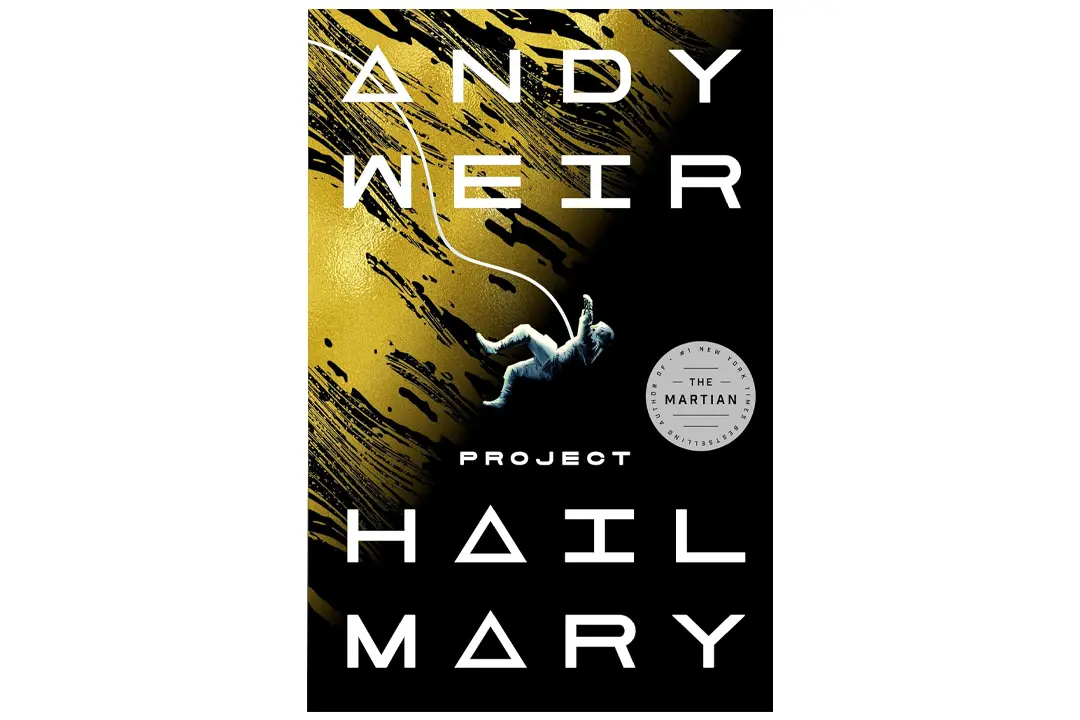
Project Hail Mary – Andy Weir: Book Summary
Beverly Ashford • 11 Mar 2026 • 100 views • 3 min read.Let me tell you about the best science fiction friendship ever written. Andy Weir's first novel, The Martian, was a survival story about a man alone on Mars. His third novel, Project Hail Mary, starts the same way—a man alone in space, facing impossible odds, using science to survive. Then it becomes something else entirely. This is still a book full of orbital mechanics, chemistry, and problem-solving. Weir hasn't changed. But Project Hail Mary has something The Martian didn't: a relationship at its center so strange and so moving that you'll think about it long after you finish. Also, one of the main characters is an alien who looks like a spider made of rocks. Trust me, you'll love him.
Project Hail Mary – Andy Weir: Book Summary
Quick Summary:
- A man wakes alone on a spaceship with no memory of who he is or why he's there
- He slowly realizes he's humanity's last hope against extinction
- He finds an unlikely ally in the most unexpected place
- Published in 2021, it became Weir's biggest success since The Martian
The Setup
Ryland Grace wakes up in a white room. He doesn't know his name. He doesn't know where he is. He's connected to medical equipment. Two corpses lie in beds beside him.
Slowly, through fragments of returning memory, he pieces together the situation:
He's a junior high school science teacher. Or he was. He's also a molecular biologist who published a controversial paper about life existing in non-water environments. That paper got him laughed out of academia.
Then it turned out he was right.
An alien microorganism called Astrophage is eating the sun. Not just our sun—stars throughout the galaxy. Astrophage absorbs stellar energy and migrates between stars, dimming them progressively. If it isn't stopped, Earth will freeze within decades.
Humanity throws everything at the problem. A global project, led by the ruthless but effective Eva Stratt, discovers that one star—Tau Ceti—isn't dimming. Something there is controlling the Astrophage.
Project Hail Mary is humanity's desperate mission: send a ship to Tau Ceti, figure out why that star is different, and bring the answer back to Earth.
The ship needs crew members who can survive the four-year coma required for the journey. Ryland Grace is one of three. Now he's the only one who woke up.
The Discovery
Grace's memory returns in pieces, alternating with his present-day crisis. He has to figure out how to run a spaceship alone, determine if his mission is still possible, and not die in the process.
Then he detects another ship.
An alien ship. Around Tau Ceti. Where no aliens should exist.
The aliens aren't hostile. They're also not human. They come from a planet orbiting 40 Eridani—a species that evolved in high-pressure, high-temperature conditions and sees through sonar, not light.
Grace names the alien "Rocky." Rocky names Grace's species "human."
Rocky is also here to solve the Astrophage problem. His planet is dying too.
The two scientists, from entirely different evolutionary backgrounds, with no common language and incompatible environments, have to figure out how to communicate, share knowledge, and save both their species.
The Friendship
This is the heart of the book.
Grace and Rocky can't breathe the same air. Rocky's atmosphere would kill Grace; Grace's atmosphere would kill Rocky. They communicate through a barrier, developing a shared language from scratch, building trust through scientific collaboration.
Rocky says "amaze" when impressed. He calls problems "bad bad bad." He's enthusiastic, brilliant, and completely devoted to the mission. He's also hilarious without intending to be—his alien perspective creates constant comedy.
But the friendship is genuine. When Grace is in danger, Rocky risks everything to save him. When Rocky is in danger, Grace does the same. They argue like colleagues. They celebrate breakthroughs like friends.
By the end, you understand why Grace makes the choice he makes—because some relationships are worth more than going home.
Key Characters
| Character | Role | Represents |
|---|---|---|
| Ryland Grace | Protagonist, scientist, teacher | Human ingenuity, reluctant heroism |
| Rocky | Eridian scientist, Grace's partner | Alien friendship, collaborative problem-solving |
| Eva Stratt | Project leader on Earth | Ruthlessness in service of survival |
| The Astrophage | Alien microorganism | The threat, but also the energy source |
| Crew members | Die before waking | The cost of the mission |
The Science
Weir loves explaining his work. If you hated the lengthy problem-solving in The Martian, you'll have the same issue here. If you loved it, you're in for a treat.
The science is speculative but grounded. Astrophage is fictional but follows consistent rules. The orbital mechanics are real. The chemistry is accurate. The biology is plausible within its invented framework.
What makes it work is Grace's voice—he thinks like a teacher, explaining concepts clearly even when talking to himself. The reader learns alongside him.
The problem-solving is the plot. Every chapter presents a new obstacle. Grace (and Rocky) figure it out step by step. It's like watching someone work through a physics problem, except the stakes are two species' survival.
The Ending
The solution to the Astrophage problem is found. A natural predator exists on Tau Ceti—a microorganism that eats Astrophage. Grace and Rocky collect samples. They prepare to return to their respective planets.
But there's a problem.
Grace's ship can make it back to Earth with the cure. Rocky's ship cannot make it back to Erid—it was damaged too severely. Rocky will die before reaching home.
Grace has a choice: go home a hero, saving humanity but letting his only friend die, or stay to help Rocky reach Erid, probably never returning to Earth.
He chooses Rocky.
The book ends with Grace living on Erid as the only human among aliens. He teaches science. He's a celebrity. He misses Earth but doesn't regret his choice.
The Eridian children call him "Teacher."
What the Book Is Really About
Science as universal language. Grace and Rocky share nothing except curiosity and methodology. They build communication through observation and experimentation. Science bridges the unbridgeable.
Friendship across difference. The book argues that connection doesn't require similarity. Grace and Rocky are as different as two beings can be. Their friendship is the most human thing in the novel.
Sacrifice without martyrdom. Grace's choice isn't framed as noble death. He survives. He thrives. He just doesn't go home. Sacrifice can be living with consequences, not dying dramatically.
Teaching matters. Grace is repeatedly identified as a teacher. His skill at explaining concepts saves humanity. The book quietly argues that teaching is one of the most important things humans do.
Reluctant heroism. Grace didn't volunteer for the mission. He was essentially drafted, then forced to go when he got cold feet. His heroism isn't innate bravery—it's choosing to do the right thing despite fear.
Frequently Asked Questions
Do I need to read The Martian first?
No. The books are unconnected except by author and style. Project Hail Mary stands completely alone.
Is Rocky really that good a character?
Yes. This sounds like hype. It isn't. Rocky is one of the best characters in recent science fiction—alien enough to be genuinely strange, relatable enough to be lovable.
Is the science too technical?
If you don't enjoy scientific problem-solving, portions will be slow. But Weir explains clearly, and the stakes keep things moving. Try the first fifty pages and see how you feel.
Is there a movie coming?
Ryan Gosling is attached to star in an adaptation. Development has been ongoing; release timing remains uncertain.
How does this compare to The Martian?
Most readers find Project Hail Mary more emotionally satisfying. The Martian is a survival story; this is a survival story with a relationship at its center. The science is similarly rigorous.
Is it appropriate for younger readers?
Some mild language and adult themes, but nothing extreme. Science-loving teenagers would likely enjoy it, though the length and technical content may challenge some.
Here's what Andy Weir achieved.
He wrote a hard science fiction novel that's also a buddy comedy. He created an alien who's more lovable than most human characters in fiction. He took the survival-through-science formula from The Martian and gave it heart.
Project Hail Mary argues that intelligence alone doesn't save species—cooperation does. That friendship can form across impossible divides. That teachers are heroes even when they don't feel like it.
And it argues this while explaining orbital mechanics, xenobiology, and relativistic physics in a way that makes you feel smarter for reading.
By the end, you'll be saying "amaze" yourself.