
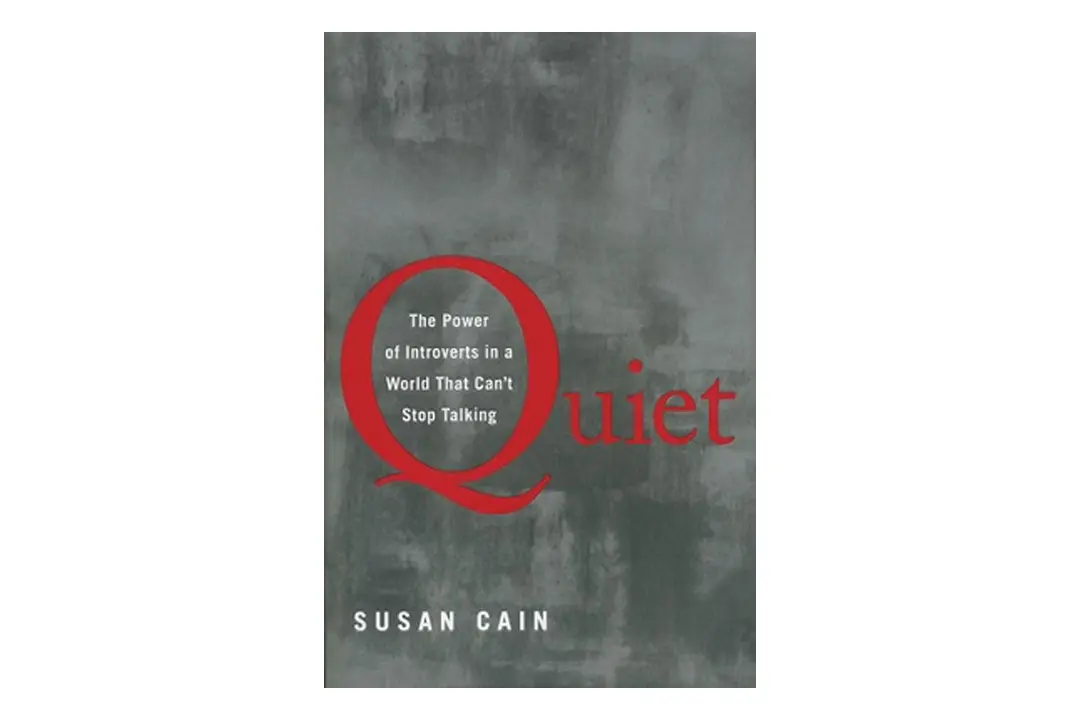
Quiet by Susan Cain: Book Summary
Beverly Ashford • 13 Mar 2026 • 85 views • 3 min read.Let me tell you about the book that made millions of people stop apologizing for needing to recharge alone after a party. Susan Cain published Quiet: The Power of Introverts in a World That Can't Stop Talking in 2012. She spent seven years researching and writing it. Before that she was a Wall Street lawyer and negotiations consultant who spent her career performing extroversion in environments that rewarded it, while privately finding the performance exhausting. The book she wrote is not a self-help manual for introverts. It is an argument — historically grounded, scientifically supported, and culturally specific — that the Western world has built its institutions around a personality ideal that suits roughly half the population and quietly penalizes the other half. The cost of this misalignment, Cain argues, is enormous. For individuals, for organizations, and for the quality of the ideas that shape the world.
Quiet by Susan Cain: Book Summary
Quick Summary:
- A former corporate lawyer argues that Western culture has built an Extrovert Ideal that systematically undervalues introverts — roughly one third to one half of the population
- Published in 2012, it became one of the most discussed nonfiction books of the decade and spawned a TED Talk with over forty million views
- Cain's central claim: introversion is not shyness, not a disorder, and not a problem to be fixed — it is a different way of engaging with the world that carries genuine strengths
- A book that will make introverts feel seen and make extroverts understand their quieter colleagues, partners, and children for the first time
The Extrovert Ideal and How It Got Built
Cain opens with a historical argument. For most of American history, she argues, the dominant cultural ideal was what she calls the Culture of Character — the Victorian notion that a person's worth was measured by inner qualities: honor, duty, integrity, moral seriousness. Public speaking manuals from the nineteenth century advised readers to be sincere rather than impressive.
This shifted dramatically in the early twentieth century as America became an urban, commercial, mass-market society. The new economy rewarded salesmanship, charisma, and the ability to win strangers over quickly. Dale Carnegie's How to Win Friends and Influence People — published in 1936 — is both a symptom and an accelerant of this shift. The Culture of Character became a Culture of Personality, in which the qualities that mattered were the ones visible to others: magnetism, enthusiasm, the ability to command a room.
This is not simply a historical curiosity. The Culture of Personality built the open-plan office, the brainstorming session, the team-based classroom, and the networking event. It built institutions that assume the best ideas emerge from the most vocal people in the room, that collaboration produces better outcomes than solitude, and that leadership requires extroverted presentation. Cain spends the book dismantling each of these assumptions.
What Introversion Actually Is
Cain is careful about definitions because introversion is genuinely misunderstood. It is not shyness — shyness is fear of social judgment, which introverts can feel but which is a separate trait. It is not social anxiety. It is not misanthropy or arrogance or depression.
The most scientifically grounded definition distinguishes introverts and extroverts by their relationship to stimulation. Extroverts need high levels of external stimulation to feel engaged and alive. Introverts reach their optimal performance at lower stimulation levels. Put an extrovert in a quiet room alone and they become bored and restless. Put an introvert in a loud, crowded party and they become overwhelmed and depleted. Neither response is pathological. They are different calibrations of the same nervous system.
This difference has measurable neurological correlates. Introverts show higher baseline arousal in certain brain regions and respond more strongly to stimuli — positive and negative. They process information more deeply and take longer to make decisions, which makes them worse at fast-moving, high-stimulation environments and better at careful analysis, sustained focus, and tasks requiring depth.
The Costs of Ignoring Introvert Strengths
The book's most practically important section examines what organizations lose by building around extrovert norms.
Open-plan offices, which now house the majority of American knowledge workers, are specifically designed to maximize the kind of spontaneous interaction that extroverts find energizing. Research consistently shows they reduce productivity, increase interruptions, impair concentration, and are associated with higher rates of sick leave. The employees most damaged by them are the ones most likely to do the organization's deepest thinking.
Brainstorming — the ubiquitous group ideation practice — has been shown repeatedly to produce fewer and lower-quality ideas than the same number of people working independently and then sharing results. The social dynamics of groups — conformity pressure, production blocking, evaluation apprehension — suppress the most unusual and valuable ideas while amplifying the most confidently stated ones. Confident and correct are not the same thing.
The Harvard Business School case study method, which Cain profiles in detail, produces graduates skilled at arguing any position forcefully in real time — exactly the skills that look like leadership and often are not. The best decisions in most domains require reflection, research, and the willingness to change your mind. None of these are rewarded in a room where social performance is the currency.
The Introvert-Extrovert Relationship
One of the book's most useful sections addresses how introverts and extroverts navigate each other — in workplaces, friendships, and particularly in romantic partnerships where the combination is common and frequently difficult.
Cain argues that the tension usually comes not from incompatibility but from misinterpretation. An introvert who needs to leave a party after two hours is not rejecting their extroverted partner. They are reaching their stimulation limit. An extrovert who processes thoughts by talking them out is not being inconsiderate of the introvert's need for quiet. They are thinking in their natural mode. Understanding the mechanism removes the moral charge from the difference.
The parenting chapters are particularly affecting. Cain addresses parents — usually extroverted ones — who are concerned about introverted children who prefer reading to playdates, who find birthday parties overwhelming, who do not raise their hands in class. Her message is direct: the child is not broken. The environment may be the wrong fit. The goal is not to cure introversion but to help the child understand their own nature and build the skills to navigate a world calibrated for extroverts without losing themselves in the process.
Introvert vs Extrovert Compared
| Dimension | Introverts | Extroverts |
|---|---|---|
| Optimal stimulation level | Lower — prefer quieter, less crowded environments | Higher — energized by social activity and novelty |
| Social recharge | Need alone time after social interaction | Energized by social interaction |
| Decision-making style | Deliberate, research-heavy, slower | Fast, intuitive, comfortable with uncertainty |
| Communication preference | One-on-one or small groups, written | Large groups, verbal, spontaneous |
| Work performance | Stronger in deep focus, independent analysis | Stronger in collaborative, fast-moving environments |
| Leadership style | Tend to listen more, empower teams | Tend to direct more, generate enthusiasm |
| Risk tolerance | Generally more cautious | Generally more comfortable with risk |
| Networking | Draining, prefer depth over breadth | Energizing, comfortable with many connections |
Frequently Asked Questions
Am I introverted or extroverted — and does it matter?
Most people fall somewhere on a continuum rather than at either extreme. Cain introduces the concept of ambiverts — people who sit comfortably in the middle — and notes they may have the most flexible social range. What matters practically is knowing where you fall well enough to design your environment and schedule around your actual needs rather than fighting them.
Is introversion fixed or can it change?
The neurological basis of introversion appears to be largely stable — it is not a phase or a choice. However, people can and do develop skills for navigating environments that do not suit their natural temperament. Cain calls this acting out of character and notes that introverts do it regularly and often effectively. The key distinction is between adapting for specific situations and living permanently in a mode that depletes you.
Does this mean introverts make better leaders?
Not categorically. Cain presents research showing that introverted leaders often outperform extroverted ones when managing proactive teams — teams that bring ideas and take initiative — because they listen and implement rather than override. Extroverted leaders often outperform with passive teams that need direction and motivation. The match between leader type and team type matters more than either trait in isolation.
How does this book relate to the Myers-Briggs?
The introvert-extrovert dimension is one of the four axes in the Myers-Briggs Type Indicator. Cain engages with MBTI but draws more heavily on the Big Five personality research, which is more empirically robust. The core introvert-extrovert distinction is one of the most reliably replicated findings in personality psychology regardless of which framework you use.
Is this book only for introverts?
Cain addresses this directly. The book is useful for introverts as validation and as practical strategy. It is equally useful for extroverts who manage, parent, or partner with introverts — understanding the mechanism changes how you interpret behavior that might otherwise seem antisocial, arrogant, or unengaged.
What should I read next?
Quiet Power by Susan Cain applies the same framework specifically to children and teenagers. The Highly Sensitive Person by Elaine Aron covers overlapping territory — many highly sensitive people are also introverted — with a focus on sensory processing. Deep Work by Cal Newport is a practical companion on building the conditions for the kind of concentrated work where introverts often excel.
The Bottom Line
Here is what Susan Cain actually argued.
Western institutions — schools, offices, churches, social norms — were built around an Extrovert Ideal that treats outgoing, gregarious, verbally assertive people as the default and everyone else as a variation in need of correction.
This is not neutral. It shapes who gets promoted, whose ideas get heard in meetings, which children get labeled as gifted versus withdrawn, and which leadership qualities get recognized versus overlooked.
Roughly half the population experiences the world differently — processes more deeply, needs more recovery time, thinks before speaking, finds large groups draining rather than energizing. This is not a disorder. It is not a deficit. It is a different relationship to stimulation that carries genuine strengths and genuine costs depending on the environment.
The book does not argue that introverts are better than extroverts. It argues that the world works better when it stops treating one as the standard and the other as the problem.
That is a reasonable argument.
And for a very large number of readers, it is the first time anyone has made it directly to them.