
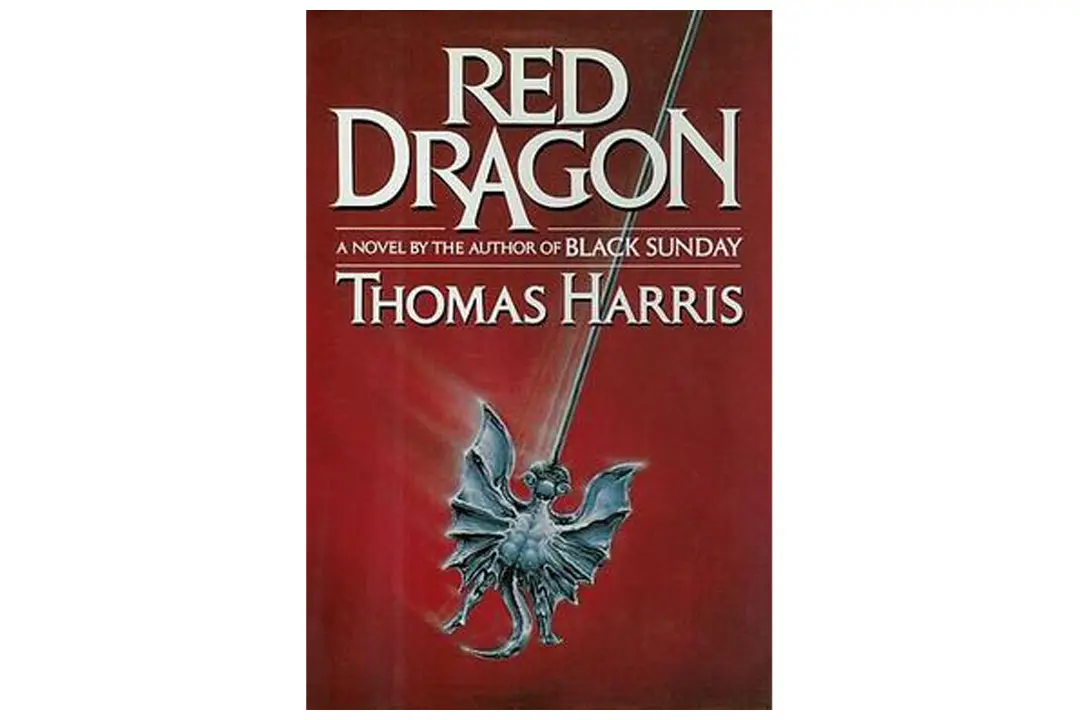
Red Dragon by Thomas Harris: Book Summary
Beverly Ashford • 20 Feb 2026 • 83 views • 4 min read.Let me tell you about the novel that created the template for every psychological thriller published in the forty years since — and introduced a villain so compelling that he eventually consumed the franchise that contained him. Thomas Harris published Red Dragon in 1981. He had been a crime reporter and had spent time with FBI agents studying criminal behavior — experience that gave him access to the specific texture of what profiling actually involves and what it actually costs. He took that knowledge and built something that the genre had not seen before: a thriller where the most frightening presence is not the killer the protagonist is hunting but the imprisoned man he visits for help. Hannibal Lecter appears in three scenes. He does not need more than three scenes. By the time Harris finished writing him, Lecter had become one of the most discussed characters in crime fiction before the book had been out long enough to generate a substantial readership. The Silence of the Lambs — the sequel — turned that character into a cultural phenomenon. Red Dragon is where it started.
Red Dragon by Thomas Harris: Book Summary
Quick Summary:
- A retired FBI profiler is pulled back to consult on a series of family murders and must do the one thing he most fears — reenter the mind of Dr. Hannibal Lecter to catch a killer even more dangerous than the man he already captured
- Published in 1981, it introduced both Will Graham and Hannibal Lecter to the world and invented the modern psychological crime thriller
- Harris's central achievement: a villain so fully realized that he dominates every scene he appears in despite being imprisoned for the entire novel
- A book about the cost of empathy as a professional tool and what it does to the person who uses it
Will Graham
Will Graham is the FBI's most gifted criminal profiler and the most reluctant person in the novel about being that. He caught Hannibal Lecter three years before the story begins — during which process Lecter nearly killed him, leaving him with physical scars and psychological damage that made continuation in the FBI impossible.
He retired to Florida with his wife Molly and her son Willy. He repairs boat engines. He does not talk about the work he used to do.
His former supervisor Jack Crawford drives to Florida to ask for his help. Two families have been murdered in their homes on successive full moons — the Jacobi family in Birmingham and the Leeds family in Atlanta. The pattern suggests a third murder is coming. Crawford needs Graham.
Graham's gift — and Harris is specific about what it is — is not deduction in the Holmesian sense. It is empathy in its most extreme and least comfortable form: the ability to think like the people he hunts by genuinely inhabiting their perspective. He does not observe crime scenes and reason toward conclusions. He stands in the rooms where things happened and feels his way into the psychology of the person who did them.
This makes him extraordinarily effective. It also means that hunting monsters requires becoming, temporarily and partially, something like a monster — and that repeated exposure leaves residue that does not fully wash off. Graham knows what that process has already cost him. He comes back anyway because Crawford tells him children will die if he does not, and Graham cannot say no to that argument.
Hannibal Lecter
Lecter is confined to a maximum-security cell at the Baltimore State Hospital for the Criminally Insane. The cell is specifically designed — no physical contact possible, all items passed through a sliding door, a guard stationed outside at all times. Dr. Frederick Chilton, the hospital's administrator, controls access with the specific jealousy of a man who understands that his most famous patient is more interesting than he will ever be.
Graham needs Lecter because Lecter is the only person whose perspective might illuminate the Tooth Fairy's psychology — the killer Graham is hunting has a level of internal complexity that requires a reference point, and Lecter is the reference point Graham has.
The visit scenes are among the most precisely written in crime fiction. Harris calibrates the power dynamic with care. Graham is free and Lecter is imprisoned, but Lecter controls every conversation they have — he reads Graham's vulnerability with the accuracy of a surgeon, offers observations that are simultaneously helpful and designed to damage, and treats the interaction as an intellectual exercise he is winning.
Lecter does not help Graham out of civic virtue. He helps because Graham interests him, because the Tooth Fairy interests him, and because the game — the mutual examination of two minds against each other through bars — is the only stimulation available to him.
Harris gives Lecter three scenes and uses each one to reveal a different dimension: the clinical intelligence, the aesthetic sensibility, the capacity for genuine cruelty deployed with perfect courtesy. By the third scene, the reader understands why Graham is afraid of him in ways that go beyond physical danger.
Francis Dolarhyde
The Tooth Fairy — Francis Dolarhyde — is the novel's most formally ambitious element. Harris alternates between Graham's investigation and Dolarhyde's perspective, giving readers direct access to the killer's psychology in ways that crime fiction rarely attempts.
Dolarhyde grew up profoundly damaged — a cleft palate, an abusive grandmother, a childhood of institutional neglect and cruelty. He is now a film technician at a commercial processing company who has access to the home movies of the families he selects as victims. He watches them before he kills them. He watches them as families — as things he never had and cannot have — and the watching is part of both the desire and the rage.
Harris does something unusual and risky: he makes Dolarhyde comprehensible without making him sympathetic. The reader understands how Francis Dolarhyde became the Tooth Fairy without being asked to forgive it or excuse it. The portrait is clinical and specific and achieved without sentimentality.
The subplot involving Dolarhyde's relationship with Reba McClane — a blind woman who works at his company, who sees him without seeing what he has become — is the novel's most painful thread. Reba is genuine. Her effect on Dolarhyde is genuine. The collision between who Dolarhyde might have been and what he has become, concentrated in their relationship, is where Harris locates the novel's tragedy.
The Investigation
Harris structures the thriller plot with competent efficiency — the procedural elements of the FBI investigation are accurate and specific without becoming technical in ways that slow the narrative. The crime scene analysis, the behavioral profiling process, the use of the National Crime Information Center, the forensic detail — these are period-accurate and grounded in Harris's actual reporting experience.
The investigation's critical vulnerability is Lecter, who eventually finds a way to communicate Dolarhyde's location and the nature of Graham's investigation to Dolarhyde despite the containment protocols. The information exchange — conducted through a coded message published in a journal that Graham should have caught and did not — accelerates the novel's final act and gives Lecter a role in the outcome that his physical confinement should have prevented.
Key Characters Compared
| Character | Core Quality | Greatest Strength | What It Costs Them |
|---|---|---|---|
| Will Graham | Empathic imagination — can inhabit any psychology | Unmatched profiling ability | His own psychological stability and peace |
| Hannibal Lecter | Comprehensive intelligence deployed without ethical constraint | Perfect psychological insight and total self-possession | Confinement — the only thing that can contain him |
| Francis Dolarhyde | Damaged yearning transformed into violence | The Tooth Fairy persona functions as identity armor | Any possibility of the ordinary life he sometimes wants |
| Jack Crawford | Tactical intelligence and institutional authority | Assembles the right people for impossible problems | His agents — he uses them with full knowledge of the cost |
| Reba McClane | Genuine perception unclouded by appearance | Sees Dolarhyde's humanity accurately | Becomes collateral in a collision she could not have anticipated |
| Molly Graham | Ordinary courage | Grounds Graham in a life worth protecting | Her certainty that she can hold him to the ordinary world |
| Freddy Lounds | Tabloid opportunism | Access and shamelessness | Everything, eventually |
Frequently Asked Questions
Should I read Red Dragon before The Silence of the Lambs?
Chronologically yes — Red Dragon introduces Graham, Lecter, and the behavioral science unit that Clarice Starling joins in Silence of the Lambs. Lecter is a more controlled and in some ways more frightening figure in Red Dragon than he becomes in subsequent novels, because Harris had not yet discovered how popular the character would become and had not yet started making accommodations for that popularity. Reading in order gives the fuller arc.
Is this more a procedural or a psychological thriller?
Both, in roughly equal proportions. The FBI investigation is procedurally grounded and accurately detailed. The psychological content — Graham's empathic process, Dolarhyde's internal world, Lecter's analytical methods — is where Harris's real interest lies and where the novel distinguishes itself from competent procedural thrillers. The procedural frame gives the psychological content a structure to operate within.
How does Anthony Hopkins's Lecter compare to the novel's version?
Hopkins plays a warmer and more theatrical Lecter than Harris wrote — the famous fava beans and Chianti line is a Hopkins addition to tone and delivery that has no equivalent in the novel's register. Harris's Lecter is colder, more precisely courteous, and more explicitly predatory without the film's almost camp quality. Both interpretations are valid; they are doing different things. Brian Cox played Lecter in the 1986 Manhunter adaptation of Red Dragon — his performance is closer to Harris's clinical original.
Is Dolarhyde a sympathetic character?
Harris invites understanding without demanding sympathy — a careful distinction that most writers in the genre do not maintain. Readers who finish the novel will understand Dolarhyde's psychology completely. Whether that understanding produces sympathy is a reader response Harris does not try to control. The Reba McClane subplot tilts toward sympathy in specific moments. The murders do not.
What makes this different from later serial killer thrillers?
Red Dragon arrived before the genre existed in its current form. The specific elements it established — the profiler who thinks like the killer, the imprisoned expert whose help comes at psychological cost, the dual perspective between hunter and hunted, the behavioral science framework — were innovations in 1981. Everything that followed exists in relationship to what Harris built here, which means Red Dragon can feel familiar on first read to readers who have absorbed the genre's conventions without reading the original text.
What should I read next?
The Silence of the Lambs is the immediate continuation and the novel that took everything Harris built in Red Dragon and refined it to its highest expression. Minette Walters's crime novels — particularly The Sculptress and The Ice House — operate in similar psychological territory with comparable craft. Patricia Cornwell's Postmortem introduced Kay Scarpetta and the forensic procedural strand of the genre that Red Dragon's investigative material helped make possible.
The Bottom Line
Here is what Thomas Harris actually built in 1981 without knowing what he was starting.
Not a serial killer thriller in the genre sense — the genre did not exist yet. A novel about what it costs to understand violence from the inside — to use empathy not as a healing tool but as an investigative one, to spend professional hours in the psychology of people who have done what Francis Dolarhyde did to the Leeds and Jacobi families.
Will Graham is the best at this work. He is also the person most damaged by doing it. Harris does not separate these facts. The gift and the cost are the same thing — the ability to feel his way into any psychology, including the ones that have been doing things to families in their homes on full moon nights.
Lecter knows this. It is why he finds Graham interesting. It is why the visits are dangerous in ways that go beyond physical threat.
And somewhere in Atlanta and Birmingham, families that existed as home movies are gone.
Graham catches the Tooth Fairy.
He pays for it in the specific currency that this kind of work always demands.
The bill comes due whether you want it to or not.
Harris knew that from his years as a crime reporter.
He put it on the page without flinching.