
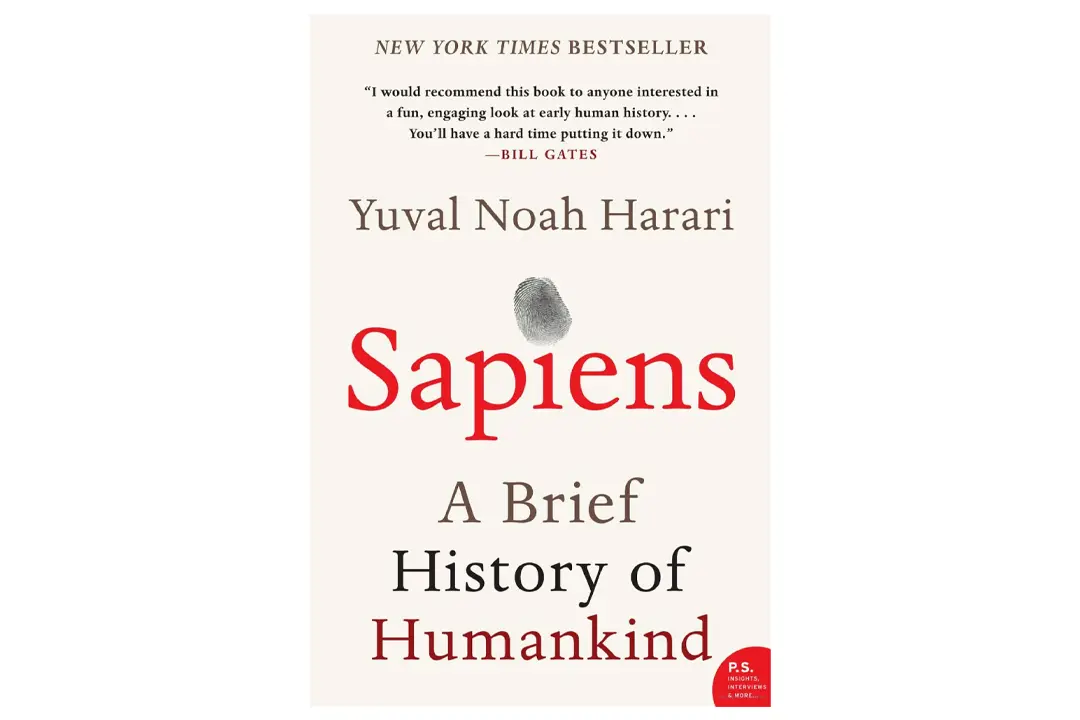
Sapiens: A Brief History of Humankind – Yuval Noah Harari: Book Summary
Beverly Ashford • 11 Mar 2026 • 56 views • 3 min read.Let me tell you about the book that makes you question everything you thought you knew about being human. Yuval Noah Harari, an Israeli historian, wrote a book that covers 70,000 years in 400 pages. That sounds impossibly ambitious. It is. And somehow it works. Sapiens became a massive bestseller—recommended by Bill Gates, Mark Zuckerberg, and Barack Obama. It spawned sequels and made Harari a public intellectual. People who never read history read this book. Why? Because Harari doesn't just describe what happened. He asks why humans became dominant—and whether that dominance made us any happier. The answers are uncomfortable.
Sapiens: A Brief History of Humankind – Yuval Noah Harari: Book Summary
Quick Summary:
- A sweeping history of humanity from 70,000 years ago to today
- Humans conquered the world through shared fictions and collective imagination
- Agriculture was history's biggest fraud—it made life worse for individuals
- Published in 2011, it became a global phenomenon that changed how millions see human history
The Cognitive Revolution
About 70,000 years ago, something changed in Homo sapiens.
We weren't the only human species. Neanderthals existed. Homo erectus existed. Homo floresiensis existed. Multiple human species shared the planet.
Then, suddenly, Sapiens exploded out of Africa and took over everything. Within a few thousand years, we'd spread to every continent. Within a few more, every other human species was extinct.
What happened?
Harari's answer: the Cognitive Revolution. Something changed in our brains that gave us a new superpower—the ability to create and believe in shared fictions.
Other animals can communicate about reality: "There's a lion by the river." Only humans can communicate about things that don't exist: "There's a god who wants us to behave this way." Or: "This piece of paper is worth ten goats." Or: "This line on the ground separates our country from theirs."
These shared fictions allow strangers to cooperate in large numbers. Chimpanzees can cooperate in groups of maybe 50. Humans can cooperate in groups of millions—because we share beliefs in nations, religions, money, and human rights.
None of these things are physically real. Try finding "the United States" in nature. Try locating "Google" or "human rights" under a microscope. They exist only because we collectively agree they exist.
This is our superpower. We dominate the planet not because we're stronger or smarter as individuals, but because we can flexibly cooperate in massive groups, united by shared myths.
The Agricultural Revolution
About 10,000 years ago, humans invented farming. Harari calls it "history's biggest fraud."
The conventional story: Agriculture was progress. Humans stopped wandering, settled down, built cities, developed civilization. Forward motion.
Harari's counterargument: Agriculture made life worse for most people.
Hunter-gatherers worked less—maybe 20-35 hours per week. They ate diverse, nutritious diets. They suffered less from infectious disease (small, mobile groups don't spread plagues). They weren't locked into hierarchies.
Farmers worked harder. Much harder. Backbreaking labor in fields, dependent on a few crops, vulnerable to famine when those crops failed. Diseases spread in dense settlements. Hierarchy emerged—kings, priests, slaves.
Then why did agriculture spread?
Because it supported more people per acre. Agricultural societies had more babies, even if those babies lived worse lives. Population growth is its own logic.
The trap: Once you adopt agriculture, you can't go back. Your population grows beyond what hunting and gathering can support. You're locked in.
Harari isn't saying we should return to foraging. He's making a different point: progress for the species isn't the same as progress for individuals. More humans doesn't mean happier humans.
The Unification of Humankind
History moves toward larger scales of cooperation.
Small bands became tribes. Tribes became kingdoms. Kingdoms became empires. Empires became global systems.
Three forces unified humanity:
Money is a universal fiction. Everyone believes in it, so it enables trade between strangers. A Christian merchant in Italy can trade with a Muslim merchant in Egypt because both believe in the value of gold coins. Money doesn't require shared gods or languages—just shared faith in the currency.
Empire spreads culture, language, and ideas. It's violent and oppressive, but it also creates larger identities. People stop being only members of tribes and become citizens of empires.
Religion provides shared values and cosmic justification. Monotheistic religions especially enabled cooperation across ethnic boundaries—Christians or Muslims are connected through faith, not blood.
These forces are still operating. Global capitalism, international institutions, and universal ideologies continue unifying humanity into a single system.
Key Concepts
| Concept | What It Means | Implications |
|---|---|---|
| Cognitive Revolution | Humans gained ability to create shared fictions | Enabled mass cooperation |
| Agricultural Revolution | Shift from foraging to farming | More people, harder lives |
| Imagined orders | Social structures based on shared beliefs | Nations, religions, corporations |
| The luxury trap | Conveniences become necessities | Progress traps us in new work |
| The unification of humankind | History moves toward larger cooperation | Global systems emerge |
| Scientific Revolution | Humans admit ignorance, seek discovery | Power through knowledge |
| Capitalism | Money reinvested for growth | Endless expansion, endless desire |
The Scientific Revolution
About 500 years ago, another transformation began.
Before this, humans thought they already knew everything important. Religion provided answers. Tradition provided guidance. Progress was not a concept.
The Scientific Revolution changed everything. Its core insight: We don't know. And: We can find out.
This sounds obvious now. It wasn't obvious then. The willingness to admit ignorance, systematically investigate nature, and apply discoveries practically—that combination was new.
Science created power. European empires conquered the world not because of moral superiority but because of gunpowder, navigation, and medicine. Knowledge became power in the most literal sense.
Science married capitalism. The expectation of growth—that tomorrow will be richer than today—drove investment in research. Banks funded expeditions because discoveries would repay loans.
Science didn't operate alone. It was funded by governments and corporations seeking power and profit. Science is not a neutral pursuit of truth—it's shaped by who pays for it.
The Question of Happiness
Harari's most provocative question: Has all this progress made us happier?
We have more stuff. We live longer. We have iPhones and medicine and climate control. But are we happier than Stone Age foragers sitting around a fire?
Harari suspects not.
Happiness seems to depend on expectations versus reality. Medieval peasants with low expectations might have been as satisfied as modern workers with high expectations and constant anxiety.
Buddhism suggests that happiness is about accepting reality, not changing it. Yet our entire civilization is built on not accepting reality—on constantly striving for more.
We may have optimized for population growth and power accumulation while ignoring the actual experience of being human.
The Future: Homo Deus
Harari ends by looking forward.
We're on the verge of becoming gods—but not like the gods we imagined.
Biological engineering might redesign our bodies and minds. Cyborg technology might merge us with machines. Artificial intelligence might create non-organic life.
The era of Homo sapiens may be ending. What comes next might be as different from us as we are from Neanderthals.
This isn't science fiction. These technologies are developing now. The question isn't whether the future will be radically different, but what we want that future to be.
Frequently Asked Questions
Is Harari a credible historian?
He's a legitimate academic—PhD from Oxford, professor at Hebrew University. But Sapiens simplifies complex debates. Specialists often disagree with his sweeping claims. It's an interpretation of history, not a textbook.
Is the "agricultural fraud" argument accepted?
Controversial. Many historians agree that early agriculture made individual lives harder. Others argue the picture is more complex. Harari's framing is provocative but not consensus.
Is this depressing?
Some readers find it so. Harari questions progress narratives and human exceptionalism. If you're attached to believing humanity is special and history is improvement, this challenges those beliefs.
Should I read the sequels?
Homo Deus (about the future) and 21 Lessons for the 21st Century (about the present) continue his thinking. They're also worth reading, though some feel he's repeating himself.
What's the main takeaway?
Humans rule the world through shared fictions—money, nations, religions, corporations. Understanding this changes how you see everything. The systems that govern us exist because we collectively believe in them.
The Bottom Line
Here's what Yuval Noah Harari achieved.
He wrote a history of humanity that makes you see yourself differently. Not as the pinnacle of evolution, but as one species among many that happened to develop a peculiar skill: believing in things that don't exist.
That skill made us powerful. Whether it made us happy is another question entirely.
Sapiens doesn't tell you what to think. It makes you think. About progress, about meaning, about what kind of future we want to build.
You'll never look at money, religion, or your country quite the same way again.