
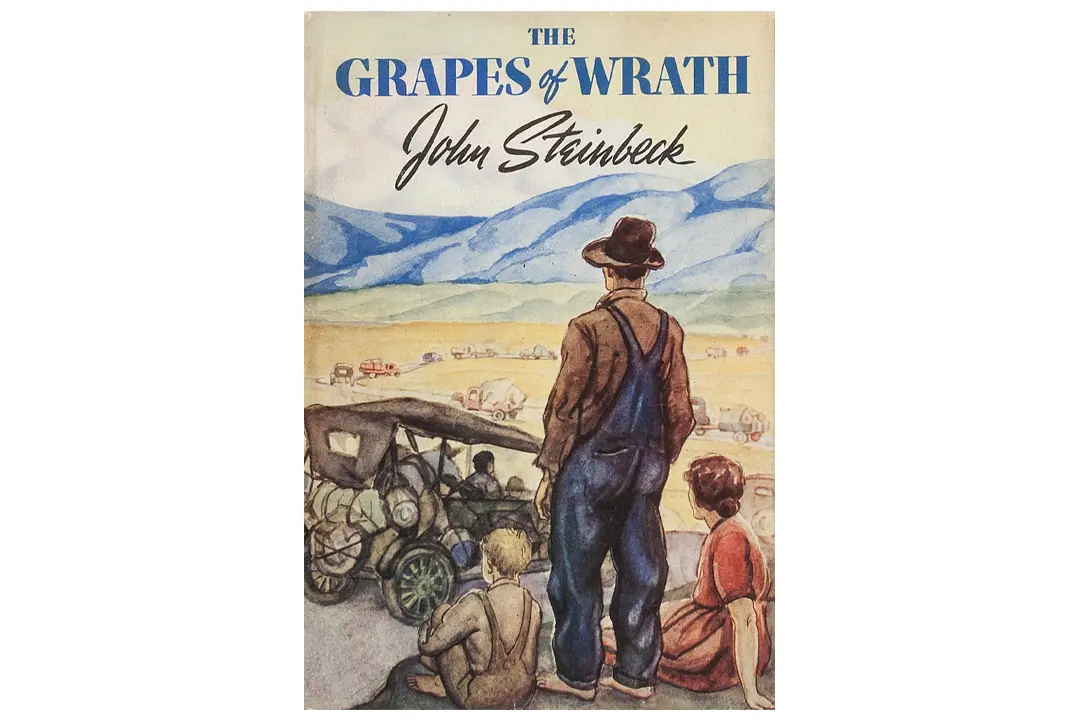
The Grapes of Wrath – John Steinbeck: Book Summary
Beverly Ashford • 10 Mar 2026 • 65 views • 3 min read.Let me tell you about the book that got banned, burned, and denounced as communist propaganda—and then won the Pulitzer Prize. John Steinbeck spent years researching migrant labor camps. He lived with displaced families. He saw children dying of malnutrition in the richest agricultural state in America. When he wrote The Grapes of Wrath, he wasn't making things up. He was reporting what he'd witnessed, wrapped in fiction powerful enough to make America look at itself. The book was called dangerous because it was true. Growers in California tried to suppress it. Oklahoma banned it. Libraries refused to stock it. None of that stopped it from becoming one of the most important American novels ever written. Here's the story that caused all that trouble.
The Grapes of Wrath – John Steinbeck: Book Summary
Quick Summary:
- The Joad family flees the Oklahoma Dust Bowl for the promise of California
- They find exploitation, poverty, and brutal hostility instead of opportunity
- The novel exposes how capitalism treats its most vulnerable
- Published in 1939, it remains devastatingly relevant to migrant workers today
The Dust Bowl Exodus
Oklahoma, 1930s. The land is dying.
Years of drought and poor farming practices have turned the soil to dust. Winds carry away topsoil that took centuries to form. Crops fail. Banks foreclose on farms that families have worked for generations. Tractors arrive to plow under homes, and there's nobody to fight—just corporations, just the bank, just the system.
The Joads are one of thousands of families with nowhere left to go. Tom Joad has just been released from prison after serving time for killing a man in a fight. He returns home to find his family preparing to leave—everything they own loaded onto an ancient truck, heading west.
California. The word spreads through the camps, the roadsides, the dispossessed: California has work. California has fruit to pick. California needs hands.
Handbills appear: "800 Pickers Wanted." The promise of wages. The promise of a new start.
What the handbills don't say: there are thousands of desperate families for every job. The growers know this. They've distributed the handbills intentionally, flooding the labor market so they can pay starvation wages. Supply and demand, working exactly as designed.
The Journey West
The novel alternates between the Joad family's specific story and broader interchapters that describe the migration in panoramic, almost biblical scope.
The Joad family loads thirteen people onto a converted Hudson truck: Tom, Ma, Pa, Uncle John, Grandpa, Grandma, pregnant Rose of Sharon and her husband Connie, children Ruthie and Winfield, and Tom's friend, the former preacher Jim Casy.
Grandpa dies almost immediately, unable to leave the land he's known all his life. They bury him by the roadside. Grandma dies crossing the desert, though Ma holds her dead body all night to keep the family moving.
Route 66 becomes a river of jalopies, all flowing west. The Joads meet other families, share camps, trade stories and warnings. Car dealers cheat them. Locals despise them. The word "Okie" becomes a slur.
California arrives not as paradise but as armed hostility. The Joads find Hoovervilles—camps of desperate families living in cardboard and tin, starving while orchards overflow with unpicked fruit. Wages drop because too many workers chase too few jobs. Anyone who protests is arrested or beaten.
The Weedpatch Camp provides brief respite—a government-run facility with sanitation, self-governance, and dignity. But there's no work nearby, and they can't stay.
The final act brings work picking peaches at starvation wages while strikers outside protest. Tom discovers that Jim Casy has become a labor organizer. That night, Casy is killed by vigilantes. Tom kills his murderer and must go into hiding, becoming a fugitive again.
The novel ends with the Joads in a barn during floods, having lost everything. Rose of Sharon, whose baby was born dead, breastfeeds a dying stranger—an act of radical generosity amid complete devastation.
Key Characters
| Character | Role | Significance |
|---|---|---|
| Tom Joad | Protagonist, ex-convict | Transforms from individual survival to collective consciousness |
| Ma Joad | Family matriarch | Holds family together through will alone |
| Pa Joad | Family patriarch | Watches his authority and purpose erode |
| Jim Casy | Former preacher | Moral philosopher, becomes labor martyr |
| Rose of Sharon | Tom's pregnant sister | Represents hope, loss, and ultimate generosity |
| Grandpa/Grandma | Elders | Die as the old life dies |
| Uncle John | Pa's brother | Carries guilt that represents collective burden |
| Connie | Rose of Sharon's husband | Abandons family when dreams fail |
The Structure: Personal and Universal
Steinbeck alternates between Joad chapters and interchapters. The interchapters pull back to show the migration writ large—the used car lots that cheat migrants, the corporate farms that exploit them, the truck stops, the camps, the system.
This structure makes a political argument: the Joads aren't exceptional. They're one family among hundreds of thousands. Their suffering is individual and universal simultaneously.
The technique can feel preachy to modern readers. Steinbeck isn't subtle about his sympathies. He wants you angry. He wants you to see that this suffering is constructed, not natural—the result of choices made by people who could have chosen differently.
What Steinbeck Is Really Saying
The American Dream is a lie for many. The Joads believe in the promise—work hard, stay honest, prosper. California proves that the game is rigged. There's no amount of hard work that compensates for a labor market designed to exploit desperation.
"I" must become "we." Tom's transformation is the novel's emotional core. He begins focused on his own survival. By the end, after Casy's death, he articulates a different vision: "I'll be ever'where—wherever you look... Wherever they's a cop beatin' up a guy, I'll be there."
The family expands. The Joads start as a tight family unit, suspicious of outsiders. Through suffering, they learn that survival requires solidarity with strangers. Ma Joad's final words direct Rose of Sharon to feed an unknown man: family has become humanity.
Dignity is revolutionary. The Weedpatch Camp scenes show that treating people with dignity costs almost nothing but changes everything. The government camp has rules, sanitation, community—and it works. The contrast with private grower camps indicts a system that chooses cruelty.
The Ending That Shocked Readers
The final scene has Rose of Sharon, having just lost her stillborn baby, breastfeeding a starving stranger in a barn during a flood.
It shocked readers in 1939. Some found it inappropriate. Others found it profound—a symbol of human generosity at its most basic, a Pietà with reversed roles, proof that even amid complete disaster, people can choose to help each other.
Steinbeck wrote and rewrote this ending. He knew it would be controversial. He kept it because nothing else was true enough.
Frequently Asked Questions
Did conditions really get that bad?
Actually worse. Steinbeck softened some details. Real migrant camps had higher death rates, especially among children. The violent suppression of organizing was documented. Steinbeck was accused of exaggeration by people who had financial interests in denying the truth.
Why was it banned?
Growers and business interests called it communist propaganda. Oklahoma objected to its portrayal of Okies. Kern County, California—where much of the novel takes place—banned it from schools and libraries. The banning increased sales.
Is it preachy?
By modern standards, yes. Steinbeck has an agenda and doesn't hide it. The interchapters sometimes read like essays. Whether this bothers you depends on your tolerance for explicit political argument in fiction.
What happened to migrant workers after the book?
Conditions improved somewhat due to public attention. Then the Dust Bowl migrants were replaced by Mexican and other immigrant workers, and the exploitation continued. The farm labor system Steinbeck described still exists in modified form.
How does this relate to Tom Joad's famous speech?
Tom's speech to Ma—"I'll be ever'where"—became iconic, adapted by Woody Guthrie into "The Ghost of Tom Joad" and later by Bruce Springsteen. It articulates a vision of solidarity that transcends individual mortality.
Should I read this if I already know the story?
Yes. The plot is only part of it. Steinbeck's prose—particularly in the interchapters—creates something between fiction and poetry. The experience of reading it can't be summarized.
The Bottom Line
Here's what Steinbeck accomplished.
He took a contemporary crisis and gave it faces. He made readers feel what statistics could never convey. He showed that poverty isn't a character flaw but a system working as designed for someone's benefit.
The novel is angry. The anger is righteous. Steinbeck watched children die in a state that could have fed them, and he wanted readers to feel that outrage.
Eighty-five years later, migrant workers still face exploitation. Housing crises still displace families. Corporations still flood labor markets to suppress wages. The specifics change; the dynamics endure.
The Grapes of Wrath isn't historical fiction. It's a mirror.