
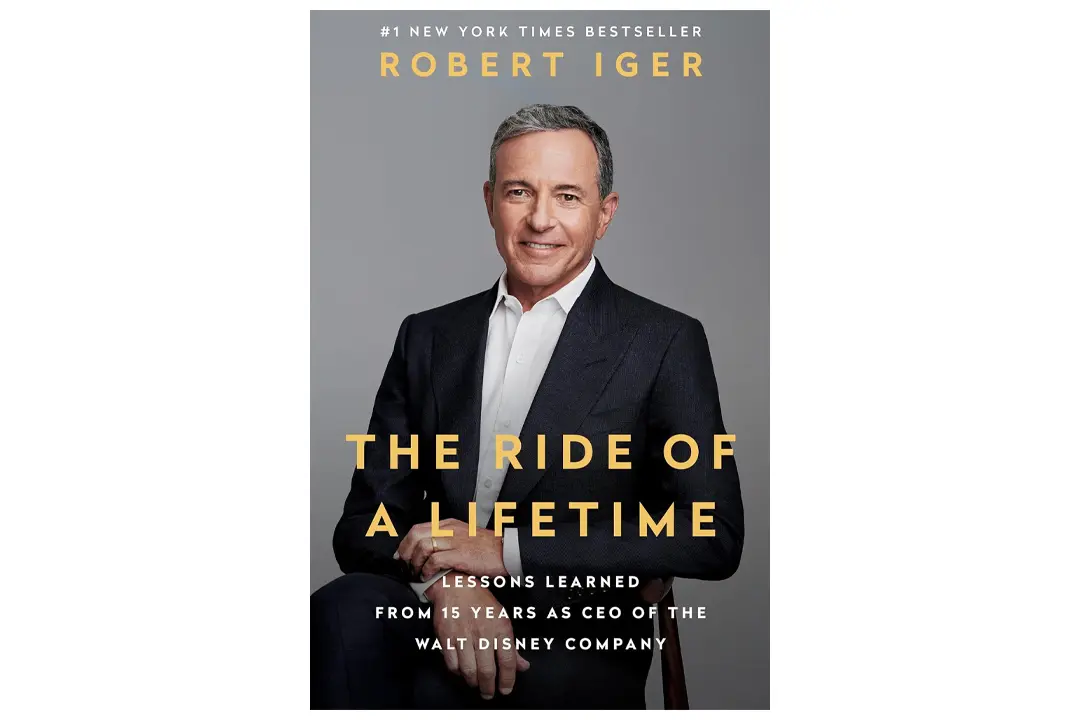
The Ride of a Lifetime by Robert Iger: Book Summary
Beverly Ashford • 13 Mar 2026 • 54 views • 3 min read.Let me tell you about the business memoir that makes leadership look less like conquest and more like sustained, disciplined attention paid to the right things at the right time. Robert Iger published The Ride of a Lifetime in 2019 after fifteen years as CEO of The Walt Disney Company. He took over in 2005 when Disney was demoralized, creatively stagnant, and locked in a destructive feud with Pixar — the animation studio that was producing the most beloved films in the world while Disney struggled to find its footing. By the time he stepped down in 2020, Disney had acquired Pixar, Marvel, Lucasfilm, and 21st Century Fox. It had launched Disney+ and positioned itself as the dominant force in global entertainment. The company's market capitalization had grown from forty-eight billion dollars to two hundred fifty billion. Iger does not write about this as triumph. He writes about it as a series of consequential decisions made with incomplete information by a person who was genuinely uncertain whether he was making the right call. That honesty is what separates this book from most CEO memoirs, which tend to reconstruct uncertainty as wisdom in hindsight.
The Ride of a Lifetime by Robert Iger: Book Summary
Quick Summary:
- The CEO who transformed Disney over fifteen years shares the leadership principles behind five of the biggest acquisitions in entertainment history
- Published in 2019, it covers Pixar, Marvel, Lucasfilm, and 21st Century Fox — deals that reshaped how the world watches stories
- Iger is unusually honest about self-doubt, failure, and the specific moments where everything could have gone differently
- A leadership memoir that reads like a quiet antidote to the aggressive, domineering CEO archetype
The Early Career: Learning Before Leading
Iger spent decades at ABC before Disney acquired the network. He was not a prodigy. He was not the most obviously talented person in the room. What he was, consistently, was organized, calm under pressure, and willing to take on work that other people found beneath them or too difficult.
He describes his early mentor Roone Arledge — the legendary ABC Sports and News president — as the most important influence on his understanding of creativity and ambition. Arledge taught Iger that quality was not one consideration among many. It was the only consideration that mattered over the long term. Everything else — cost, convenience, politics — was a distraction from the question of whether the thing you were making was genuinely excellent.
Iger also worked closely with Tom Murphy and Dan Burke at Capital Cities, the company that acquired ABC and was itself later acquired by Disney. From Murphy and Burke he learned restraint, decency, and the importance of treating people with respect regardless of their position. These two influences — Arledge's creative ambition and Murphy and Burke's human decency — became the dual foundation of Iger's leadership approach.
The Three Priorities
When Iger became CEO he did something unusual. He identified three strategic priorities and communicated them clearly, repeatedly, and without qualification. He did not have fifteen priorities. He had three.
First: invest in high-quality branded content. Disney's competitive advantage was its ability to create stories people loved across generations. Everything had to flow from that creative foundation.
Second: embrace technology. The entertainment industry was being disrupted by digital distribution and Iger believed that Disney had to lead that disruption rather than resist it. This conviction eventually produced Disney+, which launched in 2019 with over ten million subscribers on its first day.
Third: become a truly global company. Disney's existing international presence was insufficient for a world where the largest entertainment markets were increasingly outside the United States.
Three priorities. Consistently communicated. Every major decision ran through those three filters. The clarity made the acquisitions legible — each one was directly traceable to at least one of the three priorities, usually all of them.
The Acquisitions
The Pixar deal is the emotional center of the book. Disney's relationship with Pixar had collapsed under Iger's predecessor Michael Eisner — Steve Jobs, who owned Pixar, had publicly declared the partnership over. Iger's first call after being named CEO-designate was to Jobs, before the appointment was publicly announced, to say that repairing the relationship was his first priority.
The conversation began a negotiation that ended with Disney acquiring Pixar for seven point four billion dollars and Jobs becoming Disney's largest individual shareholder. Iger's willingness to give the Pixar creative team — John Lasseter and Ed Catmull — full creative authority over Disney Animation as well as Pixar was the decisive element. He was not acquiring an asset. He was acquiring a culture and he understood that the culture required protection to survive the acquisition.
Marvel followed in 2009 for four billion dollars. Most analysts thought Disney overpaid. The Marvel Cinematic Universe subsequently became the highest-grossing film franchise in history. Iger admits he did not fully anticipate the MCU's scale but believed deeply in the value of Marvel's character library and its connection to audiences.
Lucasfilm in 2012 for four billion dollars brought Star Wars into the Disney portfolio. The meeting with George Lucas was delicate — Lucas was protective of his legacy in ways that required Iger to navigate carefully between honoring what Lucas had built and communicating honestly that Disney would take the franchise in new directions.
The Fox acquisition in 2019 for seventy one billion dollars was the largest and most complex — a deal that added significant content libraries, international assets, and the FX network while requiring extensive regulatory navigation.
The Leadership Principles
Iger organizes the book around principles rather than chronology. The principles are direct and practiced rather than theoretical.
Optimism is the first. Not naive optimism but the disciplined communication of genuine belief that problems can be solved. Leaders who project pessimism produce pessimistic organizations. The mood at the top flows down.
Courage is the second. Iger defines this specifically as the willingness to take risks that have uncertain outcomes — to make the Pixar call before the appointment was announced, to offer creative autonomy that reduced Disney's control, to pursue deals that most advisors found overpriced.
Focus is the third. Three priorities, not fifteen. The ability to say no to things that do not serve the core mission, even when those things are good things.
Decisiveness is the fourth. Iger is specifically critical of leaders who treat deliberation as a virtue in itself. Gathering information matters. Endless deliberation produces paralysis and erodes trust.
A Note on Failure
The book covers the acquisition of Fox and the launch of Disney+ but does not cover the COVID-19 pandemic, which shut down Disney's theme parks and devastated the company's revenue within months of Iger's planned retirement. The timing means the book ends on an upswing that reality immediately complicated.
Iger returned as CEO in 2022 after his successor Bob Chapek was removed. The book does not cover this period either. For the complete story of Iger's tenure, other sources are needed.
Key Acquisitions and Their Logic
| Acquisition | Year | Price | Strategic Rationale | Outcome by 2019 |
|---|---|---|---|---|
| Pixar | 2006 | $7.4B | Revive Disney Animation, repair Jobs relationship | Frozen, Zootopia, creative renaissance |
| Marvel | 2009 | $4.0B | Character library, male audience, franchise potential | MCU becomes highest-grossing franchise in history |
| Lucasfilm | 2012 | $4.0B | Star Wars and Indiana Jones libraries, legacy IP | Seven Star Wars films, Disney+ series |
| BAMTech | 2017 | $1.58B | Streaming technology infrastructure | Direct-to-consumer foundation for Disney+ |
| 21st Century Fox | 2019 | $71.3B | Content libraries, international assets, Hulu stake | Disney+ launch accelerated significantly |
Frequently Asked Questions
Is this book only useful for people in corporate leadership?
No. The principles Iger describes — clarity of priorities, optimism as discipline, courage as risk tolerance, decisiveness as respect for others' time — apply across professional contexts. Readers at every career stage find the framework practical rather than abstract.
How honest is Iger about his failures?
More honest than most CEO memoirs. He discusses the failed Disney acquisition of Twitter, his complicated feelings about the Fox deal's scale, and specific moments of self-doubt before major decisions. The book is not confessional but it does not reframe every difficulty as a lesson cleanly learned.
How does this compare to Shoe Dog or Steve Jobs biographically?
Shoe Dog and Steve Jobs are more emotionally raw — Knight and Jobs both operated at extremes that Iger deliberately avoided. The Ride of a Lifetime is a quieter book about sustained competence and relational intelligence rather than obsessive genius. The contrast is instructive: there are multiple paths to building something significant.
Does the book address the controversies of Disney's content decisions?
Minimally. Iger briefly acknowledges the creative risks in Star Wars sequels but does not engage deeply with the critical reception. The book is forward-looking and strategic rather than defensive or retrospective about specific creative decisions.
Is the Pixar acquisition story the best part?
Most readers say yes. The combination of the personal relationship with Jobs, the creative stakes, and the elegance of the solution — genuine autonomy as the price of the deal — makes it the most instructive section for understanding how Iger actually operated.
What should I read next?
Creativity Inc. by Ed Catmull covers the Pixar acquisition from the inside and is the essential companion to this book. No Rules Rules by Reed Hastings covers Netflix's competing philosophy of corporate culture — a useful contrast to Disney's approach. Only the Paranoid Survive by Andy Grove is the older foundational text on strategic inflection points that Iger's acquisition strategy implicitly addresses.
The Bottom Line
Here is what Robert Iger actually built over fifteen years.
Not a collection of acquisitions. A framework for making consequential decisions under uncertainty — knowing that you will not have enough information, knowing that advisors will disagree, knowing that the outcome will not be visible for years — and making them anyway with clarity, optimism, and genuine respect for the people and cultures involved.
The deals worked because Iger understood something that dealmakers often miss: you are not acquiring assets. You are acquiring people and cultures. If the people leave and the culture dissolves, the assets are worth considerably less than you paid.
Pixar kept its culture. Marvel kept its culture. The creative engines kept running because Iger structured the deals to protect what made them valuable in the first place.
That is the lesson hiding underneath all the deal figures and acquisition timelines.
Know what you are actually buying.
Then structure the deal to protect it.