
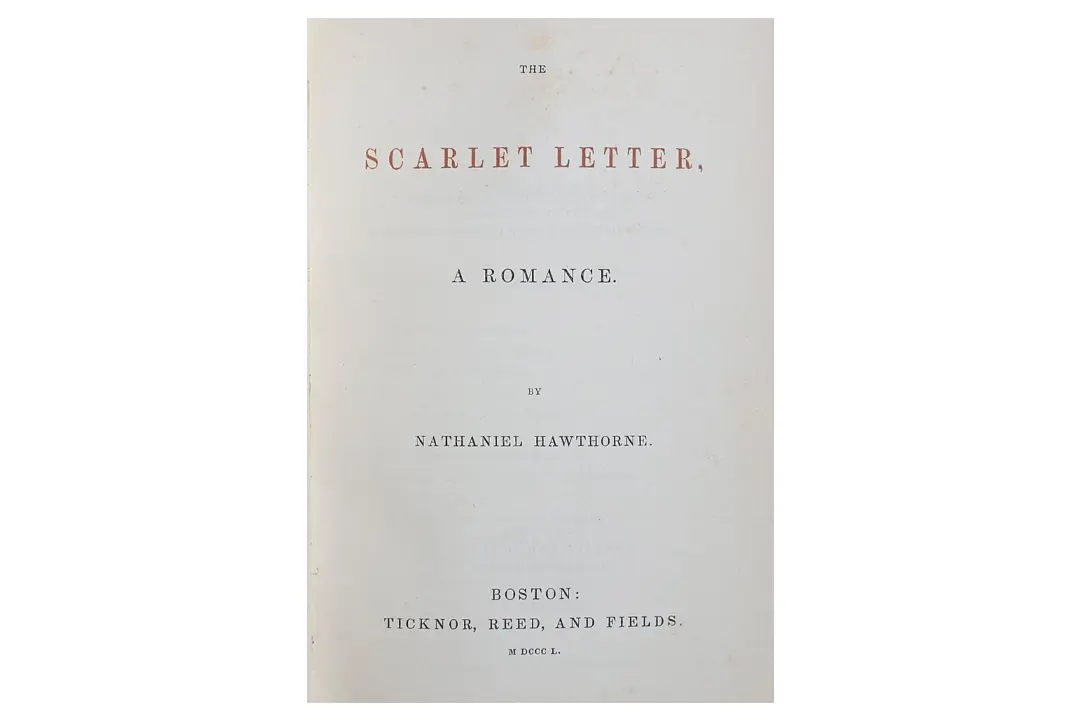
The Scarlet Letter – Nathaniel Hawthorne: Book Summary
Beverly Ashford • 11 Mar 2026 • 84 views • 3 min read.Let me tell you about a book that invented the American way of talking about sin. Nathaniel Hawthorne had Puritan ancestors who persecuted Quakers and participated in the Salem witch trials. He added the "w" to his family name partly to distance himself from them. Then he wrote a novel examining exactly what his ancestors' worldview did to people. The Scarlet Letter isn't really about adultery. It's about what happens when society decides to make an example of someone. It's about the difference between public punishment and private guilt. It's about how we destroy people with shame while the truly guilty walk free. Sound familiar? Hawthorne wrote it in 1850. It could have been written about social media yesterday.
The Scarlet Letter – Nathaniel Hawthorne: Book Summary
Quick Summary:
- A woman in Puritan Massachusetts is publicly shamed for adultery
- She refuses to name her lover, bearing punishment alone
- The novel explores guilt, hypocrisy, and the cost of hidden sin
- Published in 1850, it remains America's great novel about public shame
The World of Puritan Boston
Massachusetts Bay Colony, the 1640s. The Puritans who settled here believed they were building a holy city—a model community watched by God and the world. Every sin threatened not just the sinner but the entire community's covenant with God.
This wasn't just religion. It was government. Church and state were inseparable. Public confession and punishment weren't cruel—they were mercy. They gave sinners a chance to repent and rejoin the community.
At least, that was the theory.
Into this world, Hawthorne places Hester Prynne, emerging from prison with a baby in her arms and a scarlet letter "A" embroidered on her dress. She's been convicted of adultery. Her husband was lost at sea (presumed dead). She became pregnant. The math is obvious.
She stands on a scaffold before the entire town. The authorities demand she name her partner. She refuses.
She will wear that letter for the rest of her life.
The Four Central Characters
Hester Prynne bears her punishment with dignity that infuriates some and eventually wins respect from others. She settles on the edge of town, supports herself through needlework (ironically—her beautiful embroidery is in demand), and raises her daughter. She transforms the "A" from adulteress into something else over years—"Able," some say, or "Angel."
Pearl is Hester's daughter, conceived in sin and wild as a forest creature. She asks uncomfortable questions. She refuses to behave. The Puritans aren't sure she's entirely human. She's the living letter A—the embodiment of her mother's sin and, paradoxically, her mother's only joy.
Arthur Dimmesdale is the young minister everyone adores. His sermons move congregations to tears. He seems holy, tormented by his own unworthiness (which his flock finds admirable). He's also Pearl's father—the man who let Hester take all the punishment while he preached about sin.
Roger Chillingworth appears in Boston on the day of Hester's shaming. He's her husband, not dead after all. He makes her promise to keep his identity secret. Then he attaches himself to the ailing Dimmesdale as his physician, gradually suspecting and then confirming the truth. His mission becomes revenge through psychological torture.
The Plot Unfolds
The early years establish Hester's isolation. She lives alone with Pearl. She does charitable work. The letter marks her everywhere. But she survives.
Chillingworth moves in with Dimmesdale under the guise of treating his mysterious heart ailment. Night after night, the two men talk. Chillingworth probes. Dimmesdale weakens. When Chillingworth discovers a mark on Dimmesdale's chest while the minister sleeps, he knows he has his man.
Seven years pass. Hester has served her sentence with such grace that some want to remove the letter. She refuses. Meanwhile, Dimmesdale is dying—tormented by guilt he cannot confess, gnawed at by a man he thinks is his friend.
The forest meeting changes everything. Hester and Dimmesdale finally speak privately. She tells him who Chillingworth really is. They plan to escape to Europe together—to start over where no one knows them.
But Dimmesdale can't do it.
On Election Day, after giving the greatest sermon of his career, Dimmesdale mounts the scaffold where Hester stood seven years before. He confesses publicly. He tears open his shirt, revealing (depending on interpretation) some mark on his chest. He dies in Hester's arms, finally at peace.
Chillingworth, deprived of his victim, dies within a year. Pearl inherits his wealth and presumably lives well in Europe. Hester returns to Boston years later, voluntarily wearing the letter until her death.
Key Themes and Symbols
| Symbol/Theme | Meaning |
|---|---|
| The Scarlet Letter "A" | Shifts from Adultery to Able to Angel—meaning transforms through context |
| The Scaffold | Site of public shame, also site of redemption—truth must be public |
| The Forest | Freedom from Puritan law, nature, honesty, but also danger |
| Pearl | Living consequence of sin, also innocent, also truth-teller |
| Chillingworth's Transformation | Revenge corrupts worse than the original sin |
| Dimmesdale's Chest | Hidden guilt manifests physically—or does it? |
What Hawthorne Is Really Saying
Public shame isn't justice. Hester's punishment is meant to reform her and warn others. Instead, it isolates her while letting the equally guilty go free. The letter becomes meaningless through overuse—then transforms into something the community didn't intend.
Hidden sin destroys worse than public sin. Hester suffers, but she survives with her integrity intact. Dimmesdale's concealment destroys him from within. His secret eats his body and soul. Public confession, however brutal, is preferable to private rotting.
Revenge consumes the avenger. Chillingworth has legitimate grievance. But his obsessive pursuit of revenge transforms him from a "calm, meditative, scholar-like man" into something demonic. By the end, he's lost more than either of his victims.
The community creates the monsters it fears. Pearl is wild partly because the community treats her as wild. Hester becomes independent and freethinking partly because she has no choice. Chillingworth becomes evil partly through his relationship with a society that lets him operate in secret while punishing Hester publicly.
Hypocrisy is the deepest sin. Dimmesdale's guilt isn't just the adultery. It's preaching against sin while sinning. It's letting Hester suffer alone. It's the gap between his public image and private reality. That gap is what kills him.
The Custom House Introduction
Modern editions include Hawthorne's lengthy introduction about working at the Salem Custom House. Many readers skip it.
That's a mistake.
The introduction frames the story as "found" manuscript. But it also establishes Hawthorne's conflicted relationship with his Puritan ancestors. He's both criticizing them and acknowledging their influence. The Custom House—where he lost his job for political reasons—becomes another space of public judgment.
Hawthorne is saying: I'm not so different from Hester. Public shame is still public shame. The Puritans are still with us.
Frequently Asked Questions
What's actually on Dimmesdale's chest?
Hawthorne deliberately refuses to confirm. Some characters see an "A" burned into his flesh. Others see nothing. Some say he inflicted it himself. The ambiguity is intentional—Hawthorne questions whether witnesses see truth or project what they expect.
Is this anti-Puritan propaganda?
Complicated. Hawthorne clearly criticizes Puritan harshness. But he also respects their moral seriousness. Modern readers tend to be more anti-Puritan than Hawthorne himself was. He's examining the costs of a worldview, not simply condemning it.
Why does Hester return to Boston?
The letter has become her identity. She's built meaning from suffering. Europe would be freedom—but freedom to be what? She returns to what she's made herself.
Is Pearl supposed to be annoying?
Kind of. She's a moral test for every character. She asks questions nobody wants to answer. She refuses to follow rules. She's uncomfortable because truth is uncomfortable.
Should I read the Custom House section?
Yes, but maybe after the novel. It provides context that enriches rereading.
Is this still relevant?
Public shaming is arguably worse now than in Puritan Boston. Social media mobs destroy lives over old posts. The dynamics Hawthorne describes—the pleasure of collective judgment, the invisibility of real sin, the transformation of victims—are all still operating.
The Bottom Line
Here's what Nathaniel Hawthorne achieved.
He wrote a novel that's both deeply American and universally human. It examines what public shame actually does—not the justice it claims, but the isolation, the hypocrisy, the damage to everyone involved.
The scarlet letter is supposed to mean one thing. By the end, it means everything and nothing. That's the point. Symbols don't stay fixed. Meanings transform. People forced into roles sometimes transcend them.
Hester endures. Dimmesdale is destroyed by concealment. Chillingworth is destroyed by revenge.
The moral isn't simple. But the warning is clear: the society that appoints itself to judge often does more damage than the sins it punishes.
That warning hasn't expired.