
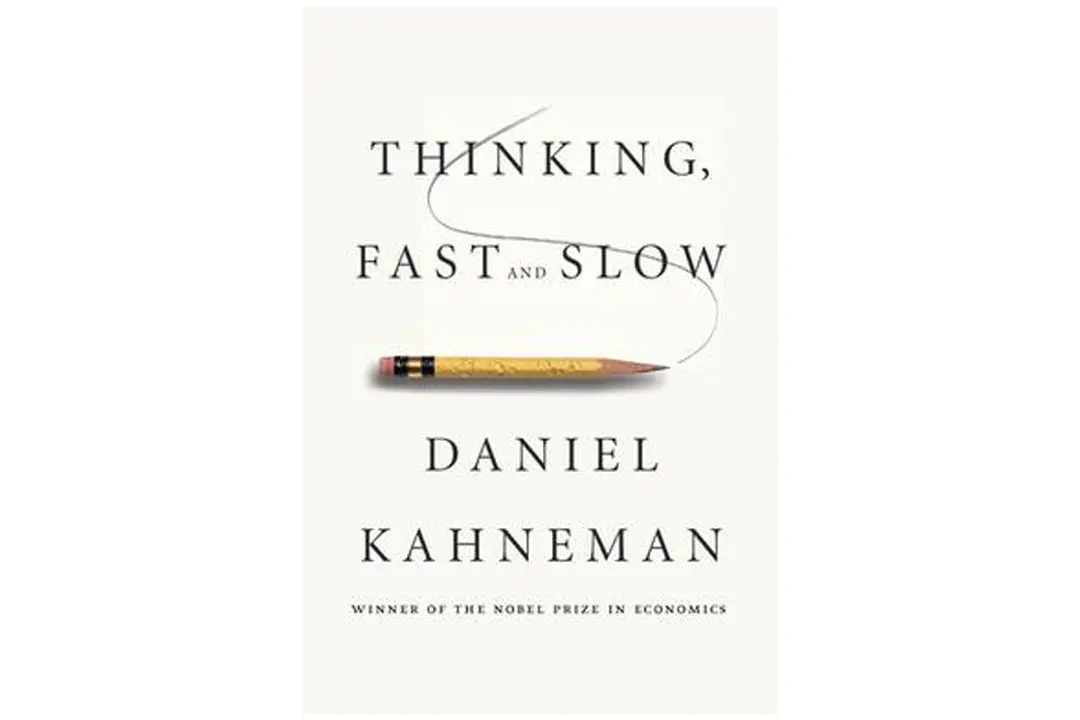
Thinking, Fast and Slow by Daniel Kahneman: Book Summary
Beverly Ashford • 13 Mar 2026 • 52 views • 2 min read.Let me tell you about the book that will make you distrust your own brain — in the most useful way possible. Daniel Kahneman published Thinking, Fast and Slow in 2011. He won the Nobel Prize in Economics in 2002 despite being a psychologist, which tells you something about how much his work upended the assumption that humans make rational decisions. This book is the summary of a career spent proving that we do not. Kahneman is not mean about it. He is not condescending. He spent decades making the same mistakes he describes. The book reads like a brilliant friend explaining, over coffee, exactly how your mind is working against you — and why that is not entirely your fault.
Thinking, Fast and Slow by Daniel Kahneman: Book Summary
Quick Summary:
- A Nobel Prize-winning psychologist explains the two systems that drive every decision you make
- System 1 is fast, automatic, and constantly wrong in predictable ways
- System 2 is slow, deliberate, and lazier than you think
- Published in 2011, it remains the most important book about human judgment ever written for a general audience
The Core Idea: Two Systems
Kahneman organizes the entire book around two modes of thinking he calls System 1 and System 2. These are not literal brain regions. They are descriptions of two different ways your mind processes information.
System 1 operates automatically and instantly. It is always running. When you read an angry face, recognize your name being called across a noisy room, or know that two plus two equals four — that is System 1. It requires no effort. It produces answers immediately. It is also the source of most of your cognitive errors.
System 2 is the deliberate, effortful thinking you do when you calculate a tip, parallel park in a tight space, or fill out a tax form. It is slower, requires concentration, and gets tired. Here is the critical problem: System 2 is lazy. It delegates as much as possible back to System 1. When System 1 produces a confident answer, System 2 often just endorses it without checking.
This division of labor is mostly efficient. It becomes a problem when System 1's fast, automatic judgments are systematically wrong.
The Biases That Run Your Life
The middle section of the book is a catalog of cognitive biases — predictable errors that System 1 produces and System 2 fails to catch. A few essential ones:
Anchoring is the tendency to rely too heavily on the first number you encounter. A real estate agent shows you an overpriced house first. Now every subsequent house seems reasonable by comparison. The anchor shapes your judgment even when you know it is arbitrary.
Availability bias means you judge the probability of something by how easily examples come to mind. Plane crashes feel more dangerous than car trips because crashes make the news. Your System 1 confuses memorability with frequency.
The halo effect means your overall impression of a person colors every specific judgment about them. You like someone's handshake, so you assume their business proposal is sound. You find someone physically attractive, so you assume they are more competent.
Overconfidence is perhaps the most consequential. Kahneman demonstrates repeatedly that experts — doctors, financial analysts, military strategists — are far less accurate in their predictions than they believe themselves to be. Confidence feels like accuracy. It is not.
Loss aversion explains why losses feel roughly twice as painful as equivalent gains feel good. You would rather avoid losing fifty dollars than find fifty dollars. This asymmetry drives irrational financial decisions, failed negotiations, and bad policy.
The Two Selves
The final section introduces a distinction that is philosophically uncomfortable. Kahneman separates the experiencing self — the one living through each moment — from the remembering self — the one that constructs a narrative about experiences afterward.
These two selves often disagree. In medical studies, patients rated the same painful procedure as worse if it ended abruptly versus if it ended with a longer but less intense final phase. The remembering self cared about the ending and the peak. The experiencing self suffered through every moment equally.
This has real implications. We make decisions based on what we think we will remember, not what we will actually experience. Vacations, careers, relationships — we optimize for the story we will tell later rather than the life we are actually living.
What To Do About It
Kahneman is honest: knowing about these biases does not make you immune to them. System 1 keeps operating regardless of your awareness. What you can do is build processes that force System 2 engagement at high-stakes moments — checklists, structured decision frameworks, pre-mortems that ask what could go wrong before you commit.
The book is not a self-help manual. It is an explanation of how human judgment actually works. The practical application is yours to construct.
Concept Comparison Table
| Bias | What It Is | Real-World Example | Who It Hits Hardest |
|---|---|---|---|
| Anchoring | First number shapes all subsequent judgments | Salary negotiation starting point | Negotiators, buyers, investors |
| Availability Bias | Memorable equals probable in System 1 | Fearing sharks more than heart disease | Everyone consuming news media |
| Halo Effect | One positive trait colors all other judgments | Attractive candidates rated as more competent | Hiring managers, voters |
| Overconfidence | Confidence mistaken for accuracy | Stock analysts predicting market movements | Experts in every field |
| Loss Aversion | Losses feel twice as bad as equivalent gains | Holding losing stocks too long | Investors, negotiators, everyone |
| Planning Fallacy | Underestimating time and cost of future projects | Home renovations, software launches | Project managers, optimists |
| Sunk Cost Fallacy | Past investment justifies continued bad decisions | Staying in a failing business | Entrepreneurs, gamblers |
| Framing Effect | How a choice is presented changes the decision | 90% survival rate vs 10% mortality rate | Medical patients, policy audiences |
Frequently Asked Questions
Do I need a psychology background to read this?
No. Kahneman writes for a general audience. The concepts are illustrated with experiments and everyday examples. It is dense in places but never technical in a way that requires prior knowledge.
Is the research still valid?
Some studies Kahneman cites have faced replication challenges in the years since publication — particularly some priming research. The core framework of System 1 and System 2, and the major biases like anchoring and loss aversion, remain well-supported. Read it as the most important framework available, not as a final word.
Will knowing about biases protect me from them?
Partially. Kahneman is clear that awareness helps at the margins — you can slow down, apply checklists, seek outside perspectives. But System 1 keeps running. You cannot think your way out of being human.
How long does it take to read?
The book is around 500 pages. It is not a quick read. Allow three to four weeks of normal reading pace. It rewards slow engagement — many chapters benefit from sitting with the concepts before moving on.
What should I read next?
Nudge by Thaler and Sunstein applies behavioral economics to policy and practical design. Predictably Irrational by Dan Ariely covers similar territory with a lighter, anecdote-heavy approach. For deeper behavioral economics, Kahneman's academic work with Amos Tversky is the original source — though significantly more technical.
Is this relevant to business and investing?
Extremely. Loss aversion, overconfidence, anchoring, and the planning fallacy are responsible for enormous financial losses at every level from personal investing to corporate strategy. Many professional investors cite this book as foundational reading.
The Bottom Line
Here is what Daniel Kahneman actually built.
Not a self-help book. Not a productivity manual. A rigorous, honest account of how human judgment works — its speed, its efficiency, its systematic failures, and the gap between the life we experience and the story we remember.
You will finish this book and notice anchoring in a price negotiation. You will catch availability bias in a news headline. You will recognize loss aversion in a decision you are about to make.
You will still make the mistake sometimes. System 1 is faster than self-awareness.
But you will make it knowingly. And that is worth something.