
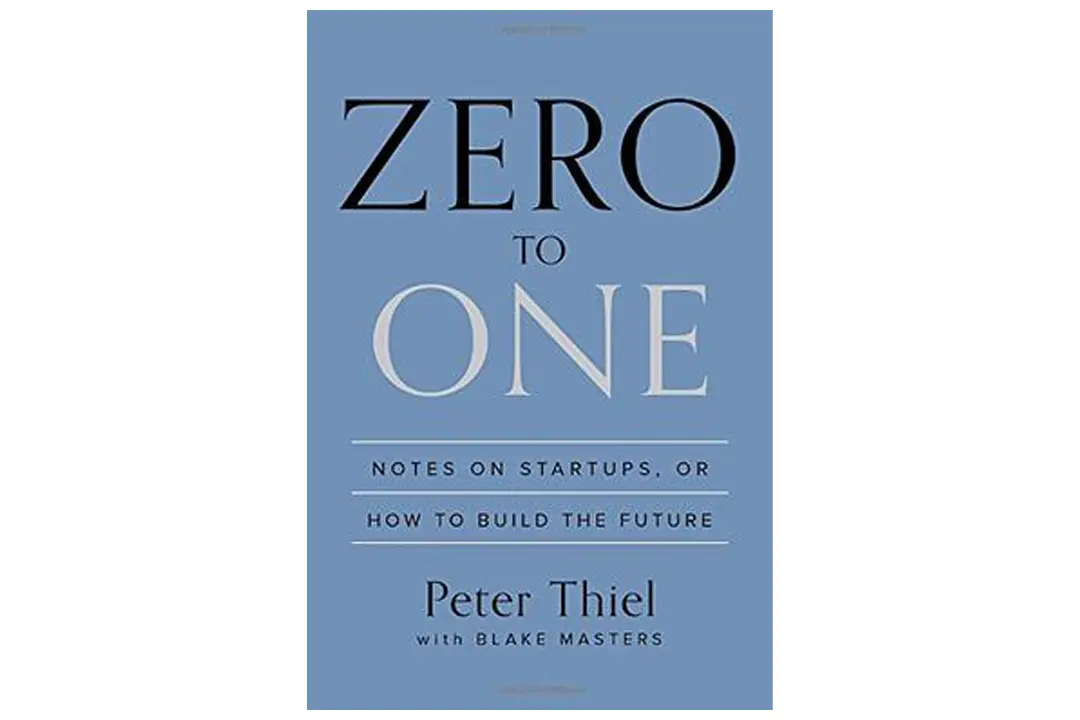
Zero to One by Peter Thiel: Book Summary
Beverly Ashford • 13 Mar 2026 • 69 views • 3 min read.Let me tell you about the business book that made an entire generation of founders feel like they had been thinking about startups completely backwards. Peter Thiel published Zero to One in 2014 with co-author Blake Masters, who had taken detailed notes on Thiel's Stanford computer science class on startups. The book distills those lectures into a framework for thinking about innovation that is deliberately uncomfortable — not because Thiel is trying to be provocative, but because he genuinely believes most conventional wisdom about business and competition is not just wrong but actively harmful. Thiel co-founded PayPal, was the first outside investor in Facebook, and built Palantir. He has thought carefully about what separates companies that create new value from companies that simply redistribute existing value. His conclusions are counterintuitive enough that readers either find them clarifying or infuriating — sometimes both in the same chapter.
Zero to One by Peter Thiel: Book Summary
Quick Summary:
- PayPal co-founder and early Facebook investor argues that true innovation means creating something that did not exist before — not copying what works
- Published in 2014, adapted from Stanford lecture notes, it became the defining startup philosophy text of its era
- Thiel's central claim: competition is for losers, monopoly is the goal, and most conventional startup wisdom is wrong
- A provocative, contrarian book that will make you question assumptions about business, progress, and how new things get built
The Core Distinction: Zero to One vs One to N
The title captures the book's central argument. Going from zero to one means creating something genuinely new — a technology, a product, a business model that did not previously exist. Going from one to n means copying something that already works and scaling it — adding one more restaurant to a proven concept, building one more e-commerce site in an existing category.
Thiel argues that most business activity is one to n. Most MBA programs teach one to n. Most management consulting optimizes one to n. And one to n is fine — it produces jobs and economic activity and incremental improvement. But it does not produce the kind of progress that actually changes the world, and it is also, paradoxically, harder to make money doing than most people realize.
The companies that capture the most value are the ones that go from zero to one and then defend what they built. The companies that compete in existing markets fight over thin margins while the monopolists collect the surplus.
Competition Is for Losers
This is the most provocative argument in the book and Thiel means it literally.
Economists celebrate competition as the mechanism that produces efficiency and benefits consumers. Thiel agrees that competition does this — and argues that this is precisely the problem from a business perspective. In a perfectly competitive market, profit margins approach zero. Every participant works harder and harder for less and less. The consumer benefits. The producers are exhausted.
Monopolies — companies with no real competition — can set prices, invest in long-term thinking, and generate the surplus that funds innovation. Google has operated as a monopoly in search for twenty years. It has used that surplus to fund self-driving cars, quantum computing, and life extension research. A Google that competed fiercely with ten other search engines for thin margins would not have the resources to do any of that.
Thiel distinguishes between illegal monopolies built through anti-competitive behavior and monopolies built through genuine innovation — creating something so good that competitors cannot catch up. He is advocating for the second kind. The goal of a startup should not be to enter a market and compete. It should be to create a market and own it.
The Seven Questions Every Business Must Answer
The most practically useful section of the book. Thiel argues that every startup must honestly answer seven questions, and that most startups fail because they cannot answer at least one of them.
The engineering question: can you create breakthrough technology rather than incremental improvement? The timing question: is now the right moment to start this particular business? The monopoly question: are you starting with a large share of a small market? The people question: do you have the right team? The distribution question: do you have a way to reach customers, not just a great product? The durability question: will your market position be defensible in ten and twenty years? And the secret question: have you identified a unique opportunity that others have not seen?
Thiel's observation is that most startup pitches answer six of these questions and ignore the seventh. The one they ignore is usually the one that kills the company.
Secrets and Contrarian Thinking
One of the book's most interesting sections concerns secrets. Thiel argues that every great business is built on a secret — something true about the world that most people do not believe or have not noticed.
He frames this through a question he asks in every interview: what important truth do very few people agree with you on? The question is deliberately hard. Most people either give a socially acceptable answer that everyone actually agrees with, or a contrarian answer that is simply wrong. A genuine answer — something true that most people reject — is the seed of a valuable company.
Airbnb's secret: people will rent out rooms in their homes to strangers and strangers will pay to stay in them. Most people in 2008 thought this was either wrong or dangerous. PayPal's secret: people needed a fast, reliable way to send money online that banks were not providing and would not provide. Uber's secret: there was enormous unmet demand for on-demand transportation that licensed taxi markets were structurally unable to satisfy.
The secret is not enough by itself. You need engineering, timing, people, distribution, and durability. But without the secret — without the insight that most people have not had — you are building in a market that others have already mapped, which means you are competing rather than creating.
The Founder's Paradox
The final section of the book addresses founders directly. Thiel observes that successful founders tend to be extreme personalities — outsiders, oddballs, people who see the world differently enough to build something new in it. He is not romanticizing this. Extreme personalities create real problems for organizations and for the people who work in them.
But Thiel's point is that the vision required to go from zero to one rarely comes from consensus thinking. The person who sees what everyone else has missed is, by definition, not seeing the world the way most people do. That difference is the source of both the innovation and the difficulty.
Core Concepts Compared
| Concept | Thiel's Argument | Conventional Wisdom | Why the Difference Matters |
|---|---|---|---|
| Competition | Destroys value, should be avoided | Healthy and necessary for markets | Competitive markets produce thin margins and exhausted participants |
| Monopoly | The goal of every successful startup | Dangerous, anti-consumer | Innovation-based monopolies fund further innovation |
| Market Size | Start small and own it completely | Target large markets for scale | Small monopoly beats large competitive share every time |
| Technology | Must be ten times better than alternatives | Incremental improvement is sufficient | Merely better products cannot overcome incumbent advantages |
| Distribution | As important as the product itself | Build it and they will come | Most startups fail on distribution not product |
| Secrets | Every great company is built on one | All important ideas are already known | Contrarian truths are the seed of valuable companies |
| Founders | Extreme personalities with unique vision | Well-rounded collaborative leaders | Consensus thinking cannot produce zero-to-one innovation |
Frequently Asked Questions
Is this book only for startup founders?
Thiel frames everything through startups but the underlying ideas apply broadly. The question of whether you are creating something new or competing in an existing space applies to careers, creative projects, and organizational strategy as much as to company building.
Is Thiel advocating for monopolies in the legal sense?
He is careful to distinguish between monopolies built through genuine innovation versus those built through anti-competitive behavior. His argument is that the goal should be to create something so uniquely valuable that competition is irrelevant — not to use market power to suppress competitors illegally. The distinction matters but critics argue it blurs in practice.
How has the book aged since 2014?
The core framework holds up well. Some specific examples have become complicated — Thiel's praise for PayPal culture and some of the companies cited have faced subsequent controversies. The philosophical framework remains the most durable element. Read the ideas as tools for thinking rather than as endorsements of specific companies.
Does the book address failure?
Briefly and honestly. Thiel acknowledges that most startups fail and that the seven questions framework is partly a diagnostic for understanding why. He is not a cheerleader. The book is more interested in the conditions for success than in reassuring readers that success is likely.
How does this compare to other startup books?
The Lean Startup by Eric Ries advocates for rapid iteration and customer validation — a methodology that Thiel explicitly argues against for truly innovative companies. They are addressing different problems. Ries is useful for companies improving existing solutions. Thiel is addressing companies creating new categories. Both are worth reading with that distinction in mind.
What should I read next?
The Lean Startup by Eric Ries as the complementary and sometimes contrasting perspective. High Output Management by Andy Grove for the operational side of building what Thiel's framework creates. Crossing the Chasm by Geoffrey Moore addresses the distribution problem that Thiel identifies but does not solve in depth.
The Bottom Line
Here is what Peter Thiel actually argued.
Most business activity is imitation. Most competition is a race to the bottom. Most startups enter existing markets and fight over scraps while the companies that created those markets collect the surplus.
The path to building something genuinely valuable is not to compete better. It is to see something true that most people have not seen, build something new from that truth, and own the market you created before anyone else realizes it exists.
This requires answering seven hard questions honestly. It requires a secret — a contrarian insight that most people reject. It requires the courage to build something that looks wrong from the outside until it obviously is not.
Most people will not do this. Competition is familiar. Copying is safe. Incremental improvement is defensible.
Zero to one is uncomfortable, uncertain, and enormously consequential when it works.
Thiel's argument is simple: if you are going to spend years building something, it should be the kind of something that could not have existed before you built it.
Everything else is one to n.
And one to n has enough people working on it already.